
 By Neng Nana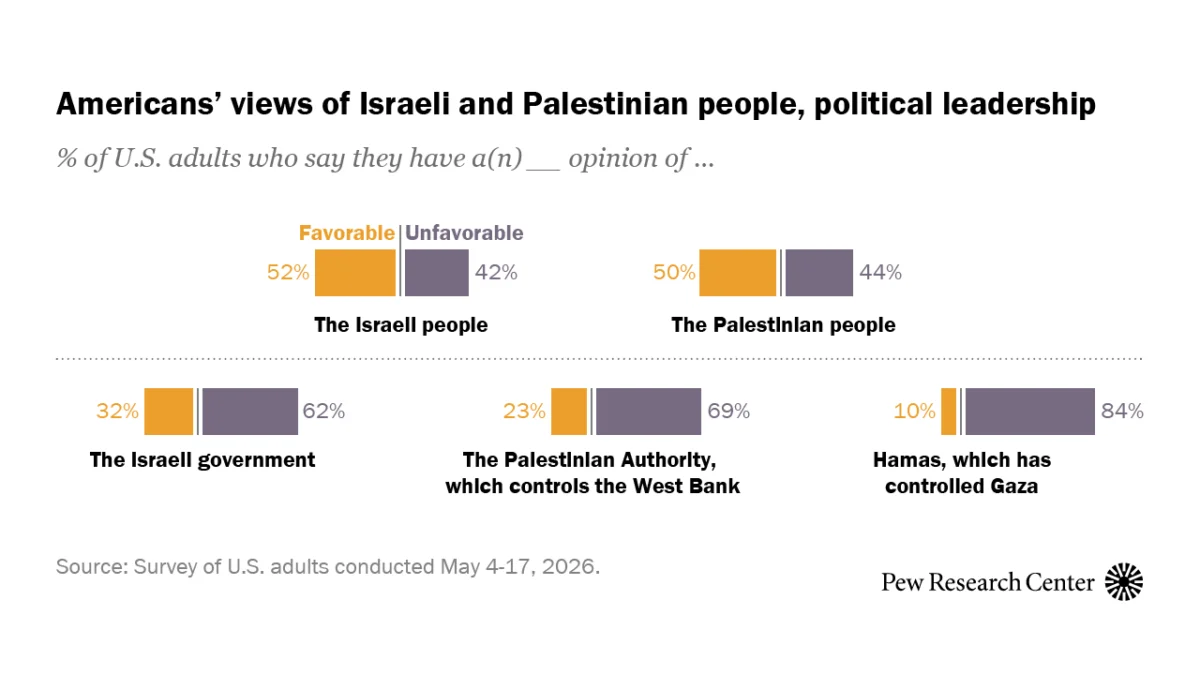
Introduction: A Sea Change in Public Sentiment
The landscape of American public opinion regarding the Middle East has undergone a profound transformation in recent years. For decades, the American public maintained a relatively stable perspective on the Israeli-Palestinian conflict, characterized by a distinct leaning toward Israel. However, new data from a comprehensive Pew Research Center survey conducted in May 2026 indicates that this consensus is fracturing.
Public attitudes toward the Israeli people and the Israeli government have soured significantly, while views toward Palestinians have remained largely steady. This divergence has brought the American public to a unique historical juncture: for the first time in recent memory, Americans view the Palestinian people with a level of favorability that rivals their view of the Israeli people. This shift transcends simple partisan lines, manifesting across various age groups, religious affiliations, and ideological demographics.
Chronology of a Shifting Landscape
To understand the current state of public opinion, one must look at the trajectory of the last several years. As recently as 2022, the disparity in favorability was stark; Americans viewed the Israeli people with significantly higher regard than their Palestinian counterparts.
The catalyst for the most recent acceleration of these trends was the October 2023 attack by Hamas on Israel and the subsequent war that engulfed the region. Following these events, American sentiment toward Israel began to decline sharply. This downward trend continued through 2024 and 2025, culminating in the data gathered in mid-2026. The survey, which polled 12,574 U.S. adults between May 4 and May 17, 2026, occurred just two months after the onset of the U.S.- and Israeli-led war in Iran, a geopolitical event that added further complexity to an already volatile international environment.
The timing of this survey is particularly notable as it precedes the July 2026 announcement by Hamas regarding the dissolution of its governing body in Gaza—a development that is expected to further complicate the political dynamics of the region.
Analyzing the Data: A Closer Look at the Trends
The data reveals a critical distinction between how Americans perceive the people of the region versus their political leadership.
The People vs. The State
Across the board, Americans are more likely to express negative views of political entities—the Israeli government, the Palestinian Authority, and Hamas—than they are of the respective populations. However, the intensity of these negative views is not uniform. While unfavorable views of the Israeli government have risen dramatically in recent years, reaching a majority of the American public, the unfavorable perceptions of the Palestinian Authority and Hamas have remained largely unchanged, though they were already high to begin with.
The Partisan Divide
Partisanship remains a powerful lens through which Americans interpret the conflict. Republicans and those who lean Republican continue to hold more favorable views of the Israeli people and the Israeli government compared to their Democratic counterparts. Conversely, Democrats and those who lean Democratic are consistently more likely to express positive views toward the Palestinian people and the Palestinian Authority.
However, the "partisan gap" is dynamic. While favorability toward Israel has dropped across the board, the decline has been more precipitous among Democrats, effectively widening the divide since 2022. On the other side of the spectrum, while Democratic views of Palestinians have remained stable, Republican views have become slightly more negative, reflecting a broader hardening of attitudes in the wake of prolonged regional violence.
Generational Shifts: The Age Factor
Perhaps the most striking demographic trend is the generational divide. Younger Americans, particularly those under the age of 30, are fundamentally rewriting the traditional narrative of the conflict.
In the 18–29 age demographic, the data shows that a significant majority now views the Palestinian people more favorably than the Israeli people. This shift is primarily driven by young Democrats. In contrast, among those 50 and older, the traditional preference for Israel remains the dominant perspective, though even within these older cohorts, the intensity of that support is being tested by the political realities of the current Israeli administration.
The Role of Religion
Religion continues to be a primary determinant of foreign policy attitudes among the American electorate.
- Jewish and Evangelical Perspectives: Jewish adults and White evangelical Protestants remain the strongest supporters of the Israeli state. Notably, White evangelical Protestants are currently the only religious group in which a majority reports a favorable view of the Israeli government.
- Shifting Jewish Sentiment: Among the Jewish community, the data suggests a subtle but significant internal shift. Younger Jewish adults (under 50) are notably less likely to hold favorable views of the Israeli government and the Israeli people compared to their older counterparts. This suggests that the "generational divide" is not just a secular phenomenon but one that is also influencing Jewish communal life.
- Muslim and Unaffiliated Perspectives: Conversely, Muslim Americans and those who identify as religiously unaffiliated (atheists, agnostics, or "nothing in particular") are significantly more likely to hold positive views of the Palestinian people and the Palestinian Authority.
Official Responses and Political Implications
The decline in favorability toward the Israeli government carries profound implications for the U.S.-Israel relationship. As public support becomes more contingent and increasingly polarized, the "special relationship" is facing new challenges.
Politicians in both parties are beginning to navigate a landscape where blind support for a foreign government is no longer the default position for a significant segment of their constituents. The fact that majorities of Americans now express an unfavorable view of the Israeli government, alongside the persistently high negative ratings for the Palestinian Authority and Hamas, suggests a growing sense of disillusionment with the entire political architecture of the region.
For decision-makers, this data serves as a warning. The shifting sentiments suggest that the American public is increasingly viewing the conflict through a lens of human rights and humanitarian concerns rather than traditional Cold War-era geopolitical alliances. This shift toward prioritizing the welfare of the "people" over the legitimacy of "governments" may force a rethink of U.S. foreign policy toward the region.
The Future: What Lies Ahead?
As the region enters a post-Hamas government era in Gaza, the question remains how these public attitudes will evolve. The dissolution of the Hamas government in Gaza creates a power vacuum that could lead to further instability or, conversely, a new opportunity for diplomatic engagement.
However, the data from the Pew Research Center suggests that the American public is currently in a state of deep skepticism. With negative views of political leadership so firmly entrenched and the partisan divide growing wider, the path to a consensus-driven foreign policy is increasingly narrow.
The stability of the current "steady" views toward Palestinians may be tested in the coming months as the reality of a post-war Gaza unfolds. Similarly, the decline in support for the Israeli government may stabilize if the regional security situation improves, or it may continue to accelerate if the political situation remains in flux.
Conclusion: A New Era of Engagement
The findings from May 2026 provide a stark snapshot of a nation in transition. The American public is no longer a monolith of support for one side of the conflict; it is a collection of shifting demographics, ideological camps, and religious groups, each grappling with the moral and political complexities of the Israeli-Palestinian conflict in its own way.
As the U.S. looks toward the future, the challenge for policymakers will be to reconcile these increasingly diverse and skeptical public views with the necessity of maintaining a coherent foreign policy. The "special relationship" is not dead, but it is undoubtedly evolving—mirroring the broader, often turbulent, changes in the American electorate itself. The era of predictable, uniform support for the status quo has come to an end, replaced by a complex, nuanced, and often contradictory set of public attitudes that will define the next chapter of American involvement in the Middle East.
Methodology Note
The Pew Research Center analysis conducted in May 2026 included a survey of 12,574 U.S. adults. This included a core group of 10,091 participants from the American Trends Panel and an oversample of 2,483 respondents from diverse religious backgrounds, including Jews, Muslims, and members of the Church of Jesus Christ of Latter-day Saints. The survey maintains a margin of error of plus or minus 1.3 percentage points, ensuring that these findings provide a highly accurate reflection of the current American consciousness regarding one of the world’s most enduring conflicts.
 Pevita Pearce