
 By Jia Lissa
In the rapidly shifting landscape of social media, the concept of the "blue checkmark" has undergone a fundamental transformation. Once a rare symbol of celebrity or institutional status, verification has evolved into a multi-tiered subscription service that defines how creators and businesses interact with Meta’s ecosystem. As of 2026, Meta Verified has moved beyond its experimental phase to become a cornerstone of the company’s non-advertising revenue model, signaling a "pay-to-play" era where security, support, and visibility are increasingly commoditized.
This report examines the current state of Meta Verified across Instagram, Facebook, and WhatsApp, detailing the costs, benefits, and strategic implications for users in a digital economy that values authenticated identity above all else.
Main Facts: The Architecture of Meta Verified
Meta Verified is a comprehensive subscription bundle designed for individuals and businesses operating within the Meta ecosystem. Unlike the "legacy" verification of the past, which was based purely on public notability, Meta Verified is an opt-in service that combines identity validation with a suite of premium features.

The Core Offering
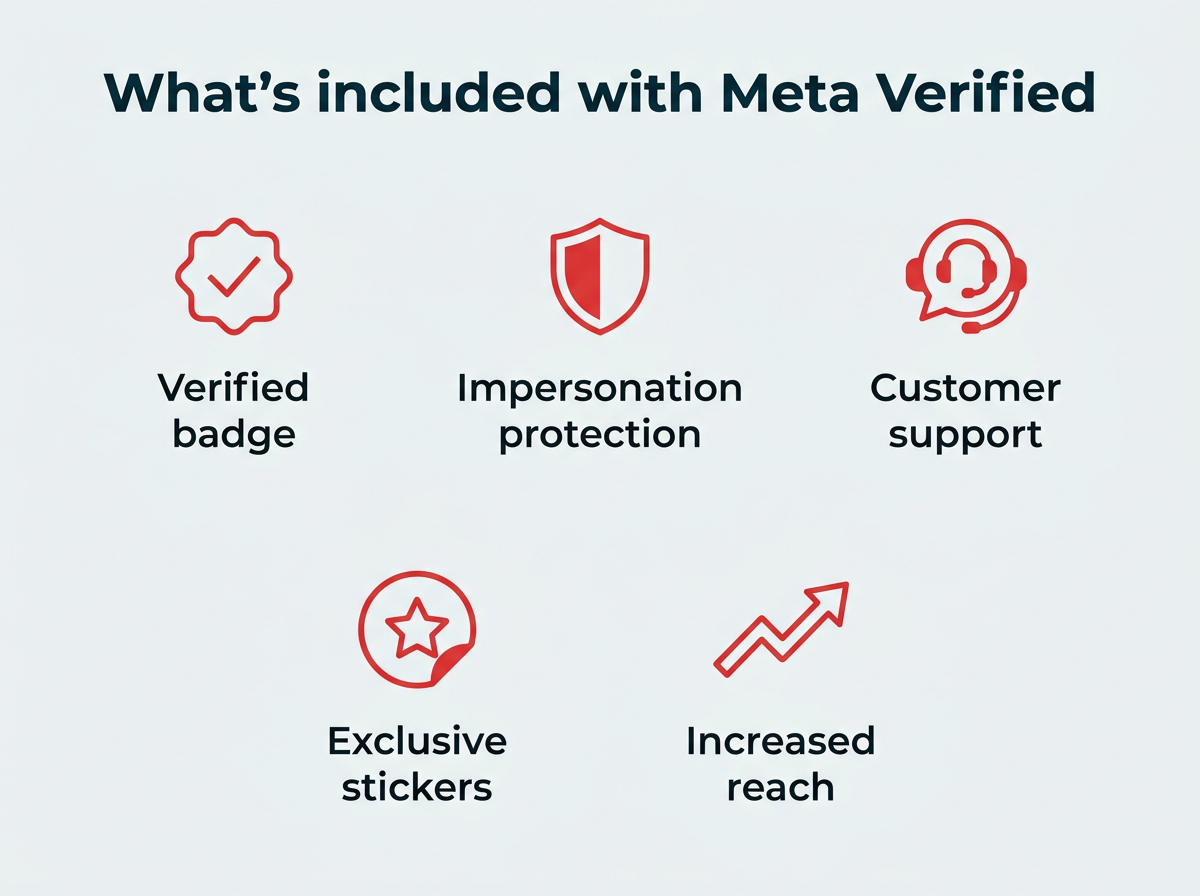
At its heart, the subscription provides four primary pillars of value:
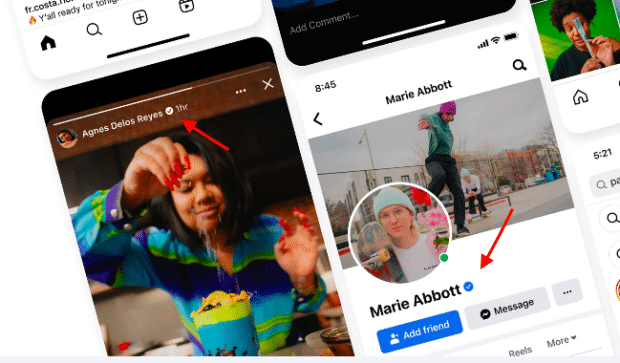
- Authenticated Identity: A verified badge that signals to the community that the account has been vetted against government-issued identification.
- Proactive Account Protection: Enhanced monitoring for impersonation, a critical concern for growing creators and established brands.
- Direct Support Access: A dedicated channel to human customer service agents, bypassing the traditional, often automated, help centers.
- Enhanced Discovery: Algorithmic prioritization in search, comments, and recommendations, designed to boost the reach of subscribers.
The Dual-Track System
It is essential to distinguish between the two types of verification currently active on Facebook and Instagram:
- Legacy Verification: Reserved for notable public figures, celebrities, and global brands. This remains free but does not include the extended benefits like direct support or reach boosts.
- Meta Verified (Paid): Available to any user or business meeting the eligibility criteria. While the badge looks identical to the legacy version, the underlying service package is significantly more robust.
Chronology: From Experiment to Ecosystem Standard
The journey of Meta Verified reflects a broader industry trend toward diversifying revenue away from a total reliance on advertising.

- February 2023: The Genesis: Meta first announced "Meta Verified" as a testing phase in Australia and New Zealand. This followed a similar move by X (formerly Twitter), though Meta’s approach focused more heavily on government ID verification to maintain platform integrity.
- Late 2023: Global Rollout for Individuals: After successful trials, the service expanded to major markets including the United States, Europe, and India. The focus remained on individual creators.
- 2024: The Business Pivot: Recognizing the demand from small-to-medium enterprises (SMEs), Meta introduced "Meta Verified for Business." This expanded the program to include WhatsApp Business, providing a way for companies to build trust in private messaging environments.
- 2025: Revenue Milestone: By Q3 2025, Meta reported that non-advertising revenue—largely driven by Meta Verified and business messaging—reached $690 million. The program became a significant contributor to the company’s bottom line.
- 2026: Maturity and Tiered Services: Today, the program is a mature ecosystem. It has shifted from a single-price model to a tiered structure, offering different levels of support and visibility depending on the subscriber’s needs.
Supporting Data: Costs, Eligibility, and Features
The cost of Meta Verified is not uniform; it varies based on the platform of purchase and the nature of the account (Individual vs. Business).
1. Pricing Structure
The pricing reflects the "app store tax" imposed by Apple and Google for in-app purchases.
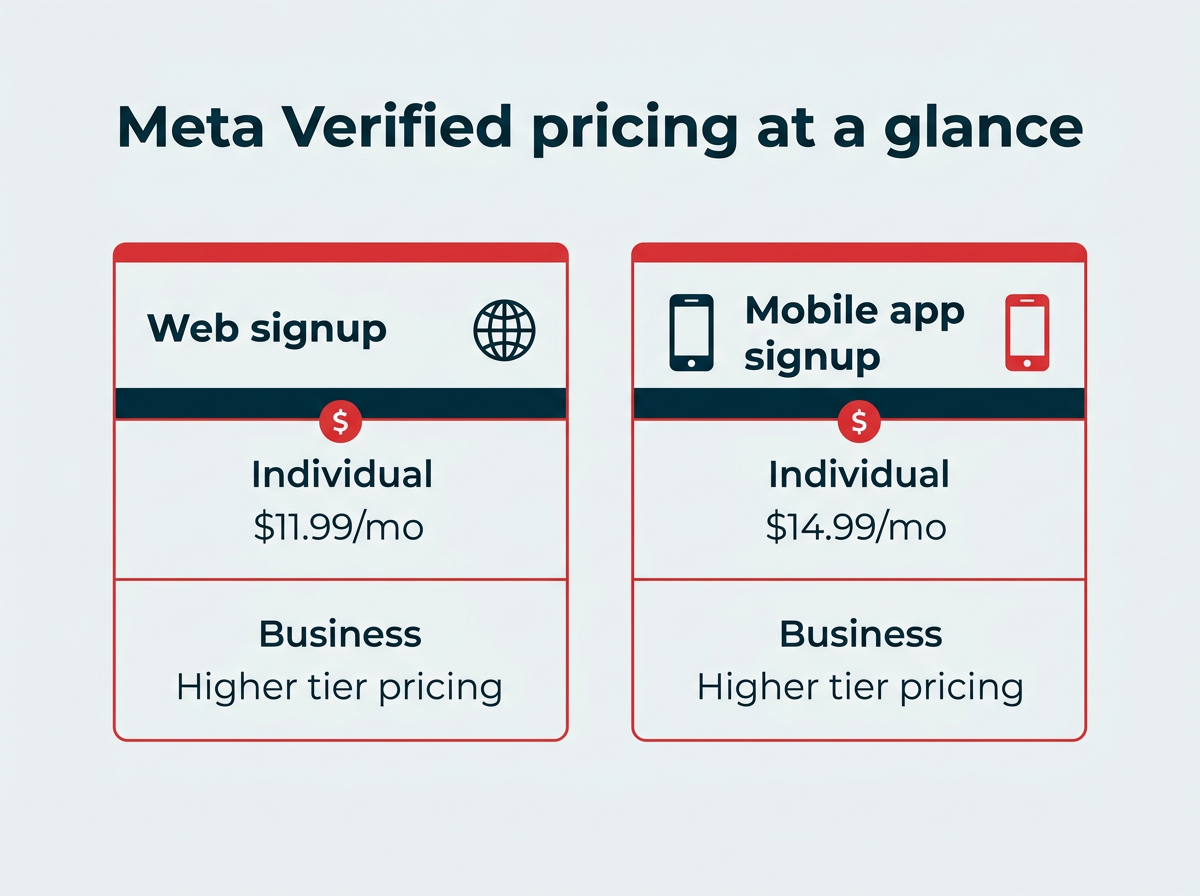
- Individual Web Signups: $11.99 per month.
- Individual Mobile Signups (iOS/Android): $14.99 per month.
- Business Tiers: Business pricing is tiered, starting higher than individual plans and scaling based on the number of managed accounts and the level of "Reach Boost" required.
2. Eligibility Requirements
Meta maintains strict barriers to entry to ensure the badge retains its value as a trust signal.
- For Individuals: Applicants must be at least 18 years old, have a profile that uses their real name, and possess a government-issued ID that matches their profile name and photo. Two-factor authentication (2FA) is mandatory.
- For Businesses: Accounts must meet a minimum tenure (often 3-6 months), have a verified business email or domain, and maintain a history of compliance with Meta’s Community Standards.
3. Feature Breakdown and Comparison
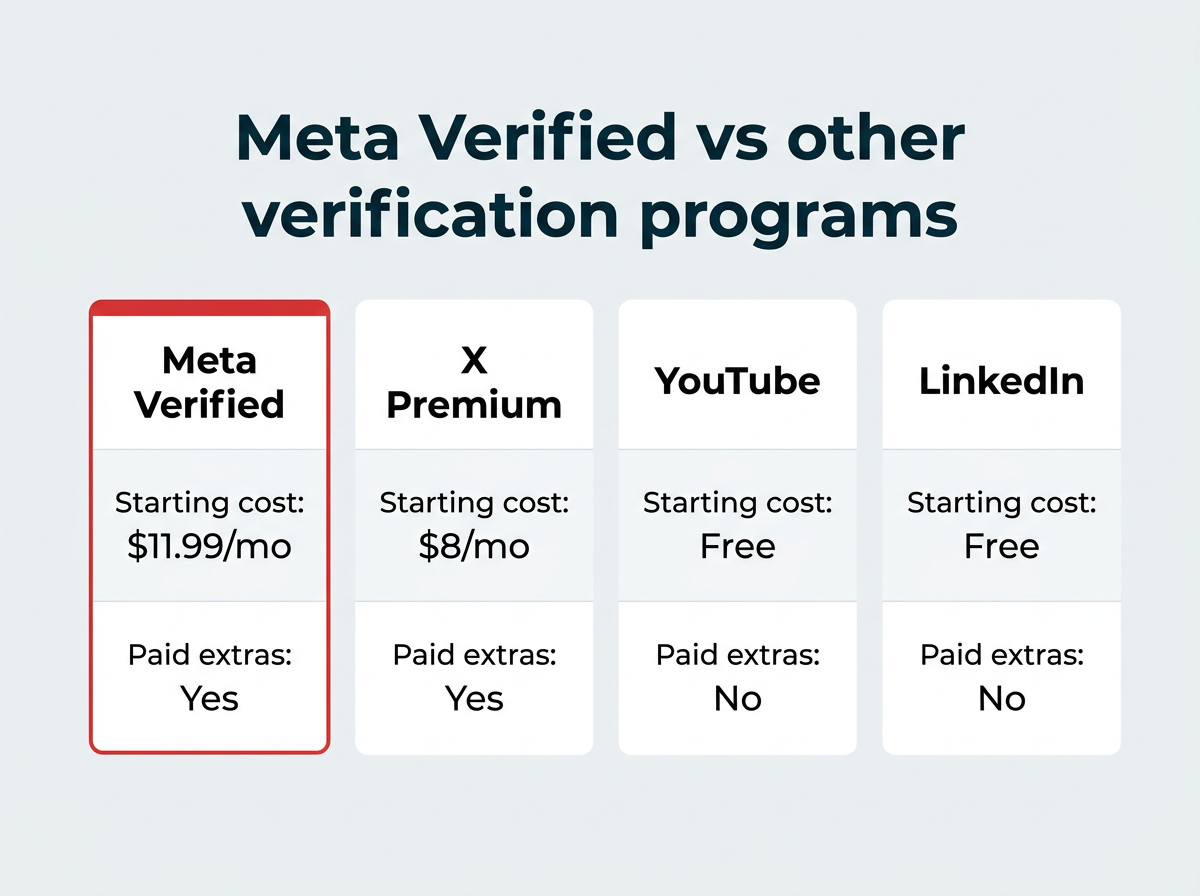
The following table illustrates how Meta Verified compares to other industry-standard verification programs in 2026:
| Feature | Meta Verified | X Premium | YouTube Verification | LinkedIn Verified |
|---|---|---|---|---|
| Starting Cost | $11.99/mo | $8.00/mo | Free | Free |
| Identity Check | Government ID | Phone/Payment | Subscriber Count | ID/Workplace |
| Direct Support | Yes (Human) | No (Varies) | No | No |
| Reach Boost | Yes | Yes | No | No |
| Key Perk | Impersonation Protection | Edit Button/Long Posts | Branding | Professional Trust |
Official Responses: Meta’s Strategic Vision
Meta’s leadership has consistently framed Meta Verified as a "value-add" service rather than a simple pay-for-protection scheme. In the initial rollout, Meta for Creators stated: "We want to build a subscription offering that’s valuable to everyone, including creators, businesses, and our community at large."
During the Q3 2025 earnings call, Meta executives emphasized that the program’s success is tied to "account security and ease of use." Mark Zuckerberg has noted that providing direct human support at scale is an expensive endeavor, and the subscription model allows Meta to fund the infrastructure required to offer this service to millions of users who were previously reliant on automated systems.
Furthermore, Meta has addressed concerns regarding the "commoditization of the blue check." The official stance is that by verifying more users, the platform becomes safer for everyone. By removing the "notability" barrier for the badge, Meta argues it is democratizing access to the tools needed to grow a digital presence safely.
Implications: The New Social Media Paradigm
The rise of Meta Verified has profound implications for the future of digital communication, creator economies, and business competition.
1. The "Safety Tax" Debate
Critics argue that by charging for impersonation protection and direct support, Meta is essentially placing a "tax" on safety. For many creators, these features are not luxuries but necessities. The implication is a two-tiered internet where those who can afford to pay receive a higher level of protection and service, while those who cannot are left to navigate automated systems that are often slow to respond to hacks or identity theft.
2. Algorithmic Hierarchy
The inclusion of "Increased Reach" as a subscription benefit has altered the competitive landscape. In 2026, the "organic" reach of non-verified accounts has seen a noticeable decline as the algorithm prioritizes content from "authenticated" (paying) sources. This creates a hurdle for new creators who may find it difficult to grow an audience without first investing in a subscription.
3. Business Credibility in the Messaging Era
For businesses, particularly those on WhatsApp, Meta Verified has become an essential tool for conversion. In an era of rampant phishing and "deepfake" brand accounts, the verified badge provides a layer of certainty that facilitates commerce. For small businesses, the ability to pay for verification—rather than waiting for a legacy badge that might never come—has leveled the playing field against larger corporations.
4. The End of "Notability"
The prestige of the blue checkmark has undoubtedly shifted. It is no longer a sign of "making it" in the traditional sense; it is a sign of being a "pro" user. This shift has forced brands and influencers to seek other ways to signal true cultural relevance, as the badge itself is now a commodity available for the price of a monthly lunch.
5. Data and Identity Centralization
By encouraging millions of users to upload government IDs, Meta is building one of the world’s most robust databases of verified human identities. This has long-term implications for how identity is managed across the web, potentially positioning Meta as a primary "identity provider" for other services and the burgeoning "metaverse" applications.
Conclusion
Meta Verified in 2026 is far more than a badge; it is a fundamental shift in the social media business model. For the individual creator, it offers a path to professionalization and security. For the business, it offers a vital trust signal in a crowded marketplace. However, as the line between "user" and "subscriber" continues to blur, the industry must grapple with the ethical questions of access and the true cost of a "free" internet.
As Meta continues to refine these tiers, the program serves as a blueprint for the future of all social platforms: a future where your identity is your most valuable asset, and verifying it is your most necessary expense.
 Basiran
  Nana Muazin
  Nila Kartika Wati