
 By Nana Muazin

In the fast-paced landscape of digital marketing, the days of ad-hoc posting and last-minute creative scrambles are officially a thing of the past. As platform algorithms grow increasingly sophisticated and consumer expectations hit an all-time high, digital marketers are turning to structured, data-driven frameworks to maintain relevance.
Effective social media content planning has evolved far beyond simple scheduling. It is now a comprehensive discipline that encompasses deep audience analysis, cross-channel repurposing, AI integration, and rigorous governance. Below is a deep dive into the evolution, execution, and technological advancements shaping social media strategy, designed to help marketing teams build sustainable, high-impact workflows.

Main Facts: The Anatomy of Modern Social Media Planning
At its core, social media content planning is the strategic process of determining what to post, when to publish it, and how every asset directly supports overarching business and marketing goals. Rather than treating social media as a reactive broadcasting channel, successful organizations treat it as a finely tuned engine requiring careful alignment of topics, formats, and campaigns well in advance.
A repeatable, robust content planning process prevents teams from reinventing their workflows month after month. Key components of this ecosystem include:

- Operational Efficiency: Shifting from single-post creation to batch-content production.
- Asset Multi-plication: Transforming a single core concept or piece of long-form content into multiple assets optimized for distinct formats and platforms.
- Strategic Consistency: Mitigating team burnout while maintaining a steady brand presence.
- Goal Alignment: Connecting daily social metrics directly to high-level leadership objectives, such as brand awareness, lead generation, and customer retention.
Chronology: The 10-Step Blueprint for Executing an Effective Content Plan
Building a seamless content operation requires a disciplined, sequential approach. Industry best practices point to a 10-step methodology that guides teams from initial conception to final measurement.
1. Set Your Goals and Key Performance Indicators (KPIs)
Every successful campaign begins with a clear destination. Teams must establish two to three overarching goals per quarter—such as increasing monthly impressions or driving qualified web traffic—and pair them with measurable KPIs. Vague objectives like "growing awareness" are replaced by concrete metrics, such as achieving a 20% increase in Q2 engagement rates.

2. Know Your Audience
Audience research anchors content in reality rather than assumption. By evaluating platform analytics and deploying social listening tools, marketers uncover the exact language, pain points, and unprompted topics that resonate with their target demographics.
3. Define Your Content Themes
Content themes (or pillars) act as structural guardrails for your brand. Whether focusing on educational tutorials, product spotlights, industry thought leadership, or culture-driven posts, every piece of content must ladder up to an established theme. If an idea does not fit a pillar, it does not belong in the calendar.

4. Choose Your Platforms
Spreading a small team thin across every available social network guarantees sub-par results. Using audience research and performance data, brands must prioritize the channels where their target demographic spends the majority of their time, tailoring cadence and formats accordingly.
5. Brainstorm Campaign and Post Ideas
Relying on regular brainstorming sessions, dedicated collaboration channels, and historical performance data ensures a healthy, evergreen pipeline of content ideas. This minimizes the friction of starting from scratch with every new content cycle.

6. Decide on Your Content Mix
A healthy social strategy balances original content with curated industry insights—often adhering to a framework like 40% original and 60% curated content. Furthermore, diversifying formats (short-form video, carousels, text posts, and stories) safeguards the strategy against algorithmic shifts.
7. Assign Responsibilities and Set Approvals
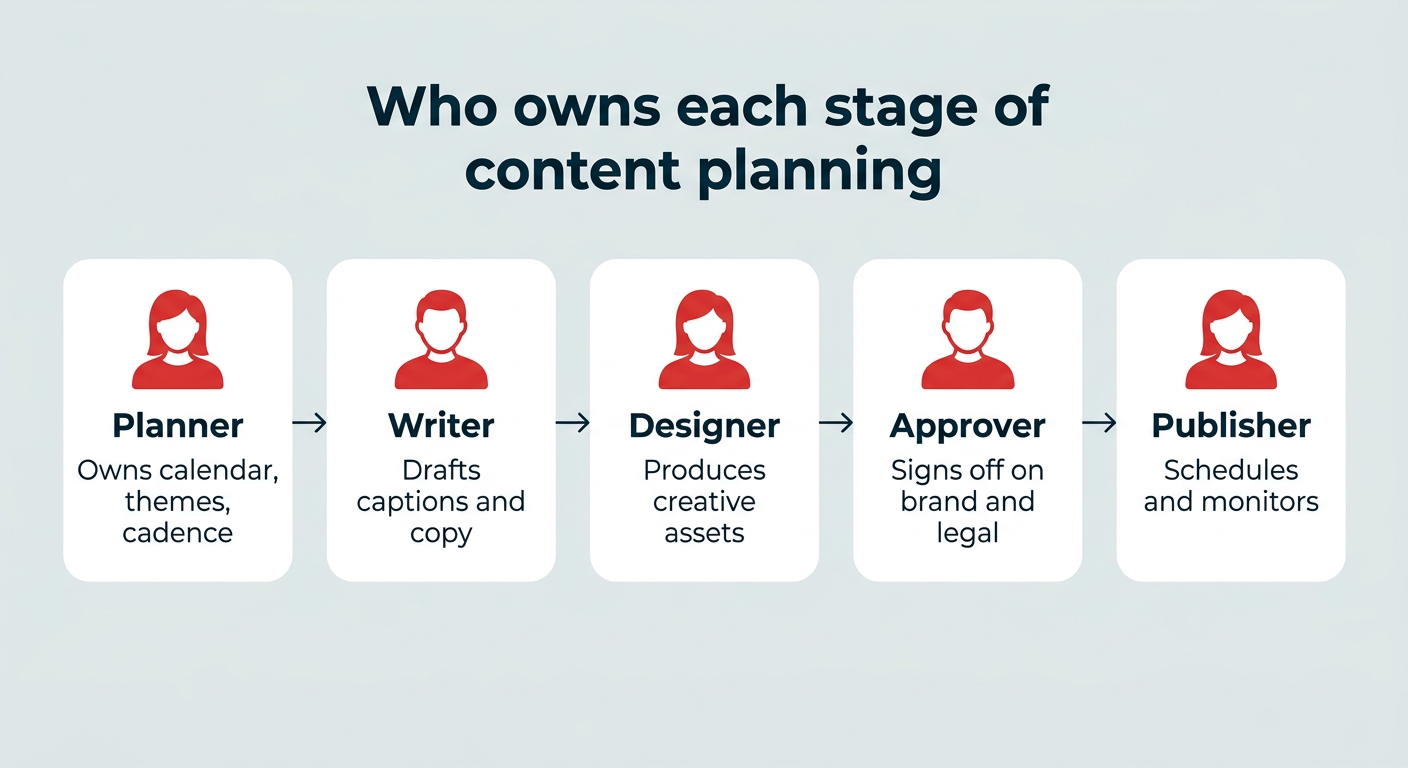
Clear ownership eliminates operational bottlenecks. Teams must explicitly define roles for planners, writers, designers, approvers, and publishers. In regulated industries, formal review workflows are vital to ensure legal and brand compliance before anything goes live.
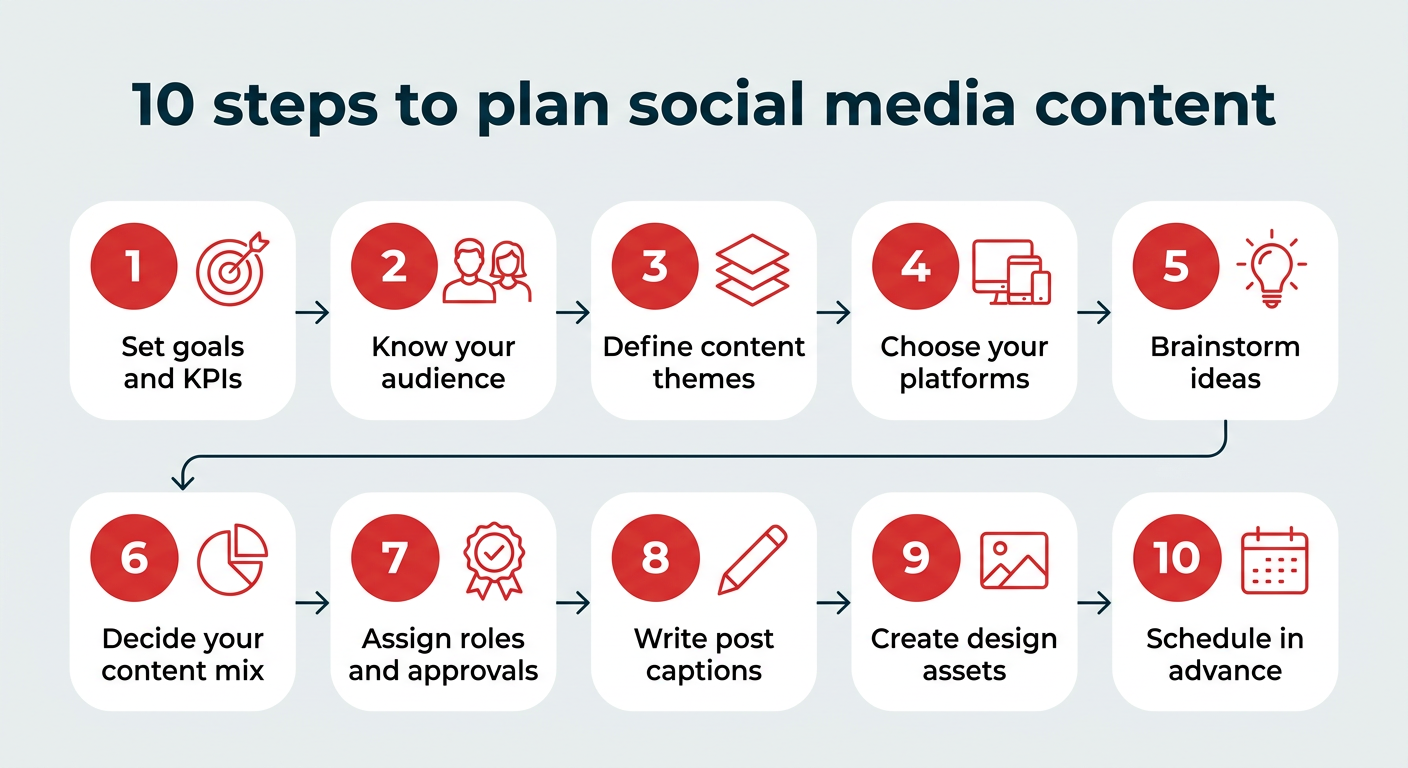
8. Write Post Captions
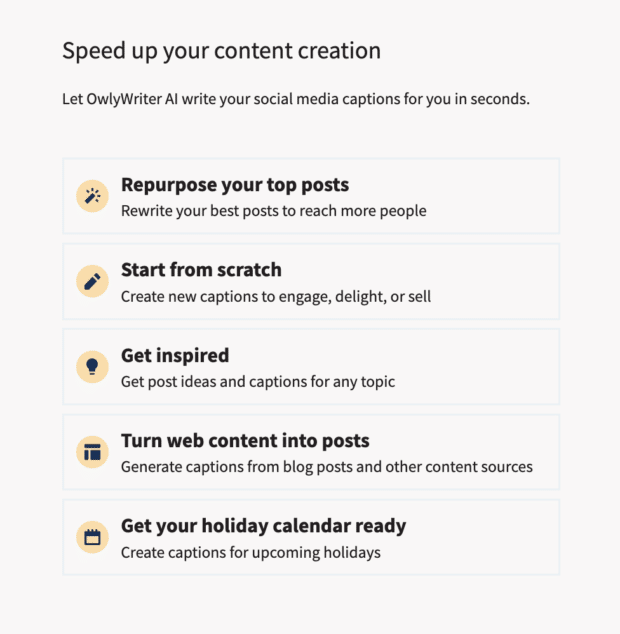
Drafting captions prior to design production ensures that the copy drives the visual narrative rather than merely reacting to it. Modern AI-assisted writing tools can accelerate this phase significantly, generating diverse angles, hooks, and hashtags based on high-level prompts.
9. Create (or Source) Design Assets
With approved captions in hand, creative teams produce the accompanying visual assets. Establishing strict internal timelines for asset delivery prevents the creative bottlenecks that frequently derail social calendars.

10. Schedule Content in Advance
Advanced scheduling tools allow teams to batch-publish content across multiple channels seamlessly. Leveraging data-driven insights—such as platform-specific "Best Time to Publish" analytics—ensures content reaches audiences when they are most active and engaged.
Supporting Data: The Current State of AI and Content Operations
Integrating artificial intelligence into social media workflows has become a primary focus for digital marketers, yet execution gaps remain a significant hurdle.

Recent data highlights the dichotomy between AI exploration and actualized value:
- The GenAI Adoption Gap: According to Gartner surveys, while roughly 77% of marketers actively explore Generative AI tools, only 44% realize significant, tangible benefits from them.
- The Quality Perception Challenge: Consumer sentiment regarding AI-generated content reveals cautionary insights; a Gartner survey found that 49% of U.S. consumers feel that the proliferation of GenAI has actually worsened overall content quality.
These statistics underscore the critical need for human oversight. While AI serves as a powerful accelerator for research, drafting, and scheduling optimization, final editorial judgment, brand voice curation, and regulatory compliance remain strictly human responsibilities.
Official Responses and Industry Perspectives
As enterprise organizations scale their social media operations across multiple regions and business units, industry leaders emphasize the necessity of connected ecosystems over fragmented, standalone tools.
Marketing strategists and software platforms alike advocate for unified operating systems that bridge the traditionally siloed stages of social marketing. According to industry workflow specialists, organizations that connect social listening, content planning, AI-assisted drafting, and governance layers experience significantly lower rates of campaign fragmentation.
Furthermore, compliance experts in highly regulated sectors—such as finance and healthcare—stress that governance cannot be treated as an afterthought. Enterprise-grade approval workflows ensure that automated or AI-assisted content drafts pass through mandatory legal reviews, mitigating brand risk without stifling publishing velocity.
Implications: The Future of Scaled Social Media Management
The shift toward structured, unified social media content planning carries profound implications for marketing departments worldwide:

- Elevated Content Quality: By automating repetitive administrative tasks—such as bulk scheduling, hashtag generation, and optimal timing analysis—marketing professionals can redirect their focus toward high-level strategy and creative storytelling.
- Cross-Departmental Synergy: Unified calendars break down communication barriers between sales, customer support, PR, and social teams, ensuring that external messaging remains coherent and timely.
- Data-Driven Evolution: Moving away from static schedules toward dynamic, analytics-backed planning cycles allows teams to continuously refine their content mix based on real-time audience feedback, driving sustainable long-term ROI.
Ultimately, transitioning from reactive posting to proactive, data-informed content planning transforms social media from an unpredictable daily chore into a predictable, high-performing growth engine for modern enterprises.
 Nila Kartika Wati
 Siti Muinah
 Evan Lee Salim
