
 By Nana
In an era defined by rapid technological shifts, the lingering aftershocks of a global pandemic, and the intense polarization of the 2024 presidential cycle, the question of what it means to be an "engaged" citizen has become increasingly complex. Are Americans retreating from their communities? Are they turning inward, or are they finding new, nontraditional ways to participate in public life?
A groundbreaking study from the Pew-Knight Initiative, released this month, suggests that the traditional binary of "engaged versus disengaged" is no longer sufficient to describe the U.S. public. By analyzing 19 different measures of participation—ranging from voting and volunteering to religious attendance and news consumption—researchers have identified four distinct groups within the American population. These "engagement groups" reveal a nation that is deeply divided not just by politics, but by the very manner and intensity with which citizens interact with the world around them.

The Four Clusters of Engagement
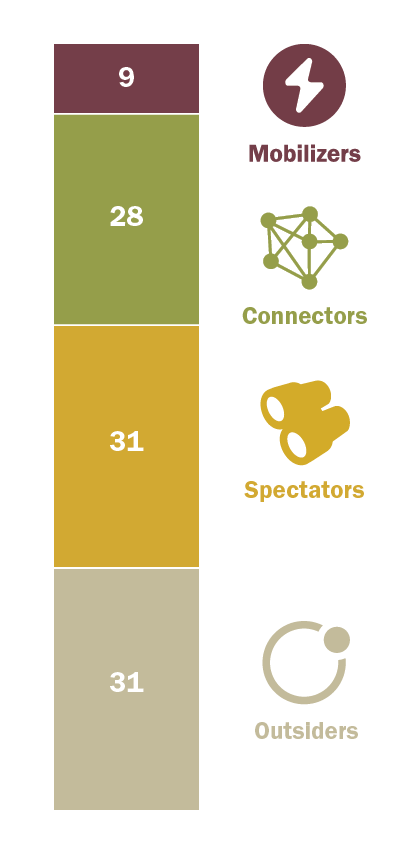
The study, based on a massive cross-sectional survey of 5,393 U.S. adults conducted between July and December 2025, reveals that Americans do not fall along a single, linear spectrum. Instead, they cluster into four distinct profiles:
- Mobilizers (9%): Highly active across every measured domain, these individuals are the bedrock of civic and political life.
- Connectors (28%): Active in community and social spheres, they are pillars of local organization but maintain a more reserved distance from high-intensity political advocacy.
- Spectators (31%): Attentive to the world through news consumption but largely passive regarding direct civic or political action.
- Outsiders (31%): The least engaged across all categories, showing minimal participation in politics, civic groups, or community life.
Chronology of a Changing Civic Landscape
To understand the current state of American engagement, one must look at the historical trajectory of the last several years. The decline in traditional markers of social capital—such as religious attendance, membership in civic clubs, and reliance on national news—has been well-documented by sociologists for decades.
However, the 2024 presidential election acted as a unique catalyst. By surveying respondents in late 2025, the Pew Research Center was able to capture the behavioral residue of a high-stakes national election. While some scholars theorized that political exhaustion might lead to a universal "retreat," the data shows something more nuanced: a persistent core of hyper-engaged individuals (the Mobilizers) operating alongside a large segment of the population that has effectively opted out of the civic theater (the Outsiders).
Supporting Data: Breaking Down the Divide
The differences between these groups are stark and often follow demographic fault lines.
The Mobilizers: Intensity and Influence
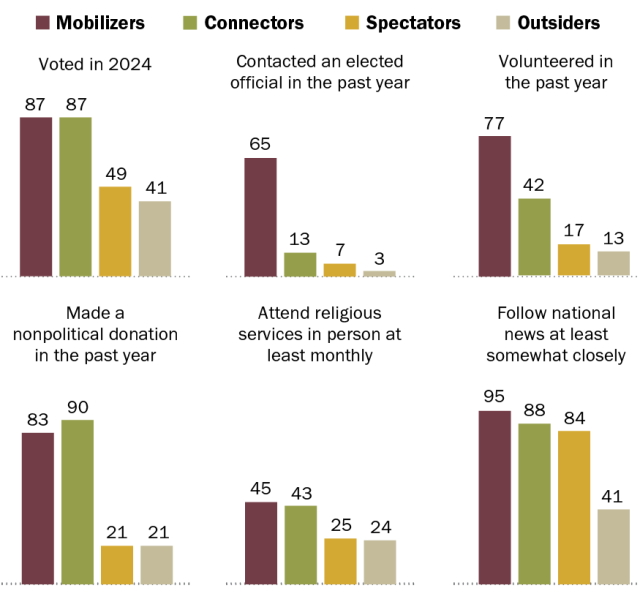
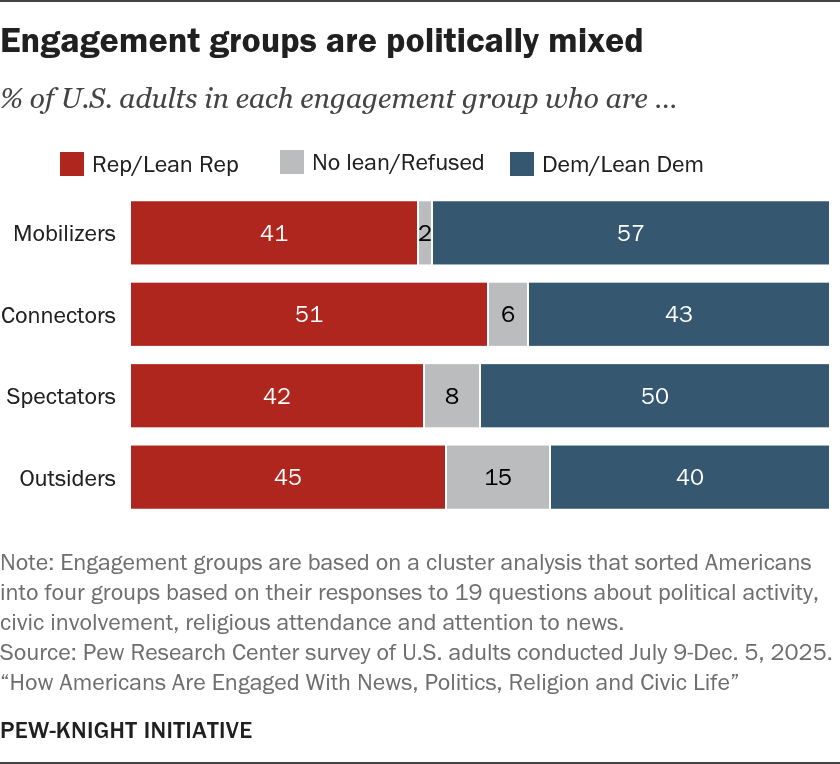
Comprising roughly one-in-ten adults, Mobilizers are the most educationally and financially privileged group. Their engagement is defined by intensity. While 87% reported voting in 2024, their participation goes far beyond the ballot box. A staggering 77% have volunteered in the past year, and 65% have directly contacted an elected official. Politically, they are not a monolith, though they lean toward the Democratic Party (57%) compared to the Republican Party (41%). They are also more likely to hold "ideologically extreme" views, with Republicans in this group identifying as "very conservative" and Democrats as "very liberal."
The Connectors: The Community Anchors
Connectors make up 28% of the public and represent the "social glue" of American life. While they share the high voting rates of Mobilizers, their focus is local. They are the ones donating to nonpolitical charities (90%) and participating in local associations (65%). They are generally older, more likely to be White, and more affluent than the average American. Unlike the Mobilizers, however, they lack the appetite for the "combat" of national politics, such as displaying bumper stickers or volunteering for campaigns.
The Spectators: The Digital Observers
Representing 31% of the population, Spectators are the youngest of the four groups. Their engagement is almost entirely informational. They follow the news with high interest—84% follow national news closely—but they are digital-first participants. They are more likely to "like" or "share" a post about the news than to attend a school board meeting. For Spectators, the internet is not just a tool; it is the primary venue for their social existence, with 56% describing their internet use as "almost constant."
The Outsiders: The Disconnected
The final 31% of the public are the Outsiders. Their low engagement is not necessarily a reflection of apathy toward society, but a lack of connection to the mechanisms of civic participation. They are less likely to have a college degree, more likely to fall into lower income brackets, and are the least likely to follow news or join community organizations. While they are as likely as anyone else to express belief in a higher power, their rates of religious attendance are among the lowest in the study.
Official Perspectives and Methodology
The Pew-Knight Initiative emphasizes that this study was designed to be inclusive of "hard-to-reach" populations. Recognizing that traditional online-only surveys often miss those who are not active in public life, the researchers employed a multi-mode approach, including paper-based and telephone surveys.
"Participation in public life takes many forms," the report states. "By looking at these behaviors together, we can finally see how they come together in people’s day-to-day lives." The methodology relied on a cluster analysis of 19 distinct behaviors, ensuring that the four groups are not merely theoretical constructs but represent real, observable patterns of behavior in the American public.

The Political Reality: A Non-Partisan Puzzle
Perhaps the most surprising finding in the study is the lack of a single "partisan home" for any of the four groups. While Mobilizers and Connectors have slight leans, the study makes it clear that polarization is not the primary driver of engagement levels.
In every group, members of both major parties—and those with no party affiliation—are present. This suggests that the divide in America is not merely "Red vs. Blue," but rather a divide in capacity and inclination to engage. A low-income Republican is far more likely to share the behavioral patterns of a low-income Democrat (Outsider) than they are to share the patterns of a high-income Republican (Connector).

Implications for the Future
The implications of this research are profound for policymakers, community leaders, and the media. If 31% of the population is effectively "out of the loop," how can public discourse ever truly be representative?
For political campaigns, the data serves as a cautionary tale: the "Mobilizers" are already saturated with messaging. Real growth, or the shift in public opinion, may depend on how parties can reach the "Connectors" or "Spectators" without alienating them with the high-intensity tactics that characterize current political life.

Furthermore, for civil society, the decline of the "Connector" role—which has historically bridged the gap between the hyper-engaged elite and the passive public—could pose a long-term threat to social stability. If the middle-ground of local, community-based engagement continues to shrink, the risk of a society polarized between a loud, hyper-active minority and a vast, disconnected periphery only grows.
As the United States looks toward the next election cycle, the challenge is clear: the path to a more robust democracy may not lie in trying to make everyone a "Mobilizer," but in finding ways to re-engage the "Spectators" and "Outsiders" in the community-level work that forms the bedrock of a healthy society.
Appendix: Methodological Transparency
- Survey Dates: July 9, 2025 – December 5, 2025.
- Total Sample Size: 5,393 adults (Cross-Sectional Survey); 5,195 respondents (American Trends Panel).
- Data Analysis: Cluster analysis based on 19 indicators, including voting history, charitable giving, religious attendance, and news consumption.
- Margin of Error: Varies by group and question; detailed topline results available via the Pew Research Center data archive.
 Pevita Pearce
  Neng Nana