
 By Pevita Pearce
WASHINGTON — For generations, the daily ritual of keeping up with current events involved unfolding a broadsheet newspaper, turning on the evening local news broadcast, or tuning into the morning radio bulletin. Today, for a rapidly growing majority of Americans, the front page has been replaced by an endless, algorithmically curated digital feed.
According to a comprehensive new survey released by the Pew Research Center as part of the Pew-Knight Initiative, 58% of U.S. adults now consider social media an important way for them to keep up with the news. This milestone represents a striking shift in the nation’s information diet, reflecting a broader cultural migration away from traditional institutional journalism and toward peer-to-peer digital networks.
The study, which surveyed 3,488 U.S. adults via the Center’s American Trends Panel between June 22 and 28, 2026, highlights just how deeply embedded platforms like TikTok, Instagram, X (formerly Twitter), and Facebook have become in the civic lives of everyday Americans. While debate continues over the reliability, polarization, and verification challenges inherent in social-platform algorithms, the data confirms one undeniable reality: social media is no longer merely a supplement to traditional media—it is a primary engine of public awareness.
Main Facts: The Shift to Social News
The headline finding of the Pew-Knight research is the sheer acceleration of social media’s prominence as a journalistic medium.
- The Majority Milestone: More than half (58%) of all U.S. adults now state that social media is an important tool for staying informed. Within that group, 13% categorize it as the most important way they get their news.
- Rapid Growth: This represents a significant leap from just four years ago. When Pew Research Center last posed this exact question in 2022, only 43% of Americans viewed social media as an important news source, with a mere 5% calling it their primary channel. Meanwhile, those who say social media is not an important way to get news have sharply dropped from 56% in 2022 to 42% today.
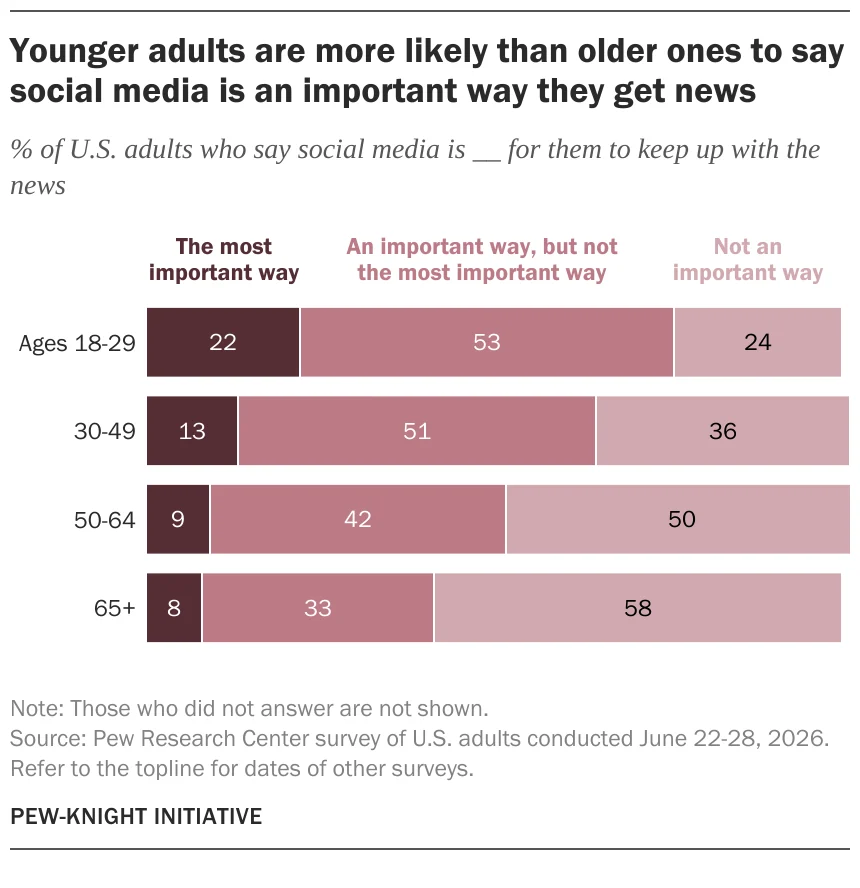
- The Generational Divide: The reliance on social platforms is heavily stratified by age. Among young adults aged 18 to 29, a staggering 76% view social media as an important news vehicle—with 22% calling it their single most crucial source. Conversely, older Americans remain far more tethered to traditional formats; only 41% of adults aged 65 and older say social media plays an important role in their news consumption.
Chronology: The Evolution of the Digital News Ecosystem
To understand how social media ascended to its current dominance, it is helpful to trace the evolution of the modern media landscape over the past two decades.
Phase One: The Aggregator Era (Early-to-Mid 2010s)
In the early days of Facebook and Twitter, social platforms served primarily as digital traffic cops. Media outlets posted links to their original reporting, utilizing platforms to drive users back to traditional websites. Users consumed headlines and brief blurbs in their feeds, but the underlying destination remained a newspaper or television network’s proprietary domain.

Phase Two: Native Content and the Pivot to Video (Late 2010s)
As platforms evolved, they actively discouraged outbound clicks, favoring "native" content that kept users inside their respective walled gardens. Facebook introduced algorithmic timelines optimized for engagement, while video formats began to dominate. News organizations, caught in a shifting economic model, tried to adapt by producing bite-sized summaries directly on social apps.
Phase Three: The Rise of the Creator-Journalist and Short-Form Video (2020–Present)
The current era is defined by the decentralization of news. Platforms like TikTok, Instagram Reels, and YouTube Shorts have birthed a new class of independent creators, citizen journalists, and subject-matter experts who deliver news directly to consumers without traditional editorial filters. This shift coincided with the COVID-19 pandemic and a series of high-stakes global elections, during which millions of users turned to their feeds for real-time, minute-by-minute updates. By 2026, the cumulative effect of these trends pushed the threshold past 50%, cementing social media as a mainstream journalistic heavyweight.
Supporting Data: Breaking Down the Numbers
A deeper dive into the Pew-Knight dataset reveals compelling insights into who uses social media for news and how those preferences break down across different demographic segments.
Age-Based Breakdown of News Importance (% of U.S. Adults)
| Demographic Group | The Most Important Way | An Important Way (Not the Most) | Not an Important Way |
|---|---|---|---|
| Ages 18–29 | 22% | 53% | 24% |
| Ages 30–49 | 13% | 51% | 36% |
| Ages 50–64 | 9% | 42% | 50% |
| Ages 65+ | 8% | 33% | 58% |
As the table demonstrates, youth culture is driving this transformation. Among adults under 30, nearly three-quarters find social media crucial for keeping abreast of current events. Even among the 30-to-49 demographic, a strong majority (64%) lean on social platforms as key news conduits.
However, a flip occurs when looking at older populations. Among those aged 50 to 64, opinions are evenly split, while 58% of seniors (65 and older) dismiss social media as unimportant to their news habits, preferring legacy television, radio, and print outlets.
Furthermore, trust correlates heavily with these habits. Younger audiences who rely on social media are also notably more trusting of the information they encounter there. Approximately half of adults under 30 report having at least some trust in the news content served up by social algorithms, a stark contrast to the deep skepticism held by older demographics.

Official Responses and Context
Industry analysts, media researchers, and philanthropic leaders have weighed in on what these shifting trends mean for the future of public discourse.
Michael Lipka, associate director focusing on news and information research at the Pew Research Center, noted that studying perceived importance—rather than just frequency of use—provides a clearer window into changing cultural attitudes.
"For years now, large shares of Americans have said they get news on social media, and younger adults are especially likely to do so," Lipka explained. "But this is still a relatively new phenomenon, and it is vital to study social media’s evolving role in the information environment. Asking about how important social media is, not just how often people use it, adds profound depth to our understanding of changing news habits."
The Pew-Knight Initiative—a joint research venture funded by The Pew Charitable Trusts and the John S. and James L. Knight Foundation—was specifically designed to explore these intersections of technology, civic information, and community identity.
In a joint statement accompanying the release, representatives from the Knight Foundation emphasized that understanding how citizens absorb facts is vital for a healthy democracy. As social investors committed to informed communities, the foundation pointed out that the democratization of information distribution offers both unprecedented access to diverse voices and unique challenges regarding fact-checking and media literacy.
Implications: Challenges and the Future of Journalism
The transition of social media into a primary news source carries profound implications for society, journalism, and democratic institutions.

1. The Disintermediation of News
Traditional news organizations no longer hold a monopoly on setting the public agenda. When algorithms—rather than human editors—determine which stories gain visibility, sensationalism, emotional resonance, and viral formatting often win out over nuanced, investigative journalism. Newsrooms are forced to adapt, transforming reporters into social media personalities just to remain visible to younger audiences.
2. The Verification and Misinformation Crisis
While social media excels at real-time breaking news, it is notoriously vulnerable to the spread of unverified rumors, deepfakes, and coordinated disinformation campaigns. As the youngest generations—who display higher levels of trust in platform content—increasingly bypass traditional gatekeepers, the burden of media literacy becomes heavier. Society faces an urgent challenge: how to equip citizens with the critical-thinking skills needed to separate rigorous journalism from digital noise.
3. Economic Pressures on Local and Investigative Reporting
Platforms profit heavily from keeping users engaged with news content, yet the ad revenue generated rarely flows back to the original newsrooms that fund investigative reporting. As audiences migrate to feeds, legacy publications continue to face financial headwinds, threatening the viability of local journalism—the very bedrock of accountable governance.
Looking Ahead
The 2026 Pew-Knight data serves as a clear marker of a permanent cultural shift. Social media is no longer a peripheral playground for digital natives; it is the central town square where the modern American public square operates. As algorithms continue to shape what the nation reads, watches, and believes, the challenge for educators, technologists, and journalists alike will be ensuring that increased connectivity translates into a truly informed public.
 Neng Nana
 Azzam Bilal Chamdy
