
 By Basiran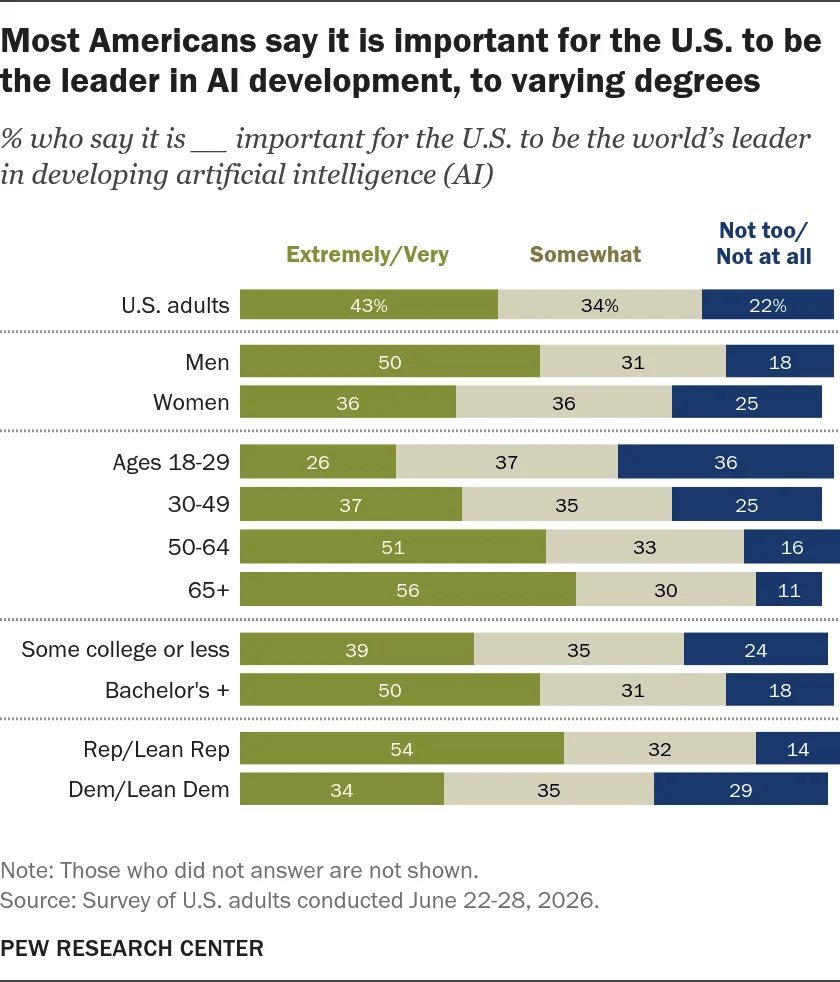
As the race for artificial intelligence dominance reaches a fever pitch, the American public is increasingly anxious about the nation’s standing on the global stage. A comprehensive new survey from the Pew Research Center, conducted in June 2026, reveals a stark reality: by a three-to-one margin, Americans believe that China has outpaced the United States in the development of artificial intelligence. This sentiment underscores a growing sense of vulnerability regarding the future of the digital economy, national security, and global inequality.
The survey of 3,488 U.S. adults offers a window into how the average citizen perceives the geopolitical rivalry between the world’s two largest economies. While the U.S. remains a hotbed for AI innovation, the public’s perception of "who is winning" is decidedly pessimistic, with a significant portion of the population expressing deep uncertainty about the technological landscape.
Main Facts: A Shifting Global Paradigm
The central finding of the survey is the perceived leadership gap. When asked to identify which nation is more advanced in AI development, 36% of Americans pointed to China, while only 12% believed the United States holds the lead. Approximately 18% of respondents suggested that both nations are currently on par, while a substantial 33%—one-third of the population—admitted they were unsure.
This uncertainty suggests that while the "AI race" is a constant topic in political discourse, the tangible progress of these technologies remains opaque to the average person. The data shows clear demographic fractures: women are more likely than men to view China as the leader (41% vs. 31%), and there is a pronounced divide based on technological literacy. Those who regularly interact with AI chatbots are slightly more likely to credit the U.S. with leadership (16%) compared to those who do not use such tools (9%).

A Chronology of the AI Arms Race
To understand the current public sentiment, one must look at the rapid acceleration of AI integration over the last three years.
- 2024: The World Artificial Intelligence Conference in Shanghai served as a global showcase for Chinese advancements, signaling to international observers that Beijing was aggressively prioritizing generative AI and large-scale model training as a matter of national policy.
- 2025: The U.S. government, under the Biden administration, formalized strict export controls and internal regulations, aimed primarily at preventing adversarial nations from accessing high-end GPU hardware and critical model weights. This period marked the hardening of the "digital iron curtain."
- Early 2026: As large language models (LLMs) became ubiquitous in the workplace, the economic stakes became clearer. Both the public and private sectors began to view AI not just as a consumer convenience, but as a critical infrastructure requirement for future military and economic security.
- June 2026: The Pew Research Center survey period. By this time, the rhetoric from Washington had shifted to a "must-win" narrative, with top-level political figures—including Donald Trump—explicitly characterizing the development of AI as a zero-sum game for global supremacy.
Supporting Data: The Importance of Leadership
Despite the widespread belief that China is ahead, most Americans recognize that the stakes for the U.S. are extraordinarily high. Approximately 43% of adults state that it is "extremely or very important" for the U.S. to maintain its position as the global leader in AI.
The data highlights a generational and partisan divide in this prioritization. Older Americans, particularly those 65 and older, are significantly more concerned about U.S. leadership (56%) than their younger counterparts between the ages of 18 and 29 (26%). This could stem from a heightened sense of concern over the erosion of American economic hegemony among older generations, who lived through the height of the Cold War and the manufacturing dominance of the late 20th century.
Partisanship also plays a critical role. Republicans are far more likely to emphasize the necessity of AI leadership (54%) than Democrats (34%). This aligns with the "national security-first" approach often emphasized by conservative leadership, which frames the development of AI as an essential component of protecting American sovereignty.

Official Responses and Political Rhetoric
The political response to these findings is reflective of a bipartisan consensus: the U.S. cannot afford to lose. The rhetoric has moved beyond simple competition into the realm of existential security.
President Donald Trump has been vocal in his assertion that the United States "must have the most powerful AI systems" in the world, framing the situation as an urgent race for global dominance. His administration’s action plans emphasize that AI is the bedrock upon which future national security will be built, suggesting that any loss of ground is tantamount to a strategic defeat.
Conversely, former President Joe Biden’s administration previously emphasized a strategy of "containment and protection." By implementing rigorous oversight and attempting to block adversaries from acquiring the compute power necessary for advanced training, the U.S. has sought to slow the progress of competitors. Both strategies—one focused on rapid, unbridled advancement and the other on defensive barriers—reflect an underlying consensus: the nation that masters AI will define the global order for the next century.
Implications: The Widening Global Divide
Beyond the immediate U.S.-China rivalry, the survey delves into the broader societal implications of AI, specifically regarding global inequality. A staggering 51% of Americans believe that the advancement of AI will exacerbate the gap between rich and poor nations. Only 7% believe that AI will help close this divide, while 16% feel it will have no significant impact.

This concern is well-founded, according to experts. The "compute divide"—the gap in access to high-end processing power and the massive data sets required to train competitive AI—is becoming a structural feature of the global economy. As wealthy nations and corporations monopolize the infrastructure of the AI revolution, developing countries risk being relegated to the role of data-providers or passive consumers of foreign-owned technology.
The survey also notes that those with higher levels of education—specifically those with a bachelor’s degree or higher—are more likely to foresee this widening gap (62% vs 46% for those with less education). This suggests that the most informed segments of the population are the most acutely aware of the potentially exclusionary nature of the current AI trajectory.
Looking Forward
The findings from the June 2026 survey serve as a wake-up call for policymakers. The American public is not only feeling the heat of international competition but is also deeply apprehensive about the humanitarian consequences of an AI-driven world.
As the U.S. moves forward, the challenge will be twofold: first, to address the public’s perception of being "behind" by fostering sustainable, domestic innovation; and second, to participate in global governance frameworks that prevent AI from becoming a tool of extreme economic polarization. Whether the U.S. can regain the lead in the eyes of its own citizens—and in the reality of global technological capacity—will depend on how effectively it balances these competing national and global interests in the years to come.

The consensus is clear: the AI race is not just about code and hardware; it is about the future of national identity and the structure of global prosperity. For now, the American public remains a cautious, if somewhat uncertain, observer of a transformation that they believe will redefine the world.
 Pevita Pearce
  Neng Nana