
 By Reynand Wu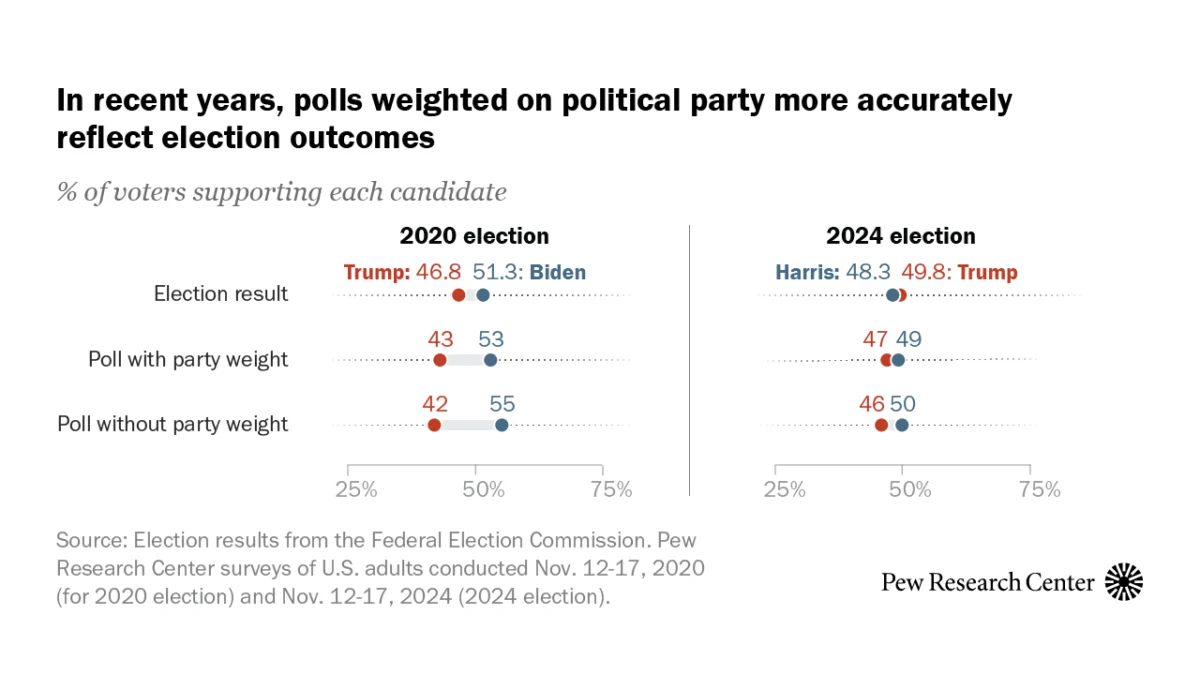
WASHINGTON — In the complex ecosystem of public opinion research, a quiet revolution is underway. For decades, the gold standard of American polling relied on a steadfast formula: reach out to a random sample of citizens, collect their responses, and adjust—or "weight"—the data to match core demographic benchmarks such as age, gender, race, education, and geography.
Today, that foundational approach is facing unprecedented strain. According to a comprehensive methodological report released by the Pew Research Center, shifting societal behaviors, collapsing response rates, and a widening partisan divide in survey participation have rendered traditional demographic weighting insufficient on its own.
To maintain accuracy, pollsters are increasingly turning to a controversial practice: political weighting. This involves explicitly adjusting survey samples to reflect the nation’s true political composition, utilizing metrics such as past voting behavior or party affiliation. While purists have long argued against adjusting polls based on politics, empirical evidence suggests that in the current media and political landscape, omitting these adjustments can lead to systematic errors.
Main Facts: The Evolution and Necessity of Political Weighting
At its core, political weighting is the mathematical process of correcting imbalances in survey data to ensure that the political makeup of respondents accurately mirrors the broader American public.
Historically, pollsters resisted adjusting surveys based on political metrics, arguing that party affiliation is an opinion rather than a fixed demographic trait. Furthermore, early election forecasts performed reasonably well for decades using only standard demographic adjustments.
However, two major structural shifts have broken this historical trend:
- The Death of Traditional Response Rates: Telephone and online survey response rates have plummeted over the last thirty years, making it harder to reach a cross-section of the public.
- Differential Partisan Nonresponse: Participation in modern surveys is no longer politically neutral. Accumulating academic and industry data demonstrates that Democrats are now significantly more likely than Republicans to participate in pre-election surveys, even when researchers control for standard demographic variables like age, race, and education.
Consequently, if the specific subset of White men over 50 who choose to answer a poll are systematically more Democratic than those who refuse, adjusting only for race, gender, and age will fail. The resulting poll will harbor an undetected partisan bias.
By incorporating past vote history or party affiliation into weighting algorithms, researchers can counteract this skew, ensuring that the relative shares of voters and nonvoters—and partisans—faithfully reflect reality.
Chronology: From Demographic Dogma to the Partisan Reality Gap
Understanding how the polling industry arrived at this crossroads requires examining how research methodologies have adapted over time.
The Era of Demographic Dominance (1990s–2000s)
For decades, public opinion research was anchored in the belief that people’s political views did not systematically affect their willingness to take polls. Even as response rates began their initial decline in the 1990s, demographic weighting—ensuring the right mix of age, education, and geography—was sufficient to correct sample imbalances. Industry models successfully forecasted elections without ever touching partisan metrics.
The Cracks in the Foundation (2010s)
As political polarization intensified across the United States, pollsters began noticing subtle discrepancies. In the wake of the 2012 and 2016 elections, methodological autopsies revealed that certain segments of the population were becoming markedly harder to reach. Distrust in institutions, media skepticism, and localized partisan messaging began depressing survey participation among specific political subgroups.
The 2020 Election Awakening
The watershed moment arrived with the 2020 presidential election. A postmortem report by the American Association for Public Opinion Research (AAPOR) revealed widespread polling errors, noting that national and state polls struggled to capture the true level of support for Donald Trump. Crucially, AAPOR found that polls weighted solely by traditional demographics frequently missed the mark. Researchers realized that having an accurate count of overall population figures was useless if the specific respondents inside the poll did not mirror the true ideological diversity of that population.
The Present Era (Mid-2020s)
Today, leading research institutions like Pew Research Center have openly reassessed their methods. Recognizing that differential partisan nonresponse is a structural reality, pollsters are establishing new best practices. They are utilizing panel-based tracking and immediate benchmarks to adjust for political affiliation, acknowledging that while political weighting is not a silver bullet, it is currently a operational necessity for political inquiry.
Supporting Data: What the Research Shows
The empirical case for political weighting rests on comparative accuracy across vast datasets.
- Average Accuracy vs. Perfect Precision: Pew Research Center studies emphasize that political weighting improves the average accuracy level across a broad array of estimates. It does not make every individual question perfect. In fact, on non-political topics—such as personal finances—political weighting makes virtually no difference or can occasionally introduce minor variances compared to pure demographic weighting.
- The COVID-19 Vaccination Gap: The consequences of ignoring political weighting extend far beyond electoral politics. In 2021, numerous health-related surveys significantly overestimated COVID-19 vaccination rates. Because these surveys did not adjust for party affiliation—and because Democrats were statistically far more likely to be vaccinated than Republicans—the lack of political weighting directly contributed to severe analytical overestimation errors.
- The 2020 Polling Postmortem: According to AAPOR’s analysis, polls weighted by partisanship and past 2016 votes did not magically achieve 100% perfection, but they successfully mitigated baseline errors that unadjusted demographic models completely missed.
- The Cost of High-Response Invalidation: High-response-rate, compulsory government surveys—such as the U.S. Census Bureau’s $250 million American Community Survey, which commands an impressive 83% response rate—have no need for political weighting. The issue is strictly concentrated in low-response-rate modern public opinion polls.
Official Responses and Industry Perspectives
The methodological shift toward political weighting has sparked intense debate within the scientific and statistical communities.
Proponents of political weighting argue that methodology must adapt to human behavior. "When the baseline assumptions of survey participation break down, clinging to outdated models is a form of methodological denial," notes one industry analyst. Researchers emphasize that the goal of public opinion polling is to capture the true voice of the public, not simply the voices of those who are most compliant or trusting of institutions.
Conversely, critics caution against the risks of circular reasoning. If a pollster forces a survey’s current political makeup to match an external, potentially outdated benchmark, they risk baking assumptions into the data. Furthermore, because party affiliation is fundamentally an attitude rather than a permanent trait—meaning it can shift rapidly over time—using it as a weighting variable introduces timing complexities. If the measurement of party affiliation is unaligned with external benchmarks, errors can actually multiply rather than diminish.
Moreover, prominent polling bodies universally agree that political weighting cannot compensate for lazy field practices. Rigorous sampling, broad outreach, and making survey participation easy and attractive for citizens from all walks of life remain non-negotiable pillars of credible research.
Implications: The Future of Public Opinion Research
The broader implications of incorporating political weighting into survey research touch upon the credibility of media reporting, democratic participation, and the future evolution of polling science.
1. A Shift in How We View "Independence"
For decades, political weighting was viewed by some critics as "fudging the numbers" to fit expected election outcomes. As transparency increases around these methodological adjustments, media organizations and the public must learn to understand that adjusting for political reality is distinct from partisan manipulation. It is an algorithmic correction for modern nonresponse bias.
2. Not a Permanent Solution
Interestingly, researchers stress that political weighting should not be viewed as a permanent feature of survey science. Just as current political dynamics create barriers to reaching conservative respondents, future social and technological shifts could alter how citizens interact with researchers. If partisan participation rates eventually rebalance, the need for political weighting could fade away entirely.
3. The Scope of Application
Pollsters must exercise discernment. Applying political weights to surveys that measure lifestyle choices, hobbies, or scientific attitudes completely disconnected from politics is statistically counterproductive. Weighting adjustments only improve estimates when the adjustment variable (partisanship) is directly correlated with both survey participation propensity and the core subject being measured.
4. Preserving Public Trust
Ultimately, the embrace of political weighting reflects a maturing scientific discipline. By confronting the realities of differential nonresponse head-on, pollsters are striving to preserve the core mission of public opinion research: providing decision-makers, media, and the public with an accurate, unvarnished reflection of societal views, no matter how difficult those views are to capture.
 Azzam Bilal Chamdy
  Asep Darmawan
  Nana Wu