
 By Azzam Bilal Chamdy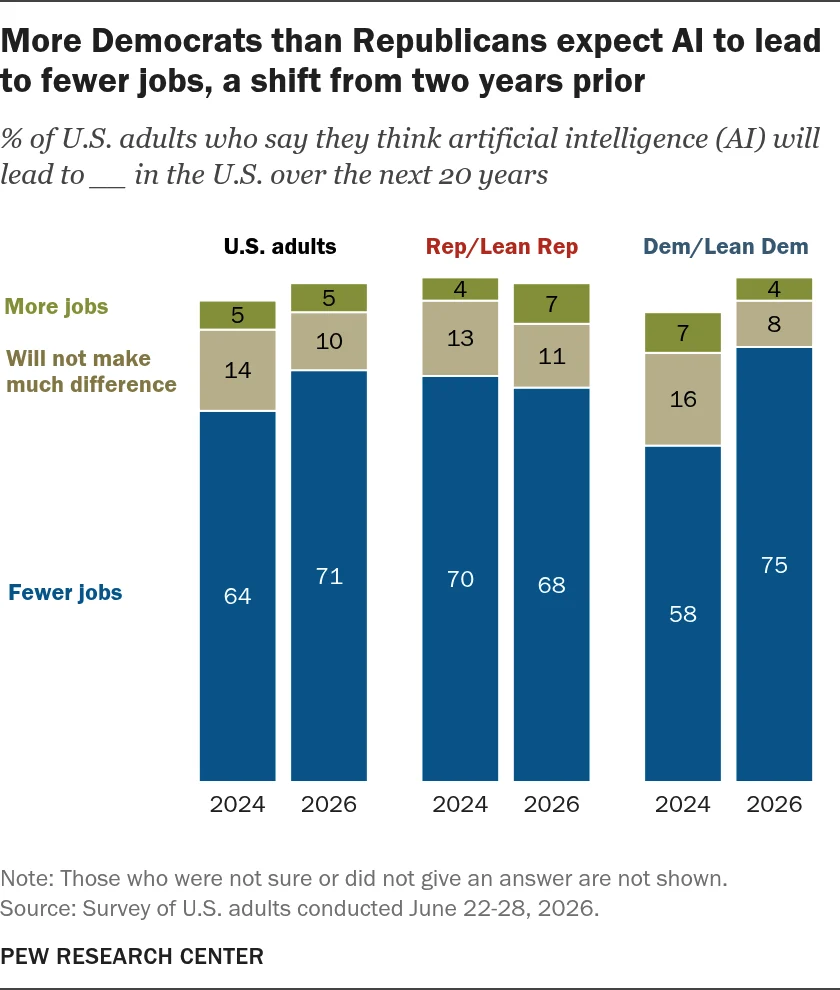
WASHINGTON — In a notable shift in public opinion, Democrats are now more likely than Republicans to express deep apprehension regarding the rapid proliferation of artificial intelligence (AI) in daily life and its looming threat to the American workforce.
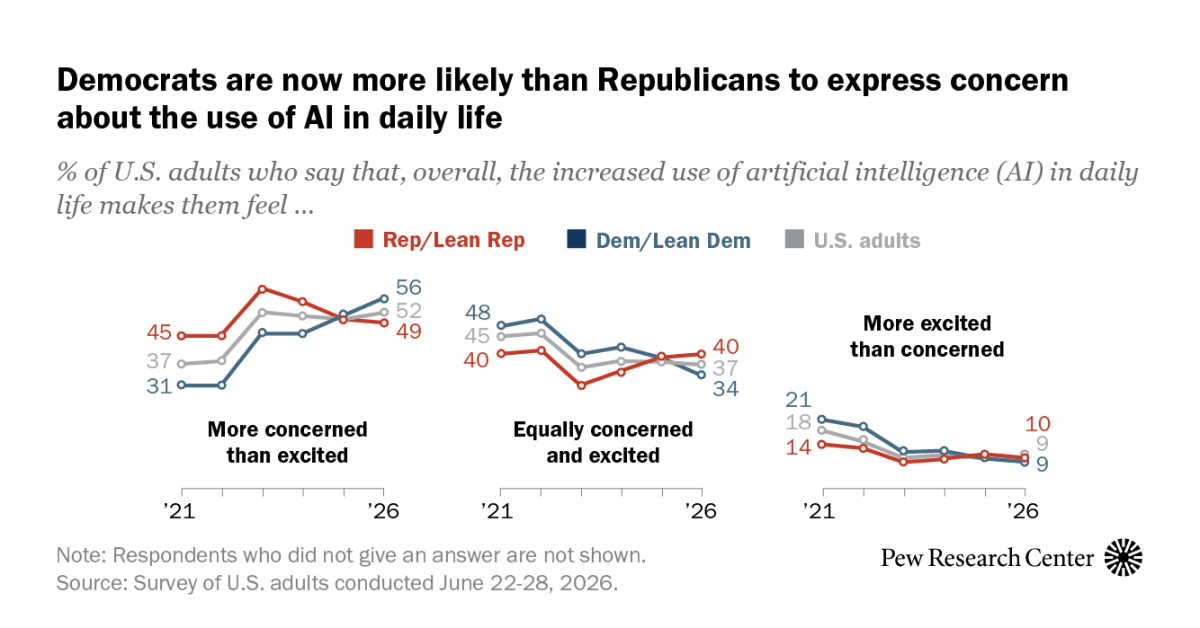
According to a comprehensive nationwide survey conducted in late June by the Pew Research Center, 56% of Democrats and Democratic-leaning independents reported feeling more concerned than excited about the expanding footprint of AI. This positions Democrats, for the first time in polling history, as more anxious about the technology than their Republican counterparts, among whom 49% share the same level of concern.
The findings mark a significant evolution in how emerging technologies intersect with American politics. As artificial intelligence transitions from Silicon Valley laboratories and corporate boardrooms into the mainstream of public consciousness, the debate over its societal impacts is rapidly hardening along partisan and ideological lines.
Main Facts and Key Findings
The national survey, which sampled 3,488 U.S. adults via the American Trends Panel between June 22 and June 28, 2026, highlights several critical transformations in public sentiment:
- A Partisan Flip: For years, skepticism toward AI was higher among conservatives. Today, however, 56% of Democrats express primary concern over AI in daily life, compared to 49% of Republicans.
- Pessimism Over Employment: A striking 75% of Democrats now predict that AI will lead to a net reduction in jobs across the United States over the next two decades. This represents a 17-percentage-point surge since 2024, when only 58% held that view. Conversely, 68% of Republicans foresee job losses, a figure that has remained relatively flat.
- Broad National Unease: Overall, American wariness toward AI continues to climb. Roughly 52% of all U.S. adults now say they are more concerned than excited about the technology, a steady increase from 37% when Pew first tracked the metric in 2021.
- The Ideological Polarization: The shifting Democratic anxiety is heavily concentrated on the left wing of the party. Among liberal Democrats, apprehension skyrocketed from 45% in 2023 to 63% in the latest survey. Meanwhile, concern among conservative Republicans dropped by 14 percentage points over the same timeframe.
Chronology of Public Opinion on AI
To understand how public sentiment reached this juncture, researchers at the Pew Research Center point to a multi-year evolution marked by explosive technological advancements and intense media scrutiny.
2021–2022: The Era of Curiosity and Caution
When generative AI tools were first creeping into public view, the American public was largely split, with a plurality adopting a "wait-and-see" approach. In 2021, only 37% of U.S. adults stated they were more concerned than excited about AI, while a robust 45% reported feeling equally concerned and excited. During this initial phase, political divides were modest, though Republicans (45%) were slightly more prone to early skepticism than Democrats (31%).
2023: The Generative AI Boom
The public landscape shifted dramatically following the widespread release of advanced generative models, large language models, and creative automation tools. By 2023, public concern surged across the board. Nationally, those "more concerned than excited" jumped to 52%. Within political camps, 59% of Republicans and 46% of Democrats expressed primary concern. At this stage, conservative circles voiced heightened anxieties over cultural impacts, algorithmic bias, and the erosion of traditional media, while the left maintained a more moderate stance.
2024–2025: Political Realignment and Economic Realities
As AI integration accelerated in corporate environments, white-collar and creative sectors began to feel the early tremors of automation. By 2024, partisan views began to decouple from past trends. While Republican concern remained high at 55%, Democratic anxiety began a sharp upward trajectory, climbing to 46%. By 2025, the two parties achieved parity at 50%, setting the stage for the definitive crossover captured in the mid-2026 data.
2026: The Midterm Election Flashpoint
By mid-2026, AI firmly cemented itself as a top-tier political issue. Surrounding the debate were high-stakes policy decisions involving the construction of massive energy-intensive data centers, federal vs. state regulatory frameworks, and workforce protections. The June 2026 survey captured the culmination of these trends, revealing that Democrats had decisively surpassed Republicans in overall anxiety and pessimism regarding employment.
Supporting Data and Statistical Breakdown
A granular examination of the survey data illustrates how distinct demographic and ideological factions view the future of artificial intelligence.
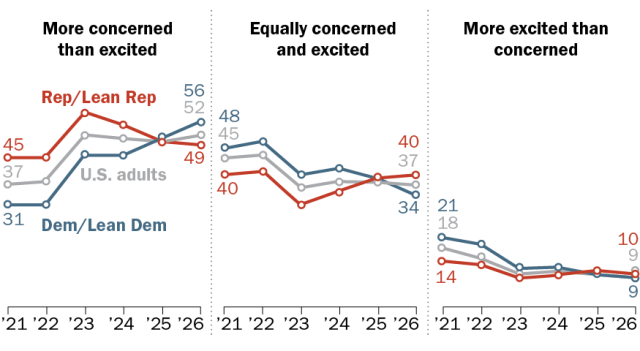
Daily Life Sentiment: Concerned vs. Excited (% of U.S. Adults)
| Year | Group | More concerned than excited | Equally concerned and excited | More excited than concerned |
|---|---|---|---|---|
| 2021 | U.S. Adults | 37% | 45% | 18% |
| Rep / Lean Rep | 45% | 40% | 14% | |
| Dem / Lean Dem | 31% | 48% | 21% | |
| 2023 | U.S. Adults | 52% | 36% | 10% |
| Rep / Lean Rep | 59% | 31% | 9% | |
| Dem / Lean Dem | 46% | 40% | 12% | |
| 2026 | U.S. Adults | 52% | 37% | 9% |
| Rep / Lean Rep | 49% | 40% | 10% | |
| Dem / Lean Dem | 56% | 34% | 9% |
Projected Impact on Jobs Over the Next 20 Years
The expectation that AI will eliminate more jobs than it creates has intensified significantly among Democrats, while holding steady among Republicans.
| Year | Group | Fewer jobs | Will not make much difference | More jobs |
|---|---|---|---|---|
| 2024 | U.S. Adults | 64% | 14% | 5% |
| Rep / Lean Rep | 70% | 13% | 4% | |
| Dem / Lean Dem | 58% | 16% | 7% | |
| 2026 | U.S. Adults | 71% | 10% | 5% |
| Rep / Lean Rep | 68% | 11% | 7% | |
| Dem / Lean Dem | 75% | 8% | 4% |
As detailed in the metrics above, only a marginal percentage of Americans—roughly 5% overall in 2026—believe that AI will be a net creator of employment opportunities. The overwhelming consensus across both political affiliations points toward workforce disruption, though Democrats have grown markedly more pessimistic since 2024.
Official Responses and Political Reactions
The shifting baseline of public anxiety has not gone unnoticed by lawmakers, campaign strategists, and policy architects in Washington. With artificial intelligence emerging as a premier issue ahead of the midterm elections, political parties are rapidly adapting their messaging to address voter concerns.
The Democratic Perspective
Democratic strategists note that the sharp rise in anxiety among liberal and moderate voters aligns with growing concerns over labor rights, corporate accountability, and economic inequality. Progressive and mainstream Democrats alike have increasingly highlighted the vulnerability of knowledge workers, administrative staff, customer service representatives, and creative professionals.
In recent months, congressional Democrats have championed proposals aimed at establishing federal safety standards, protecting workers from algorithmic displacement, and ensuring transparent labor practices. Campaign messaging on the left increasingly frames AI governance as a critical test of whether the federal economy will protect working-class and middle-class families or concentrate wealth further into the hands of major technology conglomerates.

The Republican Perspective
On the right, the plateauing and slight decline in overall apprehension—particularly among conservative voters—reflects a complex mix of economic pragmatism and skepticism toward federal regulation. Many conservative lawmakers emphasize the imperative of winning the global AI race against geopolitical adversaries, most notably China.
While conservative populists share anxieties regarding white-collar job displacement and cultural bias embedded in mainstream AI models, the prevailing party orthodoxy often favors free-market innovation over heavy-handed government intervention. Republicans have largely focused their policy critiques on cutting bureaucratic red tape, expediting energy permits for massive AI data centers, and preventing perceived political censorship or "woke" coding biases within proprietary algorithms.
Implications for Public Policy and the Economy
The data compiled by the Pew Research Center carries profound implications for the future trajectory of American governance, labor markets, and electoral politics.
1. The Midterm Legislative Landscape
As AI solidifies its place as an election-cycle talking point, lawmakers will face mounting pressure to deliver legislative solutions. However, the partisan divide over how to regulate the industry is likely to widen. While Democrats lean toward protective labor legislation, safety audits, and strict ethical guidelines, Republicans favor market-driven growth, infrastructure expansion (such as power grids and data hubs), and deregulation. This ideological split could result in legislative gridlock just as the public demands federal leadership.
2. Workforce Transformation and Retraining
With more than 70% of Americans anticipating a net loss of jobs over the coming decades, the demand for robust workforce transition programs has never been more urgent. Economists and labor experts point out that anxiety is no longer confined to blue-collar manufacturing jobs displaced by robotics; it now permeates white-collar professional sectors. Policy discussions must increasingly focus on large-scale retraining initiatives, educational reform, and the viability of social safety nets designed to cushion the blow of rapid automation.

3. Public Trust in Emerging Technology
The steady decline of citizens who feel "more excited than concerned" about AI—hovering at a meager 9% in 2026—serves as a cautionary metric for tech developers and corporate executives. Without a concerted effort to build public trust, demonstrate tangible societal benefits, and address widespread fears of economic obsolescence, the technology sector risks facing severe regulatory backlashes driven by anxious electorates.
Ultimately, the transformation of AI from a niche scientific marvel into a front-burner political issue signals a new era in American civic life. As Democrats and Republicans alike grapple with the profound economic and social uncertainties of the machine age, public policy must adapt swiftly to balance the demands of technological innovation with the economic security of the American worker.
 Reynand Wu
  Asep Darmawan
  Nana Wu