
 By Ali Ikhwan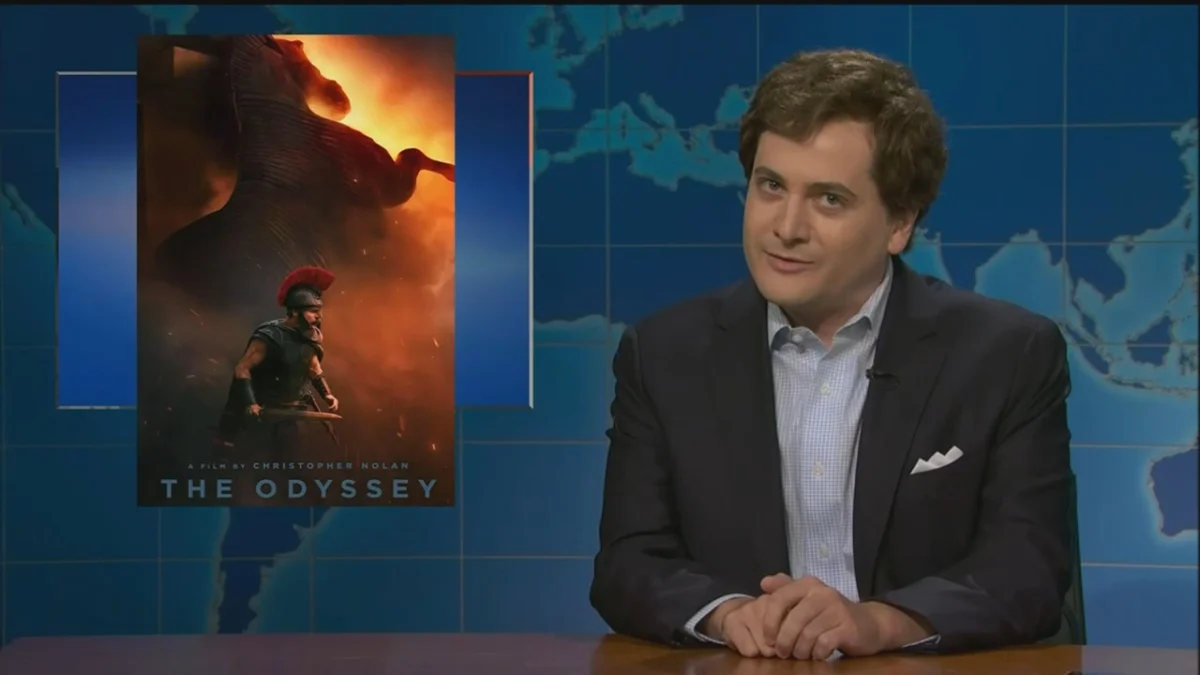
The long-awaited Season 52 premiere of Saturday Night Live (SNL) wasted no time in re-establishing its satirical dominance, leaning heavily into its most reliable comedic weapon: the “Weekend Update” desk. Among the highlights of the season-opening broadcast was the return of cast member Jeremy Culhane, who brought back his now-signature impression of controversial conservative commentator Tucker Carlson.
In a segment that blurred the lines between political punditry and pop-culture commentary, Culhane’s Carlson took a bewildered, pseudo-intellectual tour through the biggest cinematic releases of the summer. The appearance marked the third time Culhane has donned the character’s signature bewildered expression and staccato delivery, cementing the impression as a staple of the show’s current political satire rotation.
The Chronology of a Viral Desk Piece
The segment began with a standard “Weekend Update” introduction from co-anchor Colin Jost, who invited the “pundit” to share his perspective on the state of modern Hollywood. What followed was a rapid-fire series of critiques that mirrored the real-life Carlson’s rhetorical style—characterized by high-pitched incredulity and the weaponization of cultural grievances.
The Breakdown of Summer Cinema
Culhane’s Carlson began his monologue by addressing the technical specs of modern film exhibition. Taking aim at the IMAX 70mm format, he remarked, “The Hollywood cabal shoots its filth with millimeters—or as I like to call it, the gay inch.” He then pivoted to a film he labeled The Odyssey, using it as a springboard for a bizarre cultural jab: “It’s so nice to see Greek people do something other than make women feel uncomfortable.”
The segment quickly moved to the year’s most dominant franchise, Spider-Man. Culhane’s character insisted on referring to the film as Spider-Man: Brand New Gender. Despite Colin Jost’s attempts to correct the title, the character doubled down, launching into an impromptu, derisive theme song: “Spider-They, Spider-Them, uses whatever bathroom it feels like.”
The absurdity continued as the character tackled the private lives of celebrities. Upon bringing up the marriage of the film’s leads, he expressed performative outrage that the female lead—Zendaya—did not adopt her partner’s surname. This led to a rambling monologue about the “erasure” of naming conventions: “Sorry kids, you don’t get two names anymore. You only get one name, like a dog. That’s the rule. That’s the goal now.”
From Genre Films to Political Betrayal
The segment concluded with a trifecta of increasingly raunchy and chaotic takes. Discussing a film titled Obsession, the character framed it as a critique of modern romance, claiming the “left” views heterosexual attraction as a horror trope. He then compared an animated film, Minions and Monsters, to “Trump’s cabinet,” before dryly announcing, “That’s right. I’ve turned on Trump. I’m so brave.” The segment ended on a predictably crude note with a suggestive riff on the Toy Story franchise, focusing on the character Woody.
Supporting Data: The Evolution of a Character
Jeremy Culhane first debuted his Tucker Carlson impression during the show’s 51st season. At the time, the reception was immediate; social media platforms, particularly X (formerly Twitter) and TikTok, saw clips of the segment go viral within hours of the broadcast.
According to metrics provided by Variety and internal NBC analytics, the Season 51 debut of the character was one of the most-watched digital clips of the year for SNL. By the time of this third appearance, the character has become a reliable “hit” for the show’s production team.
The strategy of using “Weekend Update” to host fictionalized political figures is a storied tradition for Saturday Night Live. However, Culhane’s portrayal is unique in its focus on the cadence of the subject rather than just the policy positions. By mimicking the specific rhetorical patterns—the long pauses, the questioning of basic definitions, and the sudden shifts into conspiracy-tinged outrage—Culhane provides a meta-commentary on the nature of cable news punditry in the 21st century.
Official Responses and Public Reception
While the real-world Tucker Carlson has not issued a formal statement regarding the parody, the segment has sparked a broader discourse regarding the role of satire in an increasingly polarized media landscape. Critics of the sketch have argued that SNL relies too heavily on “easy targets” in the conservative media sphere, while supporters maintain that the show is simply reflecting the absurdity of the current political discourse back at its architects.
Television critics have noted that Culhane’s performance is notable for its restraint. Unlike some of the show’s more caricatured political impressions, Culhane avoids prosthetics and heavy makeup, relying almost entirely on vocal affectation and physical mannerisms. This “low-fi” approach to satire has resonated with audiences who find overly theatrical impressions distracting.
Implications: The Future of SNL’s Political Satire
The success of the “Tucker Carlson” segment signals a continued shift in how Saturday Night Live handles political figures in its 52nd season. With the show facing increasing competition from social media creators who can produce satirical content in real-time, SNL has had to double down on its high-production-value “Weekend Update” segments to stay relevant.
The Pundit-as-Performer
The implications for future seasons are clear: the show is moving toward a model where “news analysis” segments act as a release valve for the week’s most chaotic political headlines. By filtering the “cultural war” through the lens of a character like Carlson, the writers can bypass the need for nuanced political debate, instead focusing on the inherent comedy of the language used by modern pundits.
Furthermore, the integration of pop-culture commentary (such as the critiques of Spider-Man and Toy Story) into a political parody allows the show to bridge the gap between two disparate demographics: the news-obsessed political junkie and the casual pop-culture consumer. This hybrid approach ensures that the “Weekend Update” segment remains the most shareable portion of the show, which is vital in an era where the “clip-ability” of a program often determines its cultural footprint.
Challenges for the Writers’ Room
However, the reliance on this format is not without its risks. The writers face the constant challenge of “punching up” while remaining funny. As the cultural landscape shifts, the parody of specific political figures can quickly become stale or repetitive. Culhane’s challenge, as the show progresses into its 52nd season, will be to evolve the character—finding new ways to make the familiar cadence feel fresh and surprising.
Ultimately, the return of Tucker Carlson to the SNL desk is a testament to the enduring power of the impression. Whether it is viewed as a biting critique of media manipulation or simply a funny bit about the absurdity of film discourse, the segment highlights the show’s ability to capitalize on the public’s obsession with its own media figures. As Saturday Night Live continues its run, the “Weekend Update” desk will undoubtedly remain the primary battlefield for this kind of televised satire, with Culhane’s performance serving as a blueprint for how to balance accuracy with absolute, unhinged comedic escalation.
As viewers look ahead to the remainder of Season 52, one thing remains certain: the pundits, the politicians, and the cultural critics are all being watched, and they are all, eventually, going to find themselves sitting at the desk, being forced to explain their own contradictions to a live studio audience. For Jeremy Culhane, the work has only just begun.
 Laily UPN
  Layla Zulfa