
 By Ali Ikhwan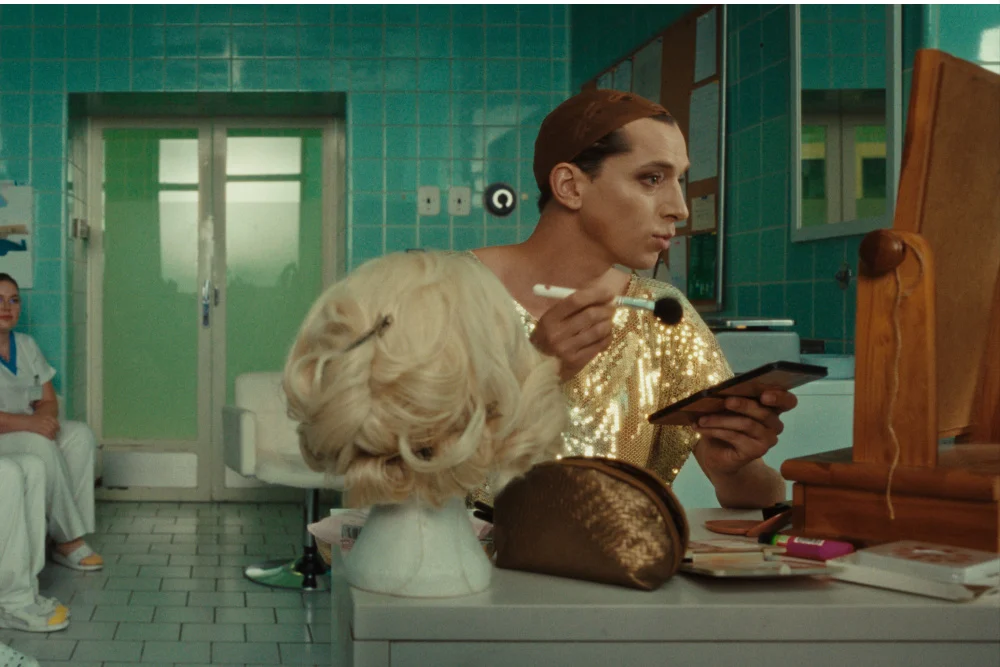
The Karlovy Vary International Film Festival, a prestigious bastion of European arthouse cinema, is rarely the venue for the "middlebrow." Yet, it is here that young Czech director Šimon Holý has chosen to debut his fourth feature, Chica Checa. With a narrative tapestry woven from threads that usually scream for high-octane drama—the sale of a generational family home, a son’s fraught coming-out, and the introduction of drag performance to a provincial village—Holý seems committed to a paradoxical mission: he is actively cooling down the temperature.
Rather than leaning into the inherent friction of these social milestones, Chica Checa opts for a safe, frictionless, and ultimately "pleasant" comedy-drama. It is a film that operates on the bedrock assumption that no matter the cultural divide or emotional rupture, everything will be perfectly fine by the closing credits.
The Anatomy of the Narrative: A Chronology of Softened Edges
The story centers on Zdena (Pavla Tomicová), a middle-aged widow living in a sprawling, inherited house in a quiet Czech village. Her daily life is largely confined to the antiseptic hallways of a local hospital, where she tends to her ailing mother.
The film’s early scenes attempt to establish Zdena’s social isolation—a narrative choice that is immediately undermined by the film’s own internal logic. We are told she is a recluse, yet the film opens with her dancing at a public event and later features her attending a bustling house party. These inconsistencies act as the first signs of a larger, systemic "will-this-do" approach to the film’s construction.
The central catalyst occurs when an affluent city dweller expresses interest in purchasing Zdena’s family home. Simultaneously, her adult son, Lukáš (Jan Cina), returns from his life in France for a visit. The inevitable collision arrives during a mundane evening of television viewing: Zdena drops a casual homophobic slur, triggering Lukáš to come out as gay and, furthermore, reveal his life as a drag performer.
What follows is a textbook "coming-out" sequence, complete with the requisite tearful mother and the shocked silence of the provincial household. However, the film’s commitment to an aggressively positive resolution ensures that by the following morning, the discord has all but vanished. The characters wake up with a clean slate, a narrative maneuver that prioritizes the film’s desire for unearned harmony over the messy, complex reality of familial reconciliation.
Formal Shortcomings: The "Educational Video" Aesthetic
The critique of Chica Checa is not merely one of tone, but of execution. Formally, the film suffers from a lack of visual cohesion. The costume design leans into a garish, television-grade aesthetic that lacks the texture one expects from a feature-length project. The cinematography, meanwhile, is plagued by the inexplicable and jarring use of wide-angle lenses in moments that demand intimacy, creating a sense of distance between the viewer and the emotional core of the scene.
More damaging is the script’s reliance on "contrived conflict." When the film decides it is time to address societal issues—such as the stigma surrounding drag or the clash between rural conservatism and urban progressivism—it does so with a heavy-handedness that borders on the didactic. In these moments, Chica Checa ceases to be a narrative film and instead resembles an instructional video, lecturing the audience on the virtues of tolerance through wooden dialogue and unnatural staging.
Supporting Data and Tonal Dissonance
A significant portion of the film’s humor—or its attempt at humor—is derived from Zdena’s sudden, heroic efforts to "come out" on behalf of her son to her acquaintances. While the film clearly views these as moments of growth, they underscore a deeper, more problematic naïveté.
The film operates on the assumption that a mother’s love is a panacea for all societal intolerance. It suggests that a quick, witty retort from a neighbor is all that stands between a bigoted world and a progressive one. This approach effectively flattens the reality of homophobia, reducing a deeply ingrained systemic issue to a series of mild, interpersonal misunderstandings that can be solved with a smile and a shrug.
The tonal struggle is further exemplified by the performances. Pavla Tomicová, tasked with embodying the film’s relentless optimism, delivers a performance of wide-eyed, mannered meekness. Her Zdena is a caricature of motherly benevolence, bordering on the artificial. In contrast, Jan Cina brings a grounding, naturalistic sensibility to the role of Lukáš. The friction between Tomicová’s hyper-earnest performance and Cina’s grounded, high-stakes portrayal creates a disjointed experience for the audience. The two actors appear to be in different movies: one is in a light, saccharine fable, and the other is navigating a modern, complex reality.
The Implications of "Positive Representation"
The most significant point of contention regarding Chica Checa is its strategy of "relentless positivity." In the current cinematic landscape, there is a strong argument to be made for positive representation—stories that normalize LGBTQ+ identities for older, potentially skeptical generations.
However, there is a razor-thin line between constructive representation and the glib erasure of the struggle required to reach that point. By smoothing over every crack and ensuring that no conflict lasts longer than a commercial break, the film risks trivializing the experiences it seeks to champion. If the film’s message is that "love conquers all," it fails to account for what happens when that love meets an obstacle that isn’t easily charmed by a "nice" personality.
The film’s refusal to engage with the reality of the characters’ challenges renders the eventual "happy ending" hollow. It is a cinematic "confection" that lacks the requisite sweetness to be satisfying, and the structural integrity to be taken seriously as a piece of social commentary.
Conclusion: A Lost Opportunity
Chica Checa sits in an uncomfortable middle ground. It is too clumsy to be a successful arthouse piece, yet too uneven to function as a genuine crowd-pleaser. While the intentions behind the project—promoting understanding and familial acceptance—are undeniably noble, the execution lacks the nuance required to turn those themes into compelling cinema.
The "will-this-do" filmmaking, characterized by erratic lensing, inconsistent character history, and a reluctance to dwell in the uncomfortable, leaves the audience with little to hold onto. For a film that deals with the monumental task of bridging generations, Chica Checa feels remarkably small. It is a reminder that in cinema, as in life, harmony that is manufactured without acknowledging the underlying dissonance often rings false.
Whether the film will find a wider audience beyond the festival circuit remains to be seen. However, as it stands, Chica Checa serves as a case study in how the pursuit of pure, unadulterated "niceness" can inadvertently dilute the very stories that need the most grit, the most honesty, and the most courage to tell. In its attempt to lower the temperature, Holý’s latest feature unfortunately ends up leaving the audience in the cold.
 Siti Muinah
  Ammar Sabilarrohman
  Layla Zulfa