
 By Ali Ikhwan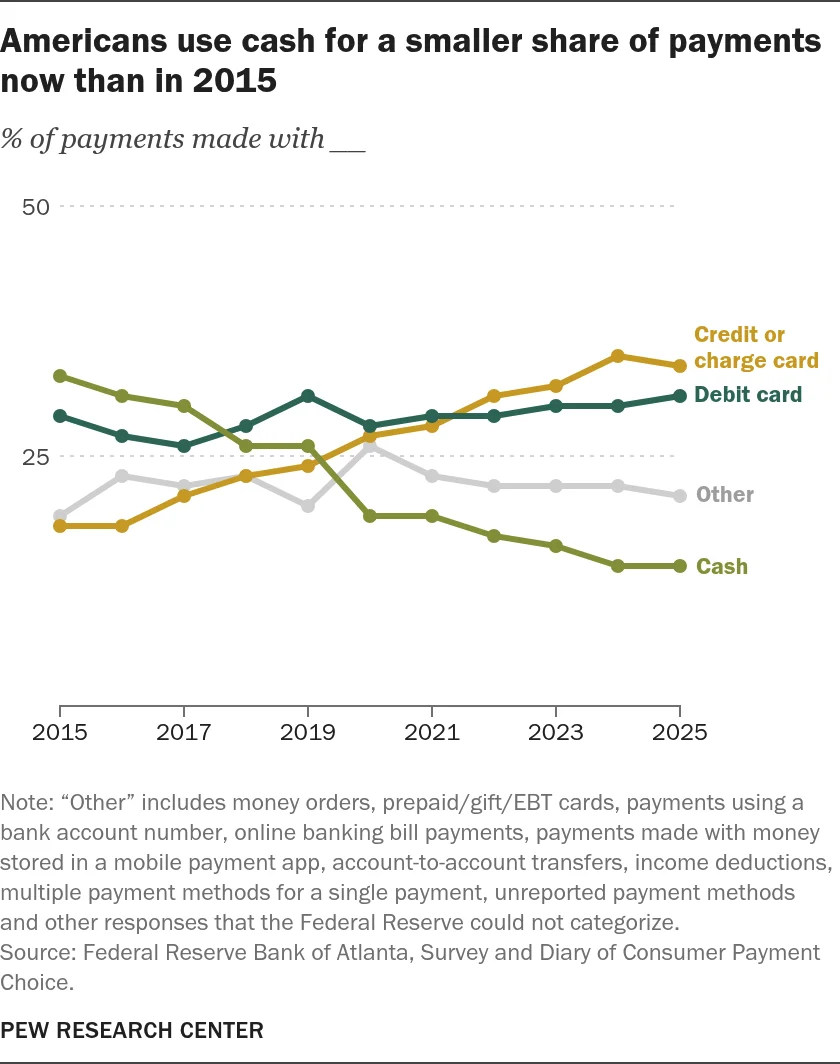
WASHINGTON — For generations, the physical wallet was defined by the crisp crinkle of paper currency and the comforting jangle of metal coins. Today, however, that wallet is increasingly empty—or replaced entirely by digital apps and a sleek array of plastic cards.
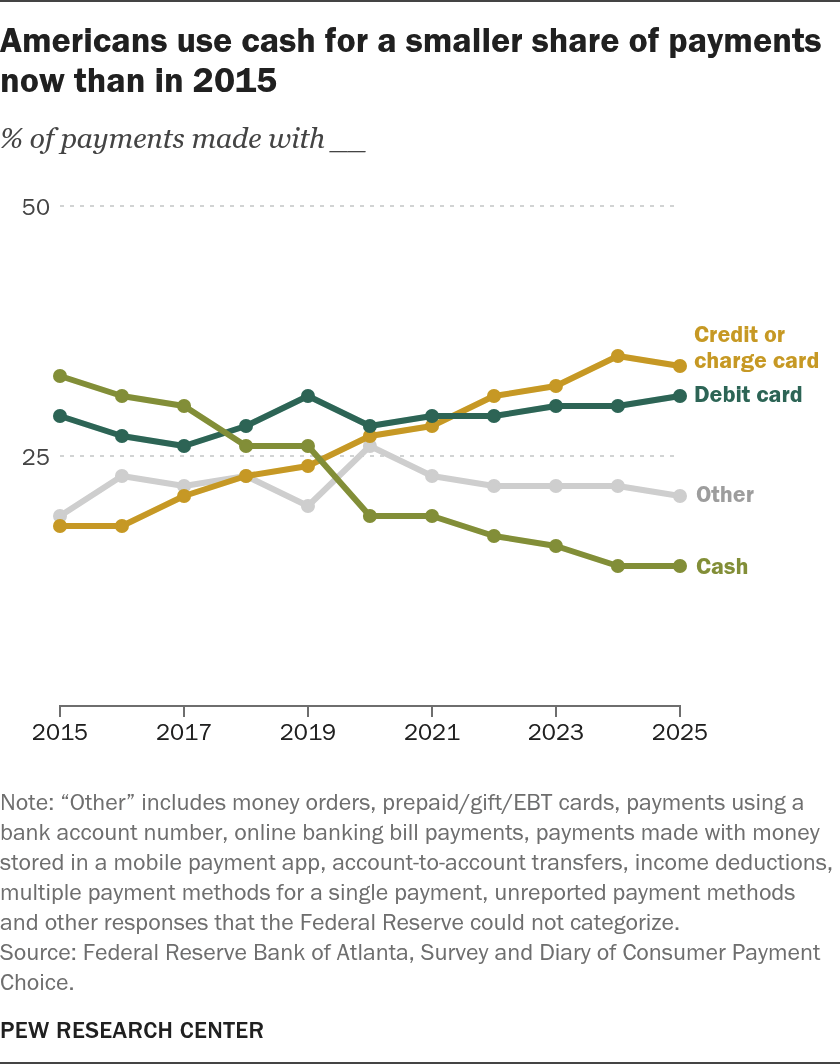
Over the past decade, the American consumer landscape has undergone a silent, structural revolution. According to landmark data from the Pew Research Center and the Federal Reserve Bank of Atlanta, cash usage in the United States has plummeted by half since 2015. As traditional greenbacks recede from daily commerce, credit and debit cards have surged to dominance, fundamentally altering how everyday transactions are conducted, how merchants operate, and how economists view consumer financial health.
Main Facts: The Great Cash Retreat
The numbers paint a stark picture of a society pivoting rapidly toward a cashless existence. Since 2015, the share of Americans who report using cash for all or almost all of their purchases in a typical week has been cut in half, tumbling from 24% to 12%.
More remarkably, a striking 42% of Americans now state that they do not use cash for any purchases during a typical week, a dramatic escalation from the 24% who reported the same a decade ago.
While Americans are carrying less paper, their reliance on electronic payment methods has soared. Credit cards, once secondary players for small everyday purchases, have captured the top spot in consumer preference. In 2025, credit cards accounted for 34% of all payments, closely followed by debit cards at 31%. Together, plastic cards now command nearly two-thirds of all consumer transactions in the United States.
Meanwhile, cash has slumped to just 14% of all payments. Yet, a fascinating behavioral paradox persists: while millions of Americans rarely or never use cash, many still keep physical bills tucked away in their pockets out of habit, emergency preparedness, or mistrust of digital infrastructure.
Chronology of a Cashless Decade: A Timeline of Shift
To understand how cash lost its crown, it is helpful to look back at the steady, methodical erosion of physical currency over the last ten years, tracked meticulously by the Federal Reserve Bank of Atlanta’s Survey and Diary of Consumer Payment Choice.
- 2015 — The Reign of Cash: At the midpoint of the last decade, cash was undisputed king. It accounted for a full third (33%) of all consumer payments tracked by the Fed. Debit cards followed closely at 29%, while credit cards lagged behind at 18%. Combined, all other methods (checks, mobile apps, online banking) made up the remaining 19%.
- 2018 — The Tipping Point for Debit: A structural shift occurred in 2018 when debit cards officially surpassed cash for the first time, capturing 28% of payments compared to cash’s 26%. Credit cards steadily climbed to 23%.
- 2020 — The Pandemic Catalyst: The global COVID-19 pandemic accelerated digital transformation overnight. Fearing viral transmission via physical objects and propelled by a massive surge in online shopping and contactless delivery, cash usage cratered from 26% to 19% in a single year. Credit cards jumped to 27%, nearly matching debit cards (28%).
- 2022 — Credit Takes the Crown: For the first time in modern economic tracking, credit cards overtook debit cards as the single most frequently used payment method in America, claiming 31% of transactions compared to debit’s 29% and cash’s anemic 17%.
- 2025 — The Modern Landscape: Credit cards solidified their lead at 34%, with debit cards steady at 31%. Cash flatlined at a historic low of 14%.
Supporting Data: Transaction Sizes and Consumer Preferences
The Federal Reserve’s granular diary data reveals that the payment method a consumer chooses is heavily dictated by the nature and size of the transaction.
Transaction Values by Payment Type
- Prepaid, Gift, and EBT Cards: These are used for the smallest average purchases, coming in at $35 in 2025.
- Cash: The average value of a cash purchase sits at $58, indicating that consumers still reserve physical bills for moderate, everyday convenience purchases like fast food, parking, or convenience store runs.
- Debit Cards: Averaging $74 per transaction, debit cards bridge the gap between everyday retail shopping and larger discretionary buys.
- Credit Cards: Averaging $80 per transaction, credit cards dominate higher-value retail, travel, and dining purchases, buoyed by reward incentives and consumer protection policies.
- Mobile Apps: Mobile payment apps (such as Venmo, PayPal, or digital wallets) fall squarely in the middle, with an average transaction value of $98.
- Checks and Online Banking: Reserved for major financial obligations, checks, account-to-account transfers, and online banking bill payments average between $400 and $700.
What Consumers Actually Want
When asked how they prefer to pay, American consumer preferences lean overwhelmingly toward plastic, though nuances remain depending on the venue:
- In-Person Purchases: 78% of Americans prefer using credit or debit cards, while only 16% prefer cash. Just a decade ago, cash preference for in-person transactions stood at 23%.
- Online Purchases: An overwhelming 92% of consumers prefer credit or debit cards for e-commerce, rendering cash and checks virtually obsolete online (<1%).
- Bill Payments: This category remains the most divided. While 47% prefer credit or debit cards for bills, 40% prefer online banking or direct account transfers. Traditional checks and cash still hold a stubborn 5% share each for bill settlement.
An interesting psychological insight emerges from the data: when people pay with credit or debit cards, it is almost always by choice—about 90% of card users genuinely want to use plastic. Conversely, 70% of cash payments are made by people who would actually prefer to use another method (primarily credit or debit cards), but are forced to use cash due to merchant minimums, cash-only policies, or technological barriers.
Official Responses and Insights from Researchers
Institutions like the Pew Research Center and the Federal Reserve stress that this shift is not merely a technological novelty, but a profound evolution in consumer habits with wide-reaching consequences.
"Pew Research Center does research to inform the public, journalists, and decision-makers," notes the center in its methodological briefs. "This research builds on our past work studying economic issues and the accelerating transition toward a cashless economy."
Financial regulators note that while the infrastructure for digital payments has scaled remarkably well—absorbing billions of contactless, tap-to-pay, and app-based transactions daily—the rapid phase-out of physical cash introduces systemic challenges that policy analysts cannot ignore.
Implications: A Cashless Future and Its Discontents
The transition from a cash-centric society to a credit- and digital-first economy carries profound economic, social, and policy implications.
1. Financial Inclusion and the "Unbanked"
The most acute concern surrounding the decline of cash is the exclusion of vulnerable populations. Millions of Americans—often referred to as "unbanked" or "underbanked"—lack access to traditional checking accounts, credit histories, or stable internet connections. As more brick-and-mortar retailers, restaurants, and municipal services go entirely "cashless," low-income individuals, the elderly, and transient populations face systemic barriers to basic goods and services.
2. Privacy vs. Convenience
Cash offers complete transactional anonymity. Every swipe, tap, and mobile transfer, however, leaves a digital footprint. The migration to credit and debit cards feeds vast data-brokerage and financial-surveillance ecosystems, where consumer spending habits, locations, and preferences are tracked, analyzed, and monetized.
3. Consumer Debt and Behavioral Spending
Behavioral economists have long noted the "pain of paying." Handing over physical cash triggers psychological mechanisms that make consumers acutely aware of money leaving their possession. Swiping a piece of plastic or tapping a smartphone bypasses this psychological friction, which studies show can lead to higher average spending and, potentially, rising household credit card debt.
4. Systemic Vulnerability
A digital economy is entirely dependent on electricity, telecommunications, and cybersecurity infrastructure. While cash remains resilient during power outages, natural disasters, or technical glitches, a fully cashless society leaves citizens and businesses exceptionally vulnerable to network outages, cyberattacks, and systemic IT failures.
Conclusion
The decade spanning from 2015 to 2025 has cemented a new financial reality in the United States. Cash is no longer king; it has been quietly dethroned by the convenience of credit and the ubiquity of digital finance. While the benefits in terms of speed, security against physical theft, and transactional efficiency are undeniable, policymakers, financial institutions, and merchants must grapple with the legacy left behind—ensuring that the march toward total digitization does not leave behind the millions of Americans who still rely on the humble dollar bill.
 Muslim
  Nana Muazin
  Siti Muinah