
 By Iffa Jayyana
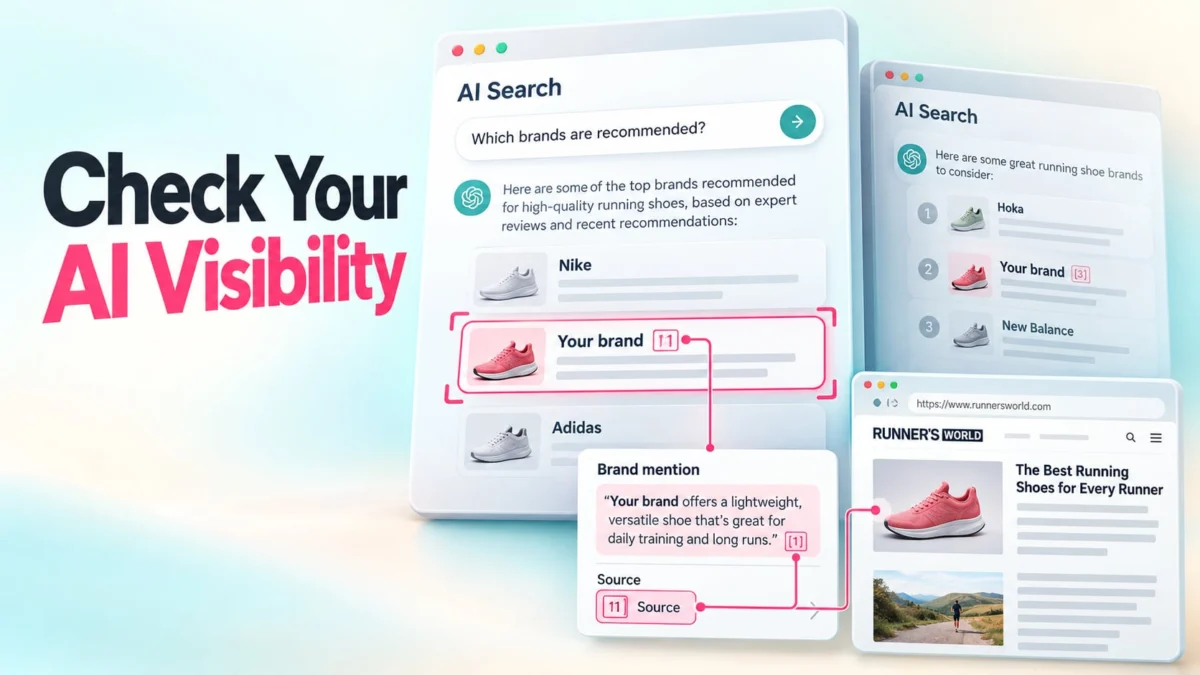
In the rapidly evolving landscape of search, marketers are increasingly pivoting toward Generative Engine Optimization (GEO)—the practice of ensuring a brand appears accurately and prominently in the responses generated by AI-powered search engines like ChatGPT, Perplexity, and Google’s AI Overviews. However, as the industry rushes to embrace these new metrics, a critical transparency gap has emerged.
Many performance reports presented to stakeholders are riddled with "vanity metrics" that sound impressive but lack the structural integrity required to support multi-million dollar marketing decisions. A report showing a surge in "AI mentions" can easily mask significant failures in accuracy, duplicate lead counting, or skewed statistical foundations. If your team is investing in GEO, the reporting standard must be clear: every claim must be supported by evidence that is verifiable, reproducible, and contextually sound.
The Anatomy of an AI Search Audit: Main Facts
When reviewing a performance report, it is easy to be dazzled by headline figures like "40% visibility." But visibility is a hollow metric if the underlying data is tainted by selection bias or algorithmic hallucinations.
The core issue lies in the nature of generative AI. Unlike traditional search, which directs users to a destination, generative engines synthesize information. This creates a risk of "confabulation"—a term defined by NIST as the production of confidently stated but erroneous content. If your report credits your brand for a specific industry category, you must verify if the AI actually said it, if it was accurate, and if the "mention" was a positive endorsement or a factual error.
Chronology of Verification: A Step-by-Step Approach
To determine if a report is actionable, marketing leaders should adopt a rigorous audit framework. This process does not require a deep background in data science, but it does require a commitment to skepticism.
1. Request the "Source of Truth"
Start by choosing a single, high-impact headline claim from your report—for instance, "Brand presence increased by 15%." Ask the author to provide the raw, underlying records. This should include the specific prompts used, the collection dates, the versions of the AI models employed, and the raw output logs. If the author cannot provide a path to reproduce the calculation, the claim must be marked as unverified.
2. Deconstruct the Percentage
The denominator is the most common place where "performance inflation" occurs. If a report claims a 30% mention rate, check how the total was calculated. Did they exclude "no-mention" answers to make your brand look more relevant? Did they omit technical failures (where the AI crashed or timed out) from the sample? A professional report must account for every query attempt, including those that yielded no result or failed to load.
3. Establish a Dated Fact Record
AI models are notorious for being "confidently wrong." Create a "Truth Document" that lists your company’s current offerings, pricing, service areas, and executive leadership. When auditing the AI’s output, compare the AI’s claims against this dated fact record. A claim that was correct six months ago may be "outdated" today, and a claim that describes your consultancy as a service provider is "contradicted" by your actual business model.
Supporting Data: Why Context Matters
The necessity for this level of scrutiny is supported by recent research. A 2025 study from the Tow Center for Digital Journalism analyzed 1,600 queries across eight AI search engines. The results were startling: the tools provided incorrect news identification in more than 60% of cases.
This data serves as a stark reminder: AI search is not a perfect database; it is a probabilistic model. When your report claims "100 leads generated via AI," you must look at the attribution model. Are these leads unique? Are they being double-counted across different referral channels?
Consider this scenario: 12 inquiries come in via AI referrals, and 8 customers mention an AI assistant during the intake process. If 5 customers fall into both categories, the total is 15—not 20. Simple addition without checking for overlap is the primary cause of inflated marketing reports.
Official Responses and Industry Standards
While there is no formal "ISO certification" for GEO reporting yet, the industry is coalescing around a few key principles. Leading practitioners now argue that human-in-the-loop review is mandatory. Even when using automated tools to audit AI performance, those tools are susceptible to "judge bias," where the model favors verbosity or self-congratulatory language.
NIST’s guidelines on AI risk management emphasize that "confidence" and "accuracy" are two separate metrics. Just because an AI sounds confident in its recommendation does not mean it is factually correct. Marketing teams should demand that their reports explicitly separate these variables:
- Supported: Evidence confirms the claim.
- Contradicted: Evidence conflicts with the claim.
- Unsupported: No verifiable evidence found.
- Ambiguous: The wording allows for misleading interpretation.
Implications for Future Strategy
The implication of this audit-heavy approach is profound: it shifts the role of the marketer from a passive recipient of data to an active curator of truth.
If a report cannot pass a basic verification test, it should not be used to justify budget allocations. If a headline claim cannot be backed by a clear, reproducible calculation, it should be treated as anecdotal at best. By demanding this level of transparency, you not only protect your brand from the reputational risks of inaccurate AI-generated information but also force your vendors or internal teams to build more robust, reliable data pipelines.
The "Usability Checklist" for Marketing Leaders
Before accepting your next monthly GEO report, ensure it passes these critical gates:
- Reproducibility: Can a neutral third party run the same prompts and arrive at a similar conclusion?
- Consistency: Are the eligibility rules for counting a "mention" the same as they were in the previous reporting period?
- Transparency: Are technical failures and "no-brand" results explicitly included in the summary statistics?
- Attribution Integrity: Is there a clear audit trail connecting an AI discovery to a unique customer lead?
- Factuality: Has the report been audited against a dated record of your product’s current features and status?
Conclusion: Trust, but Verify
The rise of generative AI search is one of the most significant shifts in the history of digital marketing. It offers unprecedented opportunities for brand discovery, but it also carries the risk of "black box" reporting that obscures reality rather than illuminating it.
Do not be satisfied with reports that simply tell you what you want to hear. Demand the raw data, challenge the methodologies, and insist on evidence that stands up to scrutiny. In the era of AI, the most valuable commodity isn’t just "visibility"—it’s the certainty that the visibility you are paying for is both real and accurate. If you cannot verify the claim, do not build a strategy upon it. By imposing these standards today, you ensure that your marketing organization remains a leader in a digital environment that rewards accuracy over algorithmic noise.
 Siti Muinah
 Asro
 Neng Nana
