
 By Neng Nana
In the hyper-accelerated landscape of 2026, the photography industry is defined by an relentless pursuit of technical perfection. We live in an era dominated by AI-driven autofocus algorithms, staggering high-ISO performance that can turn night into day, and resolutions that push the boundaries of human perception. Yet, amidst this technological arms race, a growing contingent of professional photographers is turning their backs on the latest flagship bodies to embrace an artifact of a bygone digital age: the Leica M9 Monochrom.

Released in 2012, the M9 Monochrom is, by any clinical standard, an obsolete machine. Its LCD screen is dim and low-resolution, its buffer is glacial by modern standards, and its high-ISO performance struggles to keep pace with entry-level smartphones. Despite this, for photographers like street artist Tomer Vaknin, it remains the most vital tool in the kit. The M9 Monochrom is not merely a relic; it is a corrective lens, a device that strips away the digital artifice of the 21st century to return to the raw, unadulterated essence of light and shadow.

The CCD Magic: Why Old Sensors Still Reign Supreme
The cornerstone of the M9 Monochrom’s enduring appeal lies in its heart: the Kodak-manufactured CCD (Charge-Coupled Device) sensor. In the transition from CCD to the now-ubiquitous CMOS sensors, the industry gained significant advantages in power efficiency, readout speed, and dynamic range. However, many purists argue that we sacrificed a specific, tactile quality of light in the process.

The M9 Monochrom’s sensor does not merely record data; it interprets the world with a unique micro-contrast that many describe as "organic." Unlike modern sensors, which can sometimes render images with a clinical, "plastic" sharpness, the M9’s CCD output possesses a mid-tone richness and a "biting" quality that feels grounded, immediate, and profoundly honest. When viewing images captured on this 14-year-old sensor, one does not see the digital noise of a bygone era; one sees a physical impression of light. It captures the world in a way that feels less like a calculation and more like an interpretation—a testament to a time when digital sensors were trying to mimic the soul of film, rather than replace it with computational perfection.

A Chronology of Obsolescence and Rebirth
To understand the resurgence of the M9 Monochrom, one must look at the timeline of its existence:

- 2012: The Bold Launch. Leica releases the M9 Monochrom, the world’s first full-frame digital camera dedicated exclusively to black-and-white photography. It was a radical, niche product that many industry analysts dismissed as a luxury toy.
- 2013–2015: The "Cult" Phase. As the limitations of early digital sensors became apparent, early adopters began to realize that the lack of a color filter array (Bayer filter) resulted in a level of sharpness and luminance resolution that no color camera could replicate.
- 2016–2020: The CMOS Dominance. The industry shifted entirely toward high-resolution CMOS sensors with advanced video features and lightning-fast processing. The M9 Monochrom was largely relegated to the secondary market, viewed as a "collector’s item" rather than a working tool.
- 2021–2026: The "Slow Photography" Movement. As AI photography became standard, a backlash emerged. Photographers began seeking "analog-like" digital experiences. The M9 Monochrom saw a massive spike in demand among professionals looking to escape the "perfection trap" of modern mirrorless systems.
Supporting Data: The Limitations as Features
The "deficiencies" of the M9 Monochrom are precisely what make it a powerful pedagogical tool for the photographer.

- The Absence of Color: By removing color, the camera forces the photographer to focus on geometry, texture, and light. It eliminates the "distraction" of vibrant hues that often save a poorly composed photograph.
- The Slow Buffer: The camera cannot "spray and pray." With a slow write speed, the photographer must commit to the moment. It is a device that mandates patience and deliberation.
- Low-Resolution Screen: Because the rear screen cannot provide a high-fidelity preview, the photographer is liberated from the "chimping" habit—constantly looking at the back of the camera. Instead, the photographer remains engaged with the environment.
These limitations act as a filter. They act as a barrier to entry, weeding out the casual, and forcing the practitioner to develop a more disciplined, intentional eye. When the "safety net" of high-speed shooting and post-processing color grading is removed, the photographer is forced to find the strength of the image in the frame itself.

The Color Paradox: A Radical Act of Vulnerability
For photographers who have built their careers on the vibrancy of color, switching to a monochrome-only body is a radical act of vulnerability. Tomer Vaknin describes the internal conflict: the persistent fear that a scene, if captured in black and white, might lose the "pop" that defines his signature style.

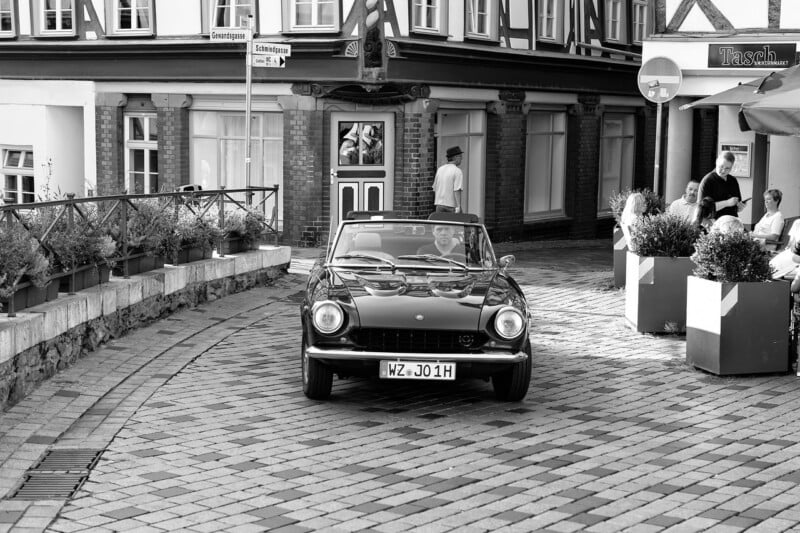
This is the "Color Paradox." We are so conditioned to believe that more data equals better photography that we fear losing the spectrum. Yet, the experience of using the M9 Monochrom consistently proves that by stripping away color, we gain a more profound grasp of composition. The camera functions as a "corrective lens." It teaches the eye to see the architecture of a scene—the way light falls across a cobblestone street, the weight of shadows in a doorway, or the subtle contrast between textures. Once the photographer learns to see in luminance, their color photography often improves, as they begin to treat color as an accent rather than a crutch.

Implications for the Modern Industry
What does the enduring popularity of the M9 Monochrom mean for the future of camera manufacturing?

The trend suggests that the industry is heading toward a bifurcated future. On one side, we have the "Computational Giants"—companies like Sony, Canon, and Nikon, who will continue to push the boundaries of AI, resolution, and speed. On the other side, we have the "Experience-Driven" market. Leica has recognized this, continuing to produce modern iterations of their Monochrom series, but the original M9 holds a special place because it is the "purest" version of this experiment.

The implication is clear: technology is not a linear progression of "better." It is a toolset. As cameras become more capable of doing the work for us—focusing, exposing, and color-grading—the value of a "dumb" tool increases. The M9 Monochrom is valuable precisely because it cannot do the work for you. It requires you to be a photographer in the classical sense.

Conclusion: Chasing the Moment, Not the Megapixel
In the final assessment, the M9 Monochrom is not a competitor to the modern flagship, nor does it attempt to be. It exists in a separate category of creative expression. For the photographer, the choice between an M11-P and an M9 Monochrom is not a choice between a superior and inferior tool; it is a choice between two different ways of seeing the world.

One is a high-performance instrument for documenting the complexities of the modern world with precision. The other is a meditative device, a way to strip back the noise and engage with the fundamental reality of light. As we move deeper into an era of synthetic images and algorithmic perfection, the value of a 14-year-old, "inferior" camera only grows. It reminds us that photography was never about the megapixels. It was always about the person behind the lens, the light in front of them, and the fleeting, singular moment that connects the two.
About the Author: Tomer Vaknin is a street photographer whose work explores the intersection of light, shadow, and human experience. His ongoing project with the Leica M9 Monochrom continues to challenge the conventional wisdom of digital photography. You can view his latest portfolio on his Instagram.
 Laily UPN
  Reynand Wu
  Lina Hope