
 By Azzam Bilal Chamdy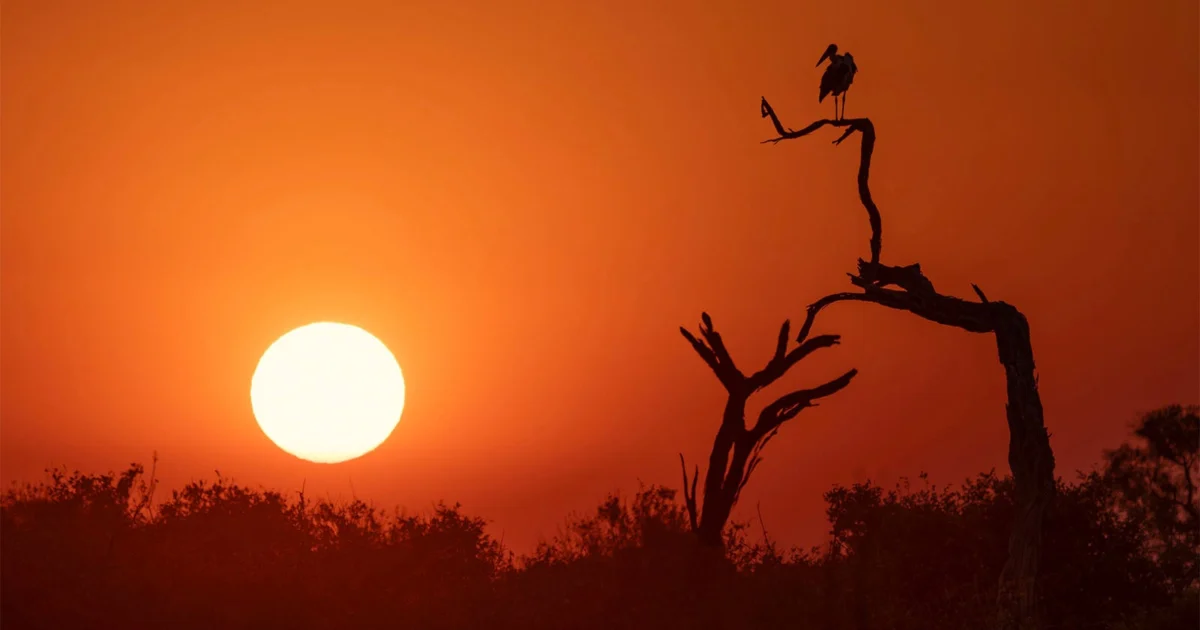
By Johan J. Botha
For thirty-five years, I have watched the landscape of wildlife and bird photography shift beneath our tripods. I have carried heavy gear through damp mornings, transitioned from the unforgiving science of slide film to the expansive flexibility of digital sensors, and now watched the complete automation of modern mirrorless systems.
Yet, as I sit on judging panels for photographic clubs, assess honors for organizations like the Photographic Society of Southern Africa (PSSA) and the Photographic Society of America (PSA), a striking paradox emerges. While the technology in our hands has evolved exponentially, a vast percentage of the imagery entering competitions remains functionally identical to what we captured in the late 1990s.
Today, technical excellence is no longer a badge of honor; it is the baseline. As automated autofocus, high-speed continuous shooting, and advanced sensor technology democratize the craft, the dividing line between an amateur and a master is no longer about capturing a subject. It is about creating an artistic vision.
Main Facts: The Democratization of Technical Perfection
The core reality of contemporary wildlife photography is that the playing field has been permanently leveled.
Modern mirrorless cameras feature high-speed processors capable of complex subject and eye recognition, shutter speeds exceeding 1/8,000 of a second, burst rates of 30 frames per second or more, and dynamic ranges that extract clean details from deep shadows and blazing highlights. Features like pre-capture buffering mean that human reaction time is no longer the primary bottleneck in action photography.
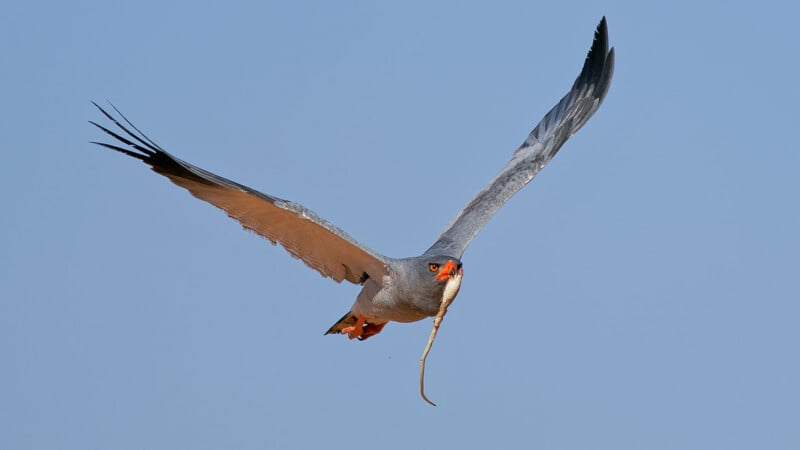
- The Baseline Shift: Tasks that once demanded decades of field craft and immense technical precision—such as photographing a fast-moving bird of prey mid-flight with its catch—can now be executed reliably by a novice equipped with modern gear.
- The Saturation of Competitions: Because technical perfection is easily accessible, salon submissions are flooded with thousands of clean, sharp, perfectly exposed images.
- The Creative Crisis: The proliferation of technical proficiency has exposed a vacuum in artistic originality. When everyone can capture a sharp image, technical sharpness loses its currency as a differentiator.
Chronology: Three Decades of Evolution in the Field
To understand where wildlife photography stands today, we must examine the distinct evolutionary phases that brought us here.
1. The Slide Photography Era (1993–2004)
During my slide-photography years, achieving a club gold medal or salon acceptance required an intimate, highly technical understanding of the exposure triangle. Film speeds were slow—often ISO 50 or 100—meaning good light during early mornings or late afternoons was mandatory.
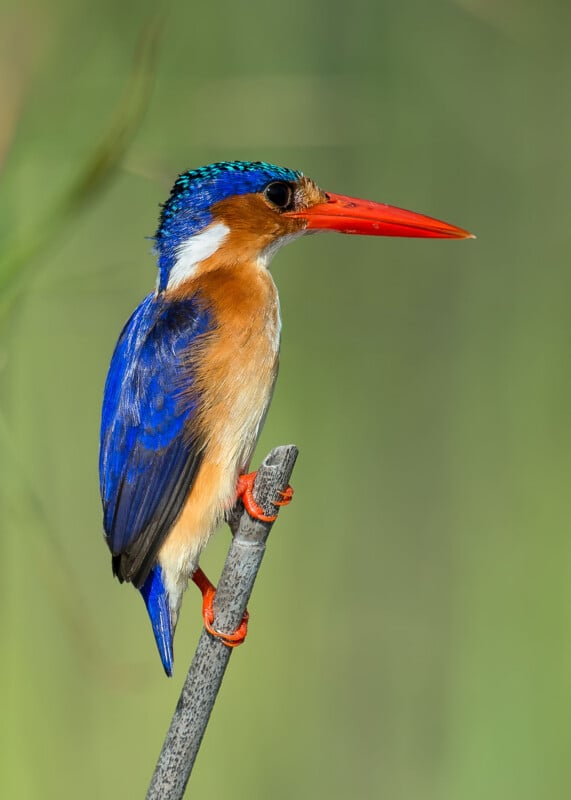
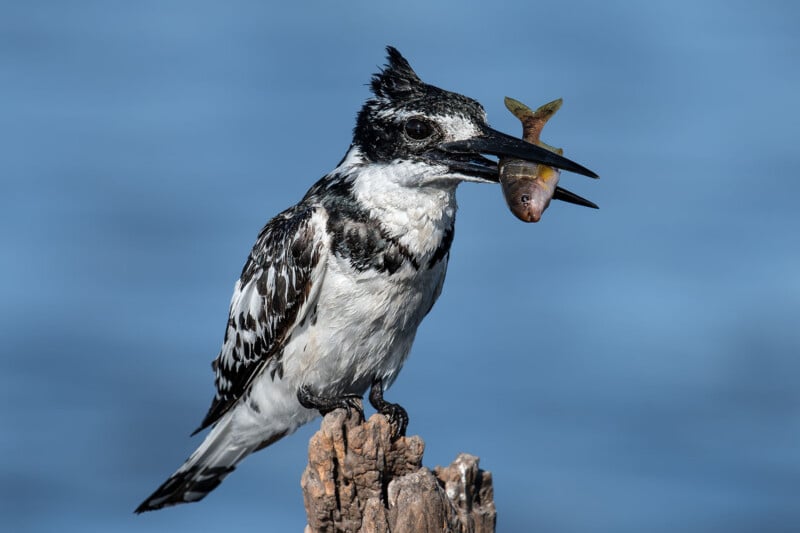
Compositional rules were rigid, typically favoring the rule of thirds, absolute corner-to-corner sharpness, and a visible catchlight in the subject’s eye. The prevailing aesthetic was what South Africans affectionately call a "voëltjie op ’n stokkie" (a bird on a twig) or a placid waterbird. Manual focus mastery and precise shutter-aperture balancing were non-negotiable because mistakes could not be previewed on an LCD screen; you only discovered success days later when the film returned from the lab.
2. The Transition to Digital
The arrival of digital sensors shattered the boundaries of traditional capture. Early digital cameras introduced basic autofocus systems, making birds-in-flight photography more accessible. As technology matured, larger sensors, improved low-light performance, and manageable file sizes allowed photographers to shoot at ISO settings previously thought impossible.
Shooting at ISO 12,800 was light-years ahead of slide film. Cropping images heavily in post-processing became a viable strategy without catastrophic loss of detail, fundamentally altering how action sequences were framed.
3. The Mirrorless Revolution (Present Day)
The true equalizer arrived with the elimination of the mechanical mirror. Modern mirrorless bodies transformed cameras into computational powerhouses. With real-time animal eye tracking, deep-learning subject recognition, and silent electronic shutters, the camera manages the physics of capture while the photographer merely steers the frame. Once a modern mirrorless system is properly configured, the mechanical hurdle of taking the photo is largely solved.
Supporting Data: The Changing Standards of Competition
The shift in camera technology has directly impacted how photographic competitions are structured and evaluated.
In standard club and salon circuits, entries often operate on a quota system where a predetermined percentage (typically 20% to 25%) of submitted images receive acceptances. In these environments, an adequate image that meets traditional slide-era criteria can still pass.
However, elite international competitions—such as the prestigious Natural History Museum Wildlife Photographer of the Year—operate under entirely different mechanics. There are no acceptance quotas to fill. Tens of thousands of images compete for a handful of spots, and the judging standard is absolute.
| Era | Primary Technical Challenge | Dominant Aesthetic | Key Differentiator |
|---|---|---|---|
| Slide Era | Manual focus, strict exposure math, slow film (ISO 50) | Tightly cropped "bird on a stick," clean background | Technical execution and access to good light |
| Digital Era | Managing digital noise, basic AF tracking, early cropping | Action sequences, broader ISO usage | Equipment capability and endurance |
| Mirrorless Era | Managing complex menus, resisting over-reliance on automation | Environmental storytelling, mood, abstract motion | Originality, impact, and unique artistic vision |
In elite contests, technical perfection is assumed. To secure recognition, entries must bypass standard tropes and deliver profound visual impact.
Official Responses and Industry Observations: The "Slide-Era Mindset"
Why, then, do we continue to see so many contemporary portfolios dominated by conventions of the past?
As a judge and portfolio assessor, I have observed that many photographers become trapped in what can be termed the "slide criteria" phase. They learn their craft in photographic clubs, calibrate their portfolios to win local awards, and draw inspiration from traditional wildlife coffee-table books.
Several systemic factors perpetuate this loop:
- Club-Level Validation: Photographers are frequently rewarded at the local club level for producing conventional, tightly cropped, perfectly sharp portraits. Local judges—many of whom may not be specialized wildlife photographers—often evaluate images based on generalized aesthetic checklists rather than progressive field standards.
- Menu Intimidation: Modern mirrorless cameras feature deeply complex operating systems. Many users find the customization menus overwhelming, choosing to rely on default automation rather than experimenting with manual overrides to create artistic interpretations.
- Fear of Abstraction: Venturing outside conventional bounds—such as employing intentional camera movement (ICM), high-key black-and-white processing, or wide environmental framing—carries a high risk of rejection in traditional scoring systems.
Implications: How to Create, Not Just Capture
The modern wildlife photographer faces a clear choice: adapt to the post-technical landscape or risk obsolescence through repetition.
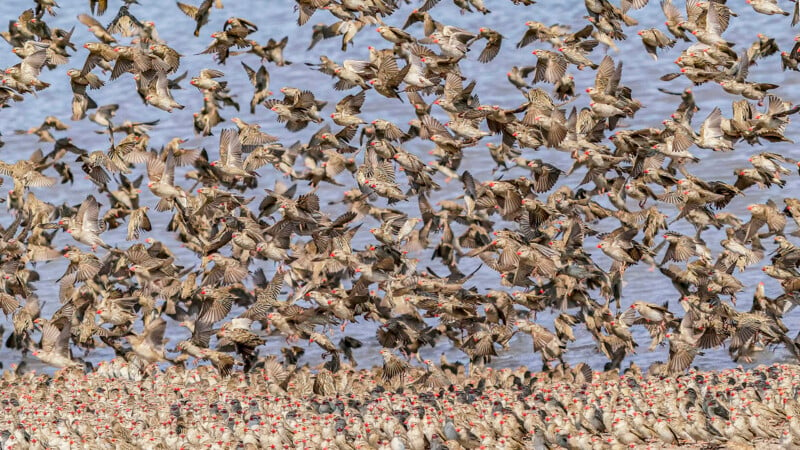
When equipped with gear that can freeze a red-billed quelea mid-landing at 1/8000s or track a goshawk across an open sky, the act of capturing no longer requires exceptional artistry. The path forward demands that we treat the camera not merely as a recording device, but as an artistic brush.
1. Give the Subject Space
The instinct to crop tightly is often a symptom of an inability to get close enough to a subject. However, masterclass imagery frequently moves in the opposite direction. By pulling back and showing the environment, the photographer provides context, atmosphere, and scale.
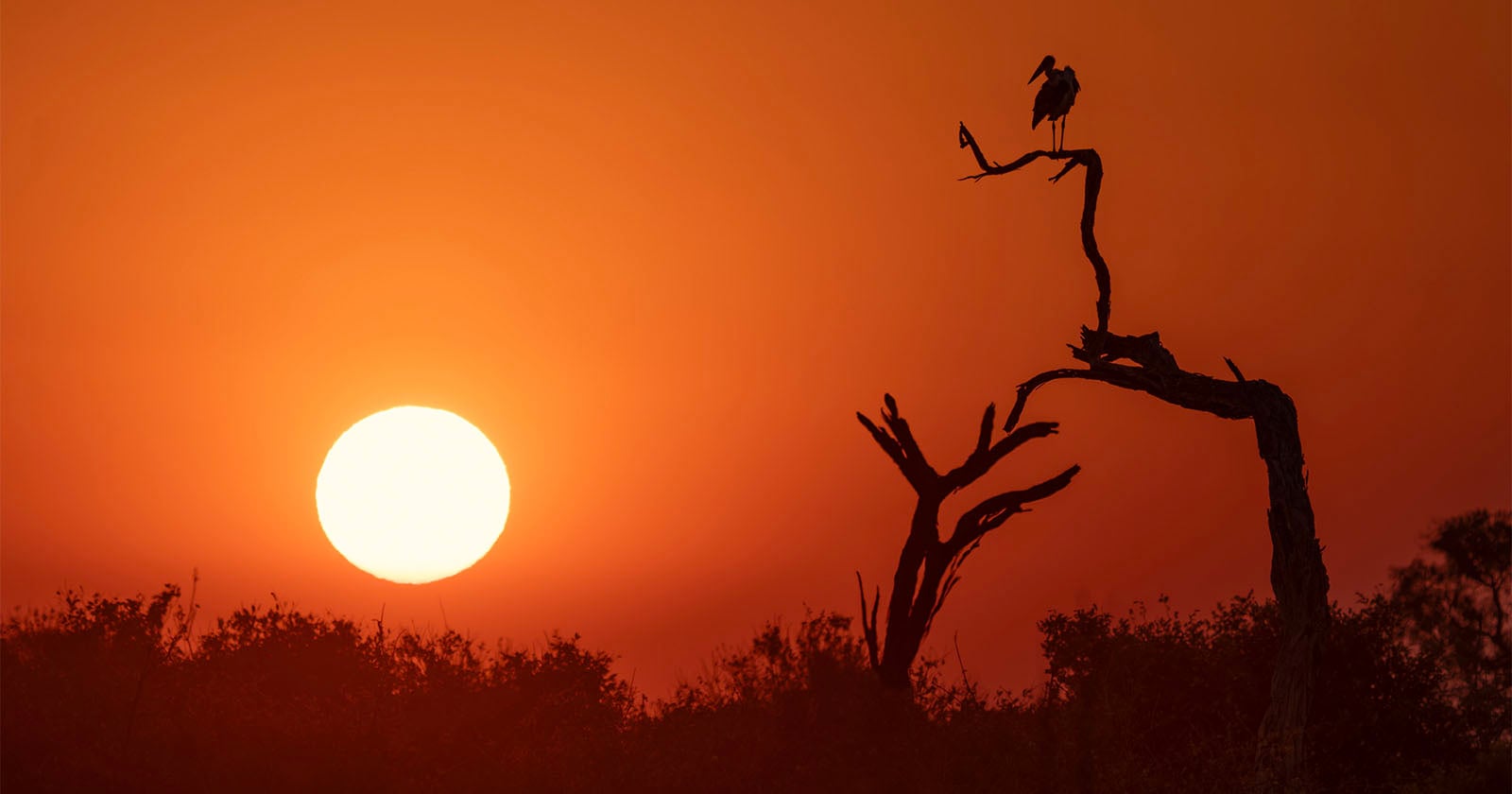
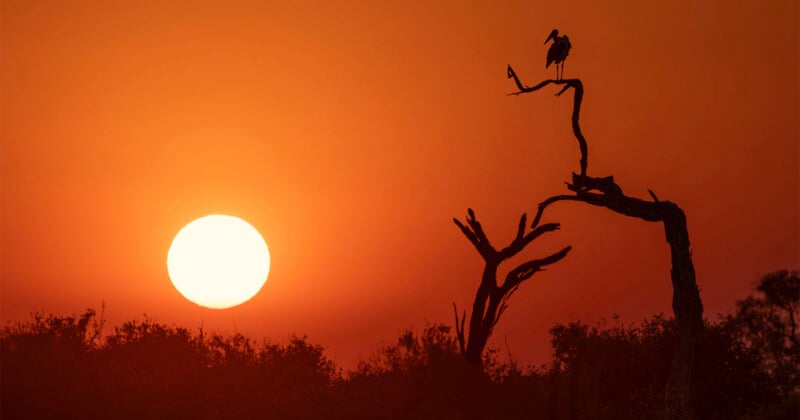
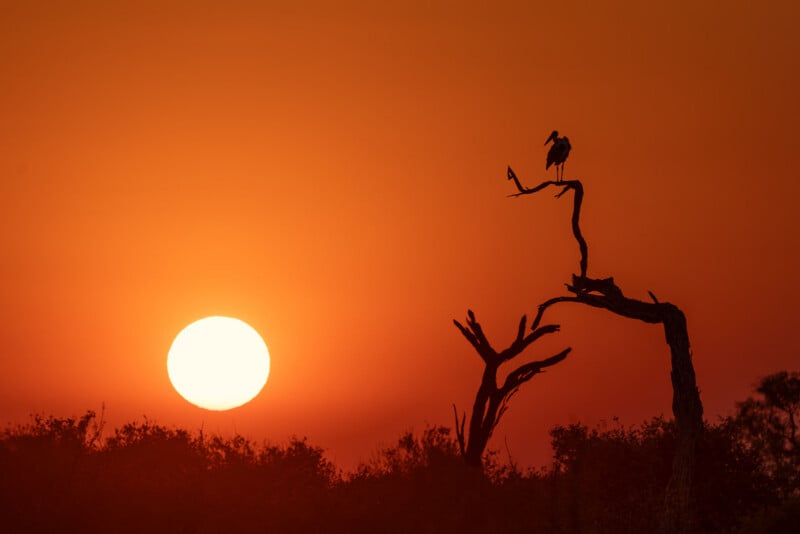
Consider a Marabou stork perched on a dead tree against a deep, glowing red sunset. The bird occupies only a fraction of the frame, yet without its presence, the environmental story of day fading into night is lost. The environment elevates the frame from an identification photo to a narrative painting.
2. Experiment with Shutter Speed and Light
Technical mastery should serve creative expression rather than clinical precision.
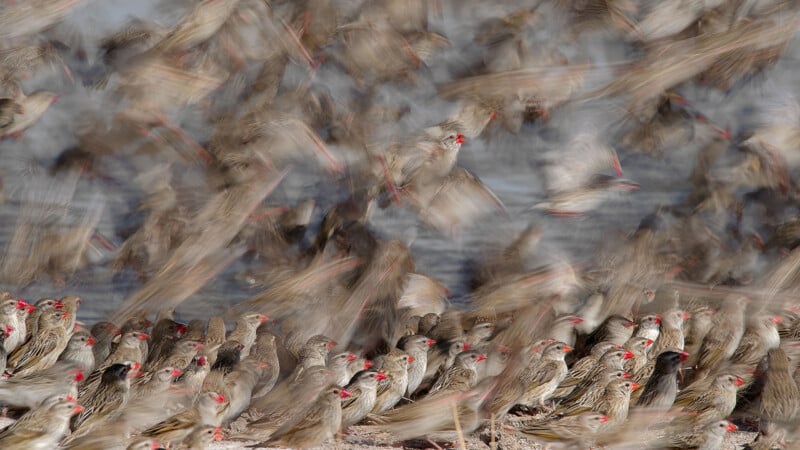
- Intentional Blur: Rather than freezing every feather of a landing flock of queleas at high shutter speeds, slowing the exposure down to 1/20s can blur moving elements while keeping grounded subjects sharp, conveying kinetic energy.
- High-Key Processing: Exploring high-key black-and-white conversions can strip away distracting color palettes to focus entirely on texture and form.
- Atmospheric Lighting: Embracing backlighting, dust, and deep shadows—such as underexposing a running ostrich kicking up dust in the final light of day—yields far more dramatic and emotional resonance than flat, evenly lit morning sun.
3. Redefine Impact
Elite wildlife photography requires a new password for entry: Impact.
Whether capturing a secretary bird throwing a lizard into the air before a swallow, or isolating ostrich chicks resting beneath the protective shade of a parent’s wings with a deliberate, artistic crop, the goal must be to show something fresh.
Technology has made the world of wildlife visible to everyone. The ultimate responsibility of the modern photographer is to make us feel it differently.
 Basiran
  Ali Ikhwan
  Nila Kartika Wati