
 By Reynand Wu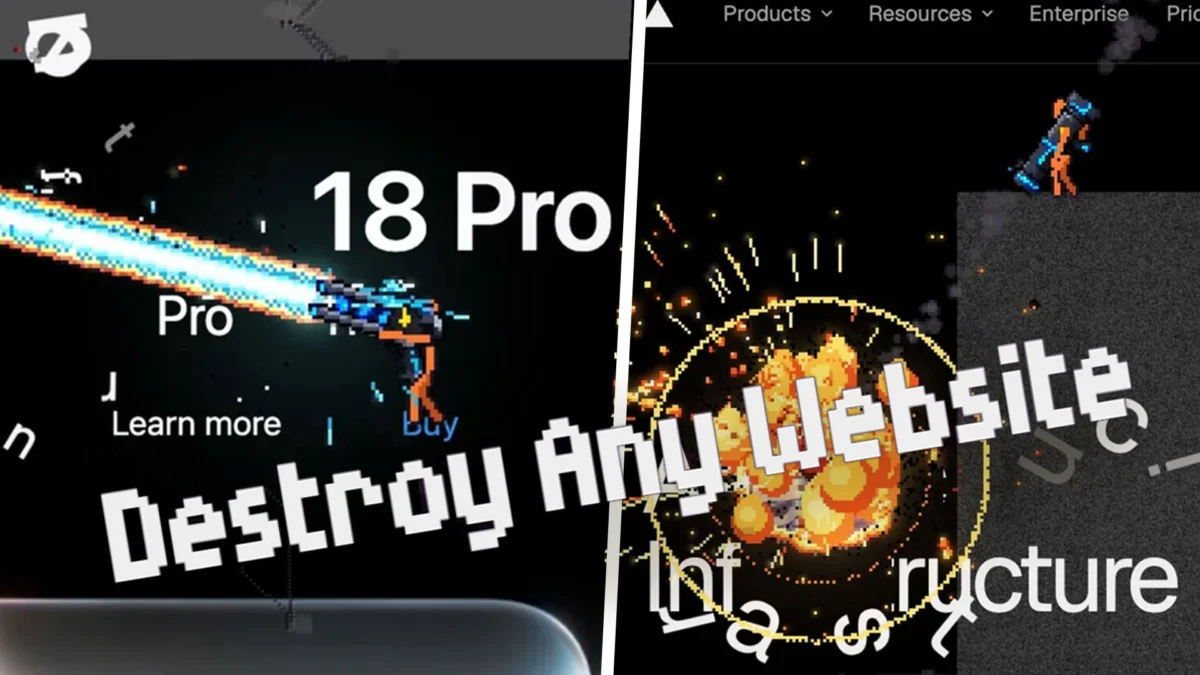
We have all been there: staring at a bloated, poorly designed website, frustrated by intrusive pop-up banners, auto-playing videos that refuse to mute, and endless blocks of text that seem to serve no purpose other than to hoard screen real estate. In moments of digital irritation, the desire to simply "blow it all up" is a universal sentiment.
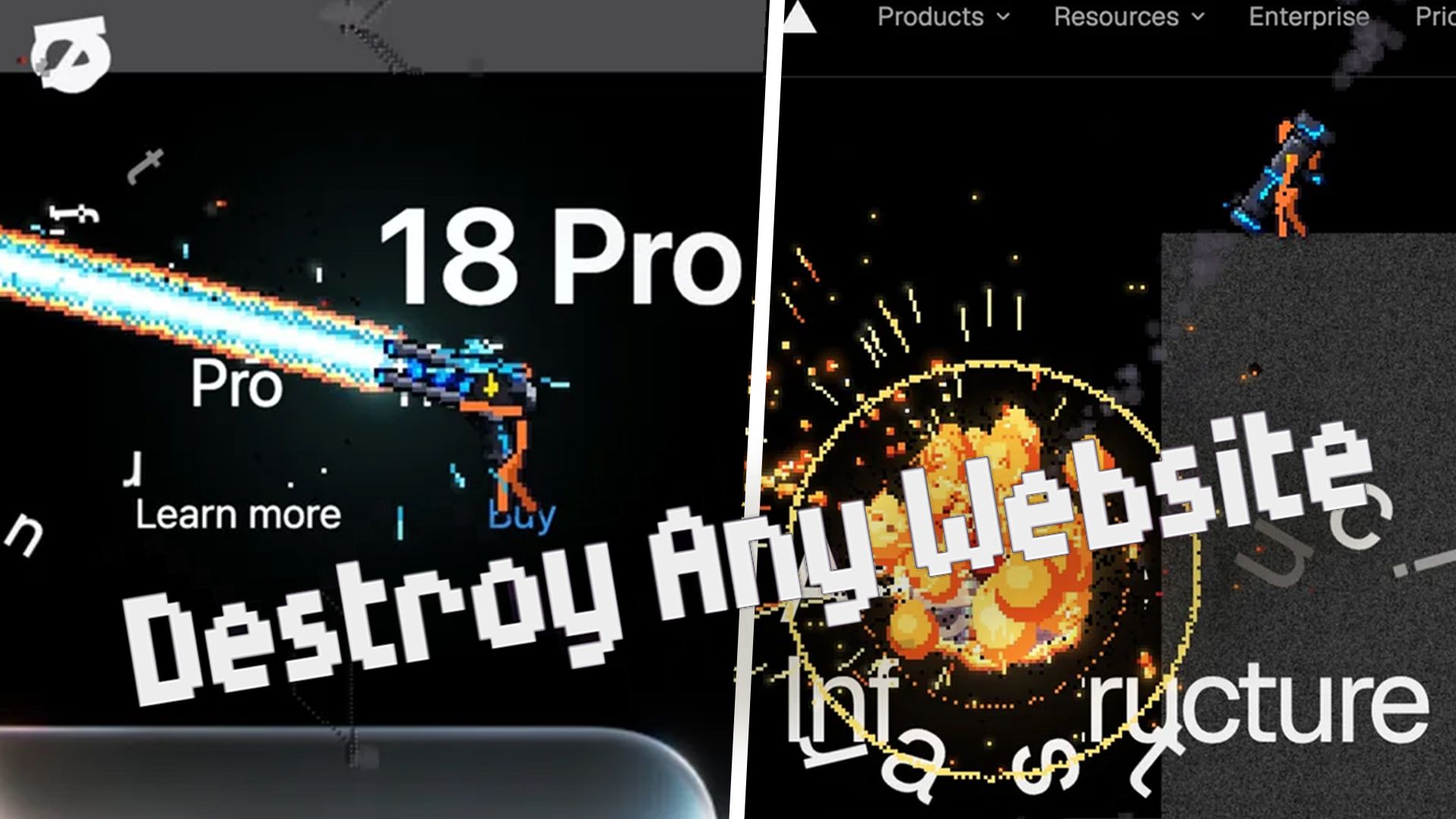
Now, thanks to a viral new project, that cathartic fantasy has become a playable reality. Destroy Any Website, a browser-based game created by design engineer Hugo Duprez, allows users to transform nearly any URL on the internet into a destructible, pixel-art battlefield. By turning the mundane architecture of the modern web into a platformer-style arena, Duprez has tapped into a unique intersection of web development, creative coding, and pure, unadulterated digital mischief.
The Core Concept: From Static Content to Destructible Chaos
At its heart, Destroy Any Website is an interactive browser experiment that treats the Document Object Model (DOM)—the structure that governs how websites are built—as a level design toolkit. When a user inputs a URL, the game engine parses the page’s elements, converting images, text containers, and banners into "divs" that function as solid, destructible platforms.
The player controls a heavily armed, miniature pixel-art warrior. With a classic retro-gaming aesthetic, this character can navigate the site, blast holes through layout elements, and effectively dismantle the UI of any page they choose to visit. Whether it is an e-commerce giant’s homepage or a personal blog, the game renders the internet as a playground for destruction.
The mechanics are intuitive yet surprisingly deep. Players use the cursor to navigate their warrior, scrolling to switch between an array of weapons. Moving downward allows the character to drop through layers of the website as if they were platforms in a traditional side-scroller. For vertical exploration, the up arrow activates a jetpack, enabling the player to soar to the header or navigate around cumbersome sidebars. Furthermore, the game supports multiplayer functionality, allowing up to five friends to enter a shared "room" to compete in the digital rubble of a chosen webpage.
A Chronology of Development: The Vibe-Coded Revolution
The emergence of Destroy Any Website is a fascinating case study in the power of modern AI-assisted development. Hugo Duprez, a design engineer at the generative AI firm Craiyon, did not build this game in a traditional, months-long production cycle. Instead, he utilized a concept he refers to as "vibe coding."
The Early Prototyping Phase
In late 2026, Duprez began experimenting with the integration of AI tools to accelerate the creation of game-ready assets. The initial vision was to bridge the gap between static web content and interactive 2D environments. By leveraging Sprite Fusion—a platform dedicated to pixel art development and management—Duprez sought a way to visualize how AI-generated sprites could interact with real-world browser data.
The Viral Launch
The game made its public debut on social media in late September 2026. A simple tweet demonstrating a stick-figure-like character obliterating a website went viral almost instantly, capturing the imagination of developers and casual browsers alike. The immediate feedback loop provided by the online community allowed for rapid iterations, as users flooded the developer with requests for compatibility fixes and new weapon types.
Current Iteration
As of today, the project is hosted on the Sprite Fusion website. While it is not a "perfect" piece of software—some websites, particularly those with complex security protocols or dynamic JavaScript, return errors or refuse to load—it represents a significant milestone in how we might view the future of interactive web interfaces.
Supporting Data and Technical Context
To understand the mechanics of Destroy Any Website, one must look at the underlying technology. The game is essentially a "scraper-meets-sandbox."
- The Sprite Fusion Engine: The game is powered by the Sprite Fusion platform, which specializes in tile-map editing and generative pixel art. By integrating this with browser-injection scripts, Duprez created a bridge that translates CSS properties into game physics.
- AI Integration: Duprez has been vocal about his use of AI tools to "vibe code" the project. This term refers to the use of Large Language Models (LLMs) and code-generation tools to draft the logic of the game, allowing the developer to focus on the "feel" and creative direction rather than the minutiae of syntax.
- Compatibility Rates: While internal figures haven’t been released, community reports suggest that the game successfully renders approximately 65-70% of standard web pages. Sites that rely heavily on
iframestructures or canvas-based rendering remain the primary challenge for the current build.
Official Perspectives: The Developer’s Philosophy
Hugo Duprez’s approach to game development is emblematic of a shift in the tech industry. In an era where game engines like Unreal Engine 5 and Unity 6 are becoming increasingly complex, Duprez is championing the "small, fast, and fun" philosophy.
"The goal wasn’t to build a perfect emulator of the internet," Duprez noted in recent communications. "The goal was to give people a way to reclaim their browsing experience, if only for a few minutes of catharsis."
For those inspired by this project to explore their own game development journey, the industry offers a wealth of resources. Whether one is interested in the high-fidelity power of Unreal Engine 5 or the accessible, rapid-prototyping capabilities of GameMaker, the barrier to entry has never been lower. Those looking to build their own creative projects are encouraged to invest in hardware capable of handling these engines; for instance, modern laptops tailored for game development are now a necessity for anyone looking to bridge the gap between creative concept and playable reality.
The Broader Implications: The Web as a Game Engine
The existence of Destroy Any Website raises intriguing questions about the future of web design and digital interaction.
1. The Gamification of Information
If we can turn a webpage into a game, what does that mean for user engagement? While the current application is purely for entertainment, the underlying technology could theoretically be used to create interactive tutorials, gamified shopping experiences, or immersive data visualization tools.
2. The Ethics of Digital Vandalism
The game is, in essence, a form of client-side modification. It does not actually harm the servers of the websites being "destroyed," as the changes exist only within the player’s local browser session. This highlights the power of client-side control: users have the ultimate authority to modify how they view the internet. It is a digital form of the "View Source" mentality, taken to its most extreme and entertaining conclusion.
3. The Democratization of Game Development
Perhaps the most important takeaway is the speed with which a solo developer—using AI tools and existing platforms—can create a piece of software that reaches millions. The "vibe coding" movement suggests that we are entering an age where the ability to articulate a vision is becoming as important as the ability to write low-level code.
Looking Forward: Beyond the Destruction
While Destroy Any Website is currently a viral sensation, it also serves as a proof-of-concept for the creative use of AI in software development. For those who find the project fascinating, there is a whole world of independent game development to explore.
Projects like Punch to Defend, a game where the solo developer incorporated his own beatboxing as the soundtrack, showcase the human element that remains vital in an era of AI. These indie titles remind us that, regardless of the tools used, the "vibe"—the soul, the intention, and the creativity—is what truly defines a memorable digital experience.
As we continue to navigate a web increasingly cluttered with advertisements and complex UI, tools like Destroy Any Website provide a much-needed outlet. It is a reminder that the internet is a human-made construct, and if it becomes too rigid or frustrating, there is always room for someone to come along, grab a pixelated rocket launcher, and change the landscape.
Are you ready to build your own masterpiece?
If this project has sparked a desire to start your own development journey, consider these resources:
- Game Development Software: Research the latest tools like Unity 6, Unreal Engine 5, or Godot to find the right environment for your skill level.
- Hardware Requirements: Ensure your workstation is up to the task by checking out the latest high-performance laptops designed specifically for game design and development.
- Community Support: Engage with platforms like Sprite Fusion to see how other creators are leveraging AI to bring their visions to life.
The digital world is your canvas. Whether you want to build it or blow it to smithereens, the tools are finally in your hands.
 Pevita Pearce
  Iffa Jayyana
  Asep Darmawan