
 By Laily UPN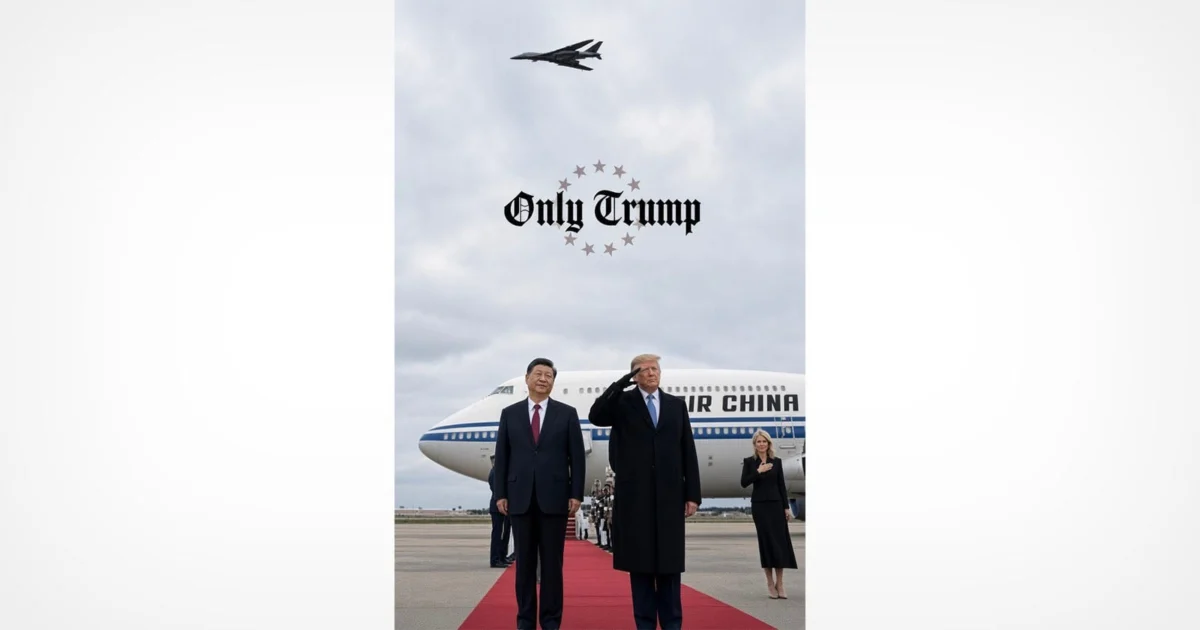
WASHINGTON — In the high-stakes theater of modern geopolitics, optics have always been as crucial as policy. But as artificial intelligence and advanced digital manipulation tools blur the line between reality and fabrication, the battleground of perception has expanded from the negotiating table to the pixel.
This new frontier was vividly illustrated when a photograph shared by Donald Trump on Truth Social—depicting a stoic, composed presidential salute alongside Chinese President Xi Jinping during a high-profile arrival ceremony at Joint Base Andrews—was comprehensively debunked as a digitally altered artifact.
The image, which contrasted sharply with real-time photojournalism captured by major news agencies, has ignited a fierce debate over media integrity, the weaponization of digital editing in political discourse, and the growing challenge of establishing a shared baseline of truth in the digital age.
Main Facts
The controversy centers on a red-carpet arrival ceremony held at Joint Base Andrews in Maryland, where President Xi Jinping touched down for a historic diplomatic visit. As the Chinese leader disembarked, a synchronized U.S. military flyover roared across the Maryland sky, providing a dramatic backdrop for the bilateral welcome.
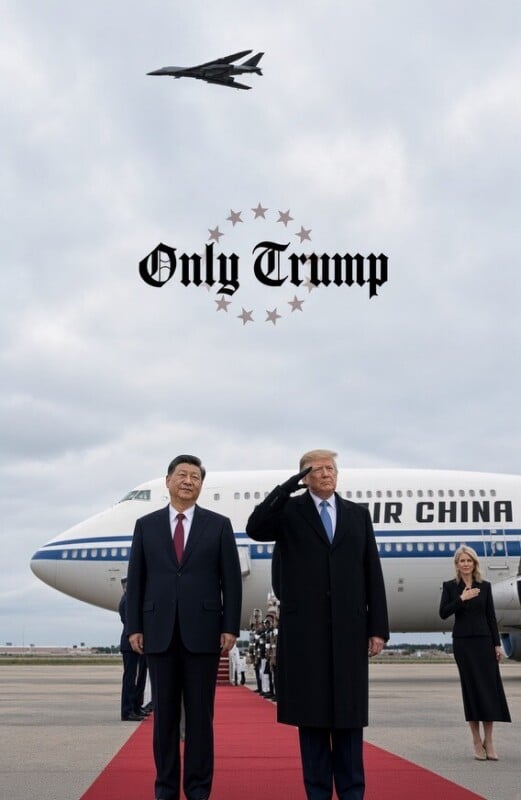
In the version of the photograph shared by President Trump to his Truth Social account, the U.S. president is depicted standing at rigid attention, offering a solemn, stoic salute as a military bomber streaks overhead. President Xi maintains a placid, nonplussed expression—a composure that Chinese state media subsequently highlighted to project calm confidence in the face of American pageantry.
However, verified visual records from multiple independent journalistic agencies—including Getty Images, Reuters, and the Associated Press—tell a starkly different story. In the authentic photojournalistic capture of the exact same millisecond, Trump is seen grimacing, caught off guard by the sudden, deafening screech of the military jet overhead.
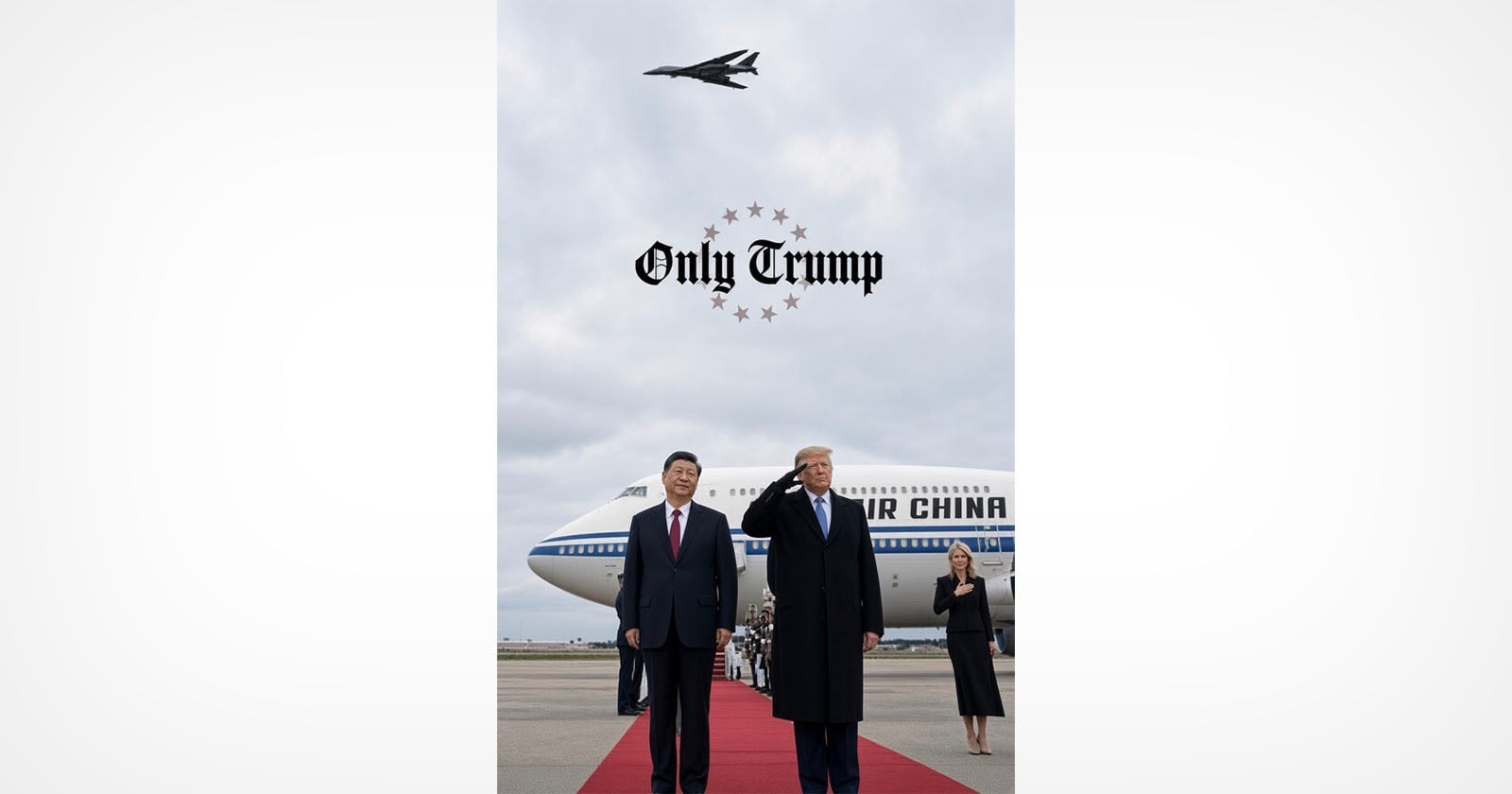
Comprehensive forensic investigations conducted by BBC Verify and digital forensics experts confirmed that the Truth Social upload was systematically manipulated. Among the glaring anomalies identified in the altered image:
- The Glove Discrepancy: In the edited photo, Trump is wearing only one black glove, whereas video and photo evidence from the entire day confirms he wore a pair of gloves on both hands.
- The Swapped Aide: Chief of Protocol Monica Crowley, who stood directly behind Trump during the ceremony, was digitally replaced in the Truth Social version by a different individual. Observers, including journalist Aaron Rupar, noted the replacement strongly resembles Natalie Harp, a presidential aide frequently referred to as the "human printer."
- Aeronautical Alterations: Specific red markings and graphic details on the side of the Air China aircraft visible in the background were systematically erased or altered in the shared version.
- Stylistic Touch-ups: Trump’s hairstyle and facial contours showed noticeable smoothing and realignment compared to raw, unedited press photographs.
Henry Farid, co-founder of GetReal Security and a recognized authority on digital forensics, evaluated the image for the BBC, concluding that the cumulative modifications point squarely to intentional digital or AI-assisted editing designed to "clean up" the visual narrative.
Chronology of Events
The unfolding of the tarmac welcome and the subsequent digital controversy followed a rapid, multi-tiered timeline spanning public diplomacy and instantaneous digital dissemination.
Wednesday: The Tarmac Welcome
- Afternoon: Air China carrying President Xi Jinping lands at Joint Base Andrews in Maryland. President Trump greets him on a red carpet amidst heavy security and protocol.
- The Flyover: As the leaders stand outside, a scheduled U.S. military jet flyover produces a sudden, loud roar. Photographic agencies capture Trump grimacing at the noise, while Xi maintains a stoic demeanor.
- Immediate Media Broadcast: Outlets like the New York Post and international networks broadcast video and high-resolution stills capturing the unvarnished moment, which quickly circulates across social media platforms like X (formerly Twitter).
Later That Day: The Truth Social Upload
- An altered image is uploaded to President Trump’s official Truth Social account. The photo replaces his grimace with a disciplined salute, modifies his handwear, swaps out a key staff member, and smooths out background details.
Thursday and Friday: Forensic Investigations and Global Reaction
- Media Scrutiny: Independent investigative units, including BBC Verify, begin analyzing pixel data, comparing the Truth Social image against raw feeds from Reuters, AP, and Getty Images.
- Expert Testimony: Digital security specialists weigh in, confirming that the collection of anomalies exceeds accidental compression artifacts and represents deliberate cosmetic editing.
- International Gloss: Chinese state media utilizes the unedited imagery to project an image of imperturbability regarding U.S. displays of military might, while Western analysts focus heavily on the domestic propagation of the manipulated alternative.
Supporting Data and Technical Evidence
The verification process relied heavily on comparative analysis across multiple independent recording mediums. In forensic journalism, establishing authenticity requires triangulating live video feeds, high-speed shutter captures, and eyewitness testimony.
| Evidence Source | What It Captured | Trump’s Expression | Attire & Staffing |
|---|---|---|---|
| Getty Images / AP / Reuters | Raw, high-shutter-speed still photography | Grimacing due to jet noise | Wearing two black gloves; Chief of Protocol Monica Crowley standing behind him. |
| Live Video Feeds (BBC, NY Post) | Continuous motion capture of the flyover | Flinching / reacting to the loud screech | Consistent with multi-camera angles; realistic environmental lighting. |
| Truth Social Upload | Post-production optimized still image | Stoic, solemn salute | Wearing a single black glove; staff member replaced by a figure resembling Natalie Harp; altered aircraft markings. |
According to forensic imaging experts, the modifications seen in the Truth Social post represent a hybrid style of editing—combining traditional touch-up techniques with generative or synthetic face-swapping elements.
"The changes are the types of cosmetic edits that you often see to ‘clean up’ photos," Farid explained to the BBC. "Given the other obvious edits, it is clear that this image has been modified. So that increases the chance that all of these differences are due to digital or AI editing."
Official Responses and Stakeholder Reactions
The dissemination of the altered photograph triggered immediate reactions from media watchdogs, political analysts, and international commentators.
- Domestic Political Sphere: Critics and political opponents seized upon the incident as a prime example of reality distortion in modern political communication. The choice to replace a momentary physical reaction—a wince at a loud noise—with a posture of unyielding strength highlights the intense pressure leaders face to maintain an unbroken facade of power.
- The Journalistic Community: Major news organizations reaffirmed the irreplaceable value of independent photojournalism. By maintaining continuous video archives and multi-angle photography, organizations like the Associated Press and Reuters provided the immutable baseline required to debunk the digital revisionism.
- International Observers: Chinese state media outlets, which frequently scrutinize interactions between Beijing and Washington, utilized the authentic footage to emphasize President Xi’s calm disposition during a potentially tense diplomatic display, contrasting it silently with the domestic American debate over the altered image.
Implications for the Future of Political Communication
The Joint Base Andrews photo controversy extends far beyond a single social media post; it serves as a case study in the broader erosion of shared reality in the digital age. As generative artificial intelligence and high-end image manipulation tools become democratized, the implications for public discourse are profound:
1. The Death of Photographic Authority
For generations, the adage "seeing is believing" anchored photographic evidence as the ultimate arbiter of truth. Today, the widespread capability to alter lighting, expressions, backgrounds, and even subjects in seconds means that digital images can no longer be accepted at face value without robust provenance tracking.
2. Narrative Control Over Empirical Fact
In modern political communication, the perceived narrative often supersedes empirical reality. When a momentary, harmless human reaction—such as wincing at a loud noise—is deemed politically disadvantageous, the temptation to deploy digital tools to rewrite the moment becomes a powerful operational impulse. This shifts political communication from persuasion to outright reality-curation.
3. The Rising Demand for Digital Forensics
As manipulated media proliferates, verification bodies like BBC Verify, Bellingcat, and independent forensic tech firms are becoming essential pillars of modern media consumption. The burden of proof increasingly falls on forensic analysts to decode pixels, metadata, and cross-reference multiple capture devices to establish what truly happened in front of the lens.
Conclusion
The image shared on Truth Social following President Xi Jinping’s arrival will be remembered not merely as an isolated social media misstep, but as a symptom of a shifting informational ecosystem. In a world where pixels can be rearranged to project strength where vulnerability was captured, the unvarnished record provided by rigorous photojournalism remains humanity’s primary defense against the rewriting of history in real time.
 Nila Kartika Wati
  Lina Irawan
  rifanmuazin