
 By Nana Muazin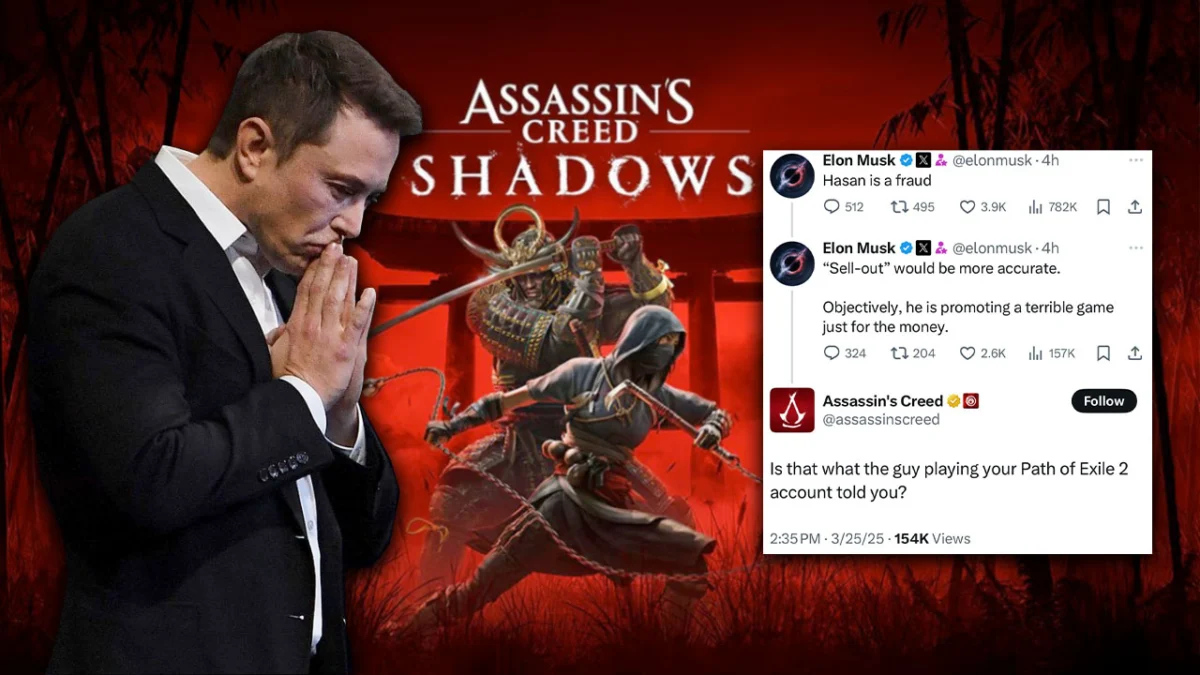
San Francisco, CA – Tech mogul Elon Musk, known for his ventures into space exploration, electric vehicles, and social media ownership, has once again found himself at the center of a widespread online controversy, this time within the fiercely passionate world of video gaming. The official Assassin’s Creed X (formerly Twitter) account delivered a decisive and widely celebrated "ratio" to Musk on his own platform, leveraging a past gaming scandal to mock his criticism of a popular Twitch streamer and the upcoming Assassin’s Creed: Shadows title. This incident has not only generated a torrent of memes and public amusement but also underscored the complex interplay of celebrity, corporate branding, and online culture wars in the digital age.
The viral exchange unfolded after Musk publicly denounced streamer Hasan Piker and Ubisoft’s latest game, prompting the Assassin’s Creed account to strike back with a pointed reference to Musk’s infamous "fraud gamer" controversy involving Path of Exile 2. The unexpected corporate jab quickly amassed hundreds of thousands of likes, transforming a contentious debate into a moment of collective internet schadenfreude at Musk’s expense.
The Spark: Grummz, Piker, and Musk’s Intervention
The genesis of this digital skirmish can be traced back to prominent video game critic Grummz, whose real name is Mark Kern, a veteran game developer known for his outspoken views. Grummz initiated a public critique of Ubisoft, the developer behind the Assassin’s Creed franchise, for its decision to sponsor "leftist" Twitch streamer Hasan Piker to promote the highly anticipated Assassin’s Creed: Shadows. This sponsorship became a flashpoint for a segment of the gaming community, particularly those who align with anti-woke sentiments and object to political leanings in their entertainment.
Hasan Piker, a prominent political commentator and streamer with a massive following, is well-known for his progressive viewpoints and often provocative online persona. His involvement in promoting Assassin’s Creed: Shadows was viewed by critics like Grummz as a politicization of the gaming space, leading to a heated discussion on X.
It was into this already simmering debate that Elon Musk, owner of X and a frequent participant in online culture wars, decided to weigh in. Musk, responding to the ongoing discussion, publicly lambasted Piker, labeling him a "fraud" and a "sell out." Furthermore, Musk didn’t spare Assassin’s Creed: Shadows, dismissing it as a "terrible game" that Piker was only promoting "just for the money." This intervention from one of the world’s most influential figures immediately amplified the controversy, drawing widespread attention and polarizing opinions further. Musk’s history of criticizing "woke" culture and perceived political agendas in various media contexts provided a clear backdrop for his strong stance against Piker and the game’s promotion.
Chronology of a Viral Takedown
The series of events leading to the Assassin’s Creed account’s viral response unfolded rapidly across X, showcasing the platform’s capacity for instantaneous, high-stakes online drama.
Initial Criticism and Escalation: The first domino fell with Grummz’s critique of the Ubisoft-Hasan Piker partnership. His posts highlighted the perceived ideological mismatch and sparked a debate among gamers. Musk, leveraging his immense platform and engagement-driven algorithm, then amplified this criticism significantly by directly attacking Piker and the game. His comments, delivered with characteristic bluntness, instantly became a central talking point.
Hasan Piker’s Counter-Challenge: Not one to shy away from confrontation, Hasan Piker swiftly responded to Musk’s accusations. In a series of spirited exchanges, some mediated through Grummz’s screenshots due to Piker reportedly blocking Musk on X, Piker challenged Musk to a "duel" in the critically acclaimed action RPG Elden Ring. This challenge was a direct gauntlet thrown, inviting Musk to prove his gaming prowess rather than merely criticizing from the sidelines. Musk, in turn, retorted by calling Piker "chickenshit" for blocking him, further fueling the personal nature of the conflict. Grummz, meanwhile, actively "egged on" the argument, sharing screenshots and commentary that kept the spotlight firmly on the escalating feud. The back-and-forth between Musk and Piker served to set the stage, building tension and drawing in a massive audience eager for the next development.
The Assassin’s Creed Intervention: Amidst this fiery exchange, the official @AssassinsCreed account made its decisive move. Rather than engaging in a lengthy debate or issuing a corporate statement, the account opted for a concise, powerful, and highly memetic response directly to Musk’s criticism. Their tweet, "Is that what the guy playing your Path of Exile 2 account told you?", was a surgical strike. It expertly weaponized Musk’s own past gaming controversy, turning his accusations of "fraud" back on him with devastating effect. The tweet was not just a reply; it was a strategically executed "ratio." In internet parlance, while a traditional "ratio" often implies a tweet receiving more replies than likes/retweets, indicating widespread disagreement, in this context, the Assassin’s Creed tweet achieved a dominant engagement (hundreds of thousands of likes and thousands of retweets) in response to Musk, effectively outperforming and publicly humiliating him on his own platform. This direct, personal, and witty retort immediately resonated with a vast online audience, propelling the tweet into viral status overnight.
The quick uptake and precise nature of the Assassin’s Creed response demonstrated a deep understanding of internet culture and meme warfare, transforming what could have been a brand-damaging controversy into a significant public relations victory.
Supporting Data: The "Fraud Gamer" Controversy Unpacked
The potency of the Assassin’s Creed tweet stemmed entirely from its pointed reference to Elon Musk’s well-documented "fraud gamer" controversy earlier this year. For those not intimately familiar with the depths of online gaming culture or Musk’s extensive digital footprint, this incident serves as crucial context.
The Path of Exile 2 Debacle: The controversy erupted when Musk began livestreaming himself playing Path of Exile 2, a complex and highly demanding action RPG known for its intricate mechanics and steep learning curve. While Musk presented himself as a seasoned player, eagle-eyed veterans of the Path of Exile community quickly identified glaring inconsistencies. They noted that Musk was operating a high-rank, evidently powerful character, yet his gameplay displayed fundamental blunders and a lack of understanding typically associated with novice players. He appeared to be "blundering across the map," performing actions indicative of someone playing the game for the very first time, despite his character’s advanced status.
This disparity immediately raised suspicions among the game’s dedicated fanbase. Further investigation by the chronically online community, scrutinizing publicly available game data, revealed another critical detail: Musk’s account appeared to be "playing from Asia or using a VPN to play from Asia." This geographical anomaly was inexplicable to players, who surmised that it pointed to a clear conclusion: Musk had likely hired someone, often referred to as a "grinder" or "booster," to play and level up his character for him. This practice, known as "account boosting," is generally frowned upon in competitive gaming communities as it undermines fair play and genuine skill progression.
The collective disbelief and amusement within the Path of Exile community were encapsulated in a viral tweet by Alex Alarga, who posted, "What an ego-trip… Elon Musk has been livestreaming himself playing overpowered Path Of Exile 2 character, proudly and seriously pretending that he got there himself, and actual POE veterans are laughing their asses off watching and dissecting that charade. Why Elon, why?" This tweet, accompanied by video evidence, perfectly articulated the widespread sentiment that Musk was attempting to "fake it till he made it," but was thoroughly exposed by a discerning audience.

Musk’s Admission: Faced with overwhelming evidence and public ridicule, Musk eventually conceded to the accusations. In a candid, albeit somewhat defensive, admission, he confirmed the account boosting, stating, "It’s impossible to beat the players in Asia if you don’t, as they do!" While framed as a competitive necessity, this admission solidified the perception that Musk had indeed been disingenuous about his gaming prowess.
This history made Musk’s subsequent accusation of Hasan Piker being a "fraud" for promoting Assassin’s Creed: Shadows particularly ironic and ripe for exploitation. The Assassin’s Creed account’s tweet directly tapped into this pre-existing narrative, making its comeback exceptionally effective and widely appreciated for its wit and audacity. The context of Musk’s own gaming "fraud" provided the perfect ammunition for Ubisoft to turn the tables on his criticism, transforming a potential PR headache into a viral triumph.
Broader Reactions and Implications
The "ratio" delivered by the official Assassin’s Creed account resonated far beyond the immediate participants, sparking a wave of public reaction, memes, and discussions about corporate engagement and celebrity behavior online.
Public Reception and Viral Memes: The immediate aftermath saw the internet explode with amusement and support for the Assassin’s Creed account. The tweet quickly garnered over 400,000 likes overnight, a clear indication of its widespread appeal. A barrage of memes and jokes at Musk’s expense flooded X and other social media platforms. Many internet users adapted popular meme formats, such as the "I owe you an apology, I wasn’t really familiar with your game," to express their newfound respect for the Assassin’s Creed brand and its social media team. This specific meme, typically used when someone admits they underestimated a product or person, was repurposed to commend the game’s official account for its unexpected and effective retort.
One X user, @soundaholism, publicly vowed to purchase Assassin’s Creed: Shadows without waiting for a sale, explicitly stating that their motivation was solely the account’s successful ratio of Elon Musk. This sentiment highlights the tangible impact such viral moments can have on consumer behavior and brand loyalty. Other users found humor in the irony of Musk, who paid $44 billion to acquire X, getting so thoroughly "cooked" and humiliated on his own platform. Jokes about the significant investment leading to public ridicule underscored the absurdity and comedic value of the situation. Screenshots of the exchange, often with humorous captions, circulated widely, cementing the incident in internet lore.
Ubisoft’s Implicit Stance: While the Assassin’s Creed account did not issue a formal press statement following its viral tweet, the tweet itself served as a powerful and unambiguous official response. It demonstrated a willingness by Ubisoft to engage directly and sharply with prominent figures, even the owner of the platform they are using, when their brand or partners are attacked. This move, while risky, paid off handsomely in terms of positive brand perception and earned media. It positioned Assassin’s Creed not just as a game franchise, but as a brand with a witty, self-aware, and bold online persona, unafraid to defend its choices and community.
Musk’s Non-Response: Notably, the article does not mention any direct counter-response from Elon Musk to the Assassin’s Creed tweet. His silence in the face of such a widely celebrated "ratio" is conspicuous and further amplified the perceived victory of the game’s account. While Musk is known for his prolific and often combative tweeting, his apparent lack of a direct comeback in this instance allowed the Assassin’s Creed tweet to stand as the definitive last word in that particular exchange.
Implications: Brand Strategy, Online Persona, and Culture Wars
This incident offers several significant implications, shedding light on evolving brand strategies, the persistent challenges of celebrity online personas, and the ongoing culture wars within digital spaces.
Brand Strategy in the Digital Age: The Assassin’s Creed "ratio" represents a masterclass in modern digital brand engagement. In an era where corporate accounts often struggle to connect authentically with internet culture, Ubisoft’s social media team demonstrated a profound understanding of meme dynamics, timing, and audience sentiment. By leveraging a widely known controversy and delivering a concise, witty, and deeply relevant jab, they transformed a potential negative narrative into a massive public relations win. This approach, while inherently risky for traditional corporate entities, proved that boldness, authenticity, and a willingness to engage on the internet’s own terms can yield significant dividends in terms of brand visibility, positive sentiment, and even direct consumer interest, as evidenced by pledges to buy the game. It underscores the shift from sterile corporate messaging to dynamic, personality-driven online interactions.
Elon Musk’s Online Persona and Hypocrisy: The incident further cemented a recurring pattern in Elon Musk’s public online persona: a tendency to engage in direct, often confrontational online spats, particularly in gaming and culture-related topics. However, his past "fraud gamer" controversy highlights a perceived hypocrisy. His willingness to accuse others of being "frauds" or "sell-outs" while having admitted to account boosting himself creates an easy target for criticism and undermines the credibility of his own pronouncements. This pattern contributes to a public image that is often seen as contradictory and at times, disingenuous, particularly among those who value authenticity in gaming and online communities. His vast influence on X makes these contradictions all the more visible and subject to scrutiny.
The Culture Wars in Gaming: Underlying the humor and viral nature of this event is the persistent and often polarizing "culture war" within the gaming community and broader internet. Grummz’s initial criticism of Hasan Piker’s sponsorship was rooted in ideological objections to "leftist" influence in gaming. Musk’s intervention further amplified this political dimension, aligning himself with critics who decry "woke" elements in media. This incident is a microcosm of larger battles being fought online over representation, political messaging, and the perceived "purity" of various cultural spaces. The overwhelming positive reception to the Assassin’s Creed tweet can also be interpreted as a pushback against Musk’s particular brand of online commentary and a broader rejection of politicizing what some view as purely entertainment. It demonstrates that online communities are not monolithic and often react strongly when they perceive a brand or figure challenging their values or sense of fair play.
The Future of X as a Platform: The incident also reflects on the evolving nature of X itself under Musk’s ownership. The platform, designed for rapid-fire, public exchanges, frequently becomes the stage for such high-stakes viral moments. While some argue that such controversies detract from the platform’s utility, others see them as key drivers of engagement and conversation. The ability of a corporate account to so effectively "cook" the platform’s owner illustrates the unpredictable and democratizing power of viral content, regardless of who owns the digital town square.
In conclusion, the Assassin’s Creed account’s viral "ratio" of Elon Musk was more than just a witty tweet; it was a potent demonstration of strategic digital engagement, a public reckoning with celebrity hypocrisy, and a vivid snapshot of the ongoing cultural skirmishes that define the modern internet landscape. It cemented a memorable moment where a corporate entity, by understanding and skillfully employing the language of online culture, managed to decisively "own" a tech titan on his own turf, leaving a lasting impression of wit, audacity, and internet savvy.
 rifanmuazin
  Nana
Nana  Iffa Jayyana