
 By Azzam Bilal Chamdy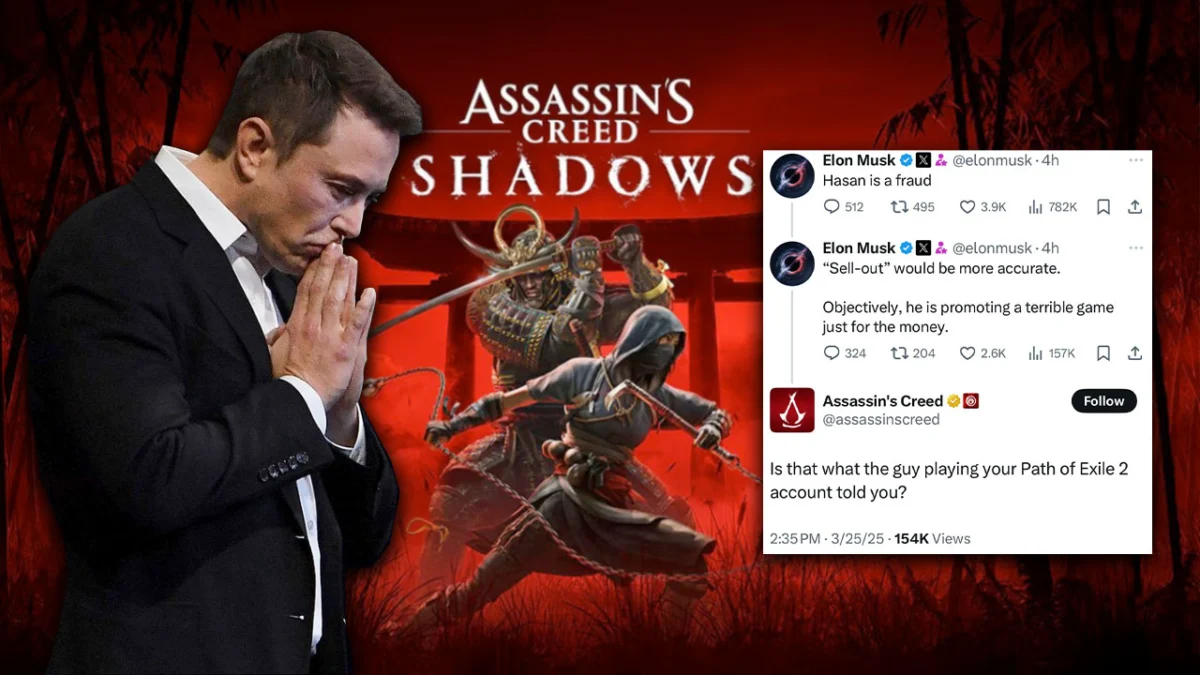
San Francisco, CA – In a digital arena where public figures and corporate entities increasingly clash, technology mogul Elon Musk has once again found himself at the center of a viral gaming controversy. This time, the official X account for the immensely popular Assassin’s Creed franchise delivered a cutting retort that swiftly garnered hundreds of thousands of likes, effectively "ratioing" Musk on his own platform and reigniting discussions about his authenticity within the gaming community.
The incident unfolded after Musk interjected into a debate regarding Ubisoft’s marketing strategy for its upcoming title, Assassin’s Creed: Shadows. His critique, aimed at a prominent Twitch streamer, inadvertently paved the way for a direct and widely celebrated challenge to his own gaming credibility, echoing a past embarrassment that had previously captivated online audiences. The exchange has not only fueled a barrage of memes and jokes at Musk’s expense but also highlighted the evolving dynamics of corporate social media engagement and the persistent scrutiny faced by public figures in the digital age.
The Genesis of a Digital Confrontation: A Chronological Breakdown
The catalyst for this latest online skirmish was a public dispute concerning the promotion of Assassin’s Creed: Shadows, the highly anticipated installment in Ubisoft’s historical action-adventure series. The narrative began with criticisms directed at the game’s publisher for its choice of promotional partners, culminating in Musk’s intervention that set the stage for the now-viral response.
The Critic, The Streamer, and The Game
The initial spark was ignited by Grummz, a figure known in video game circles for his outspoken and often critical commentary. Grummz took to X to voice his disapproval of Ubisoft’s decision to sponsor Hasan Piker, a prominent leftist Twitch streamer, to play Assassin’s Creed: Shadows. Grummz’s critique centered on the perceived ideological alignment of Piker and questioned the suitability of such a partnership for promoting a mainstream game.
Hasan Piker, with his massive online following, is recognized not only for his gaming content but also for his politically charged commentary, which often leans left-wing. His streams attract hundreds of thousands of viewers, making him a highly influential figure in the digital landscape, and thus a valuable, albeit sometimes controversial, target for influencer marketing campaigns. Ubisoft’s decision to collaborate with Piker was a strategic move to tap into his expansive and engaged audience, a common practice in modern game promotion designed to generate hype and reach diverse demographics. However, this strategy, like many that cross cultural or political lines, can sometimes alienate segments of a brand’s audience or draw the ire of critics like Grummz.
Musk’s Intervention and Accusations
It was into this simmering debate that Elon Musk, owner of X and a frequent commentator on a wide array of topics, decided to weigh in. Echoing Grummz’s sentiments, Musk directly attacked Piker, labeling him a "fraud" and a "sell out." Musk further intensified his critique by asserting that Piker was promoting a "terrible game just for the money," implying a lack of genuine enthusiasm or ethical compromise on Piker’s part.
Musk’s intervention, while perhaps intended to support Grummz’s stance or express his own views on influencer marketing, quickly drew attention due to his own contentious history with gaming authenticity. His public persona, often characterized by attempts to appear relatable and "chronically online," has frequently been undermined by perceived gaffes or missteps, particularly when it comes to video games. This established pattern primed the internet for a critical response, anticipating hypocrisy given Musk’s own past actions.
Assassin’s Creed Strikes Back
The official @AssassinsCreed account, managed by Ubisoft, was notably quick and incisive in its response. Rather than engaging directly with Musk’s critique of the game or the streamer, the account deftly pivoted to Musk’s own gaming history, specifically referencing his widely publicized "fraud gamer controversy" from earlier in the year.
The tweet, which instantly went viral, posed a rhetorical question that directly challenged Musk’s integrity: "Is that what the guy playing your Path of Exile 2 account told you?" This single, pointed query served as a potent callback to a past incident where Musk was accused of faking his gaming prowess. The effectiveness of the tweet lay in its precision and its ability to weaponize Musk’s own past against him, turning his accusation of "fraud" back onto the accuser.
The immediate impact was staggering. Within hours, the tweet amassed over 400,000 likes and countless retweets, signifying a massive public endorsement of the official account’s stance. This rapid virality demonstrated the internet’s collective memory and its willingness to amplify moments of perceived comeuppance, especially when directed at high-profile figures. The Assassin’s Creed account’s strategic use of humor and a deep understanding of internet culture allowed it to achieve a significant "ratio"—a term on X referring to a tweet receiving significantly more replies and retweets than likes, often indicating widespread disagreement or mockery, though in this case, the high likes indicated widespread agreement and approval of the roast.
Unpacking the "Fraud Gamer" Controversy: Musk’s Path of Exile 2 Debacle
The Assassin’s Creed tweet’s potency stemmed directly from its reference to a widely publicized and embarrassing incident involving Elon Musk and the action role-playing game Path of Exile 2. This earlier controversy had already established a narrative of inauthenticity around Musk’s gaming claims, making the Assassin’s Creed callback particularly devastating.
The Path of Exile 2 Incident
Earlier this year, Elon Musk became embroiled in a significant public relations imbroglio after he was observed livestreaming himself playing Path of Exile 2. The game, known for its complex mechanics, deep skill trees, and challenging gameplay, requires considerable dedication and understanding to master, especially at higher ranks. Musk presented himself as a seasoned player, operating a high-rank character, implying personal achievement and skill.
However, "eagle-eyed veterans" of the Path of Exile community quickly noticed glaring inconsistencies in Musk’s gameplay. Despite controlling what appeared to be an advanced character, his movements, decision-making, and overall understanding of the game’s intricate systems were indicative of a novice. Players observed him blundering across the map, making fundamental errors, and generally demonstrating a lack of familiarity with mechanics that a high-ranking player would intuitively grasp. This disconnect between his character’s apparent progression and his actual in-game performance immediately raised suspicions among the highly engaged and knowledgeable Path of Exile community.
Geographical Discrepancies and Account Boosting Allegations
Further investigation by the online community unearthed more damning evidence. Publicly available game data, accessible to experienced players, indicated that Musk was "playing from Asia or using a VPN to play from Asia." This geographical anomaly was particularly perplexing, as Musk resides in the United States, and there was no logical reason for him to be playing from an Asian IP address unless deliberately obfuscating his location or, more likely, delegating the gameplay to someone else.
The community quickly coalesced around the conclusion that Musk had hired someone to "grind" at the game for him, effectively "boosting" his account to a high rank. Account boosting, the practice of paying a skilled player to play on one’s account to achieve higher ranks or unlock content, is a contentious issue in competitive gaming. It undermines the integrity of leaderboards, devalues genuine player achievement, and is often seen as a form of cheating.
Under mounting pressure and widespread accusations, Musk eventually admitted to "account boosting." His justification, delivered in a characteristic attempt at wit, was equally controversial: "It’s impossible to beat the players in Asia if you don’t, as they do!" This statement, rather than absolving him, seemed to confirm the perception that he was willing to circumvent fair play to maintain an image of gaming prowess, further cementing the "fraud gamer" label. His explanation implied that "everyone does it" in Asia, attempting to normalize a practice widely considered unethical in most gaming communities.
The Viral Evidence
The entire debacle was captured and widely disseminated across social media. A particularly impactful tweet by Alex Alarga, dated January 9, 2025, perfectly encapsulated the public sentiment. Alarga’s post included a video clip of Musk’s questionable gameplay, alongside a caption that highlighted the absurdity of the situation: "What an ego-trip… Elon Musk has been livestreaming himself playing overpowered Path Of Exile 2 character, proudly and seriously pretending that he got there himself, and actual POE veterans are laughing their asses off watching and dissecting that charade. Why Elon, why? 🤦♂️🤦♂️"
This tweet, and others like it, provided undeniable "supporting data" that validated the community’s suspicions and solidified the narrative of Musk’s gaming inauthenticity. The video evidence, coupled with his eventual admission, served as a potent reminder for the Assassin’s Creed account to leverage in its viral "ratio."

Official Responses and Public Reactions
The aftermath of the Assassin’s Creed tweet saw a flurry of responses from the involved parties and a broad spectrum of reactions from the online community, further amplifying the incident’s reach and impact.
Hasan Piker’s Counter-Challenge
Prior to the Assassin’s Creed intervention, Hasan Piker had already engaged directly with Musk in a series of exchanges, largely mediated or instigated by Grummz. Piker, known for his confrontational style, challenged Musk to a "duel" in Elden Ring, another highly popular and notoriously difficult action RPG. This challenge was a direct gauntlet thrown, inviting Musk to prove his gaming skills in a live, unboosted setting.
Musk’s response to Piker’s challenge was dismissive and somewhat juvenile. He retorted by calling Piker "chickens—" for having blocked him on X, thereby sidestepping the challenge and resorting to personal attacks. Grummz, meanwhile, continued to egg on the argument, seemingly enjoying the spectacle of the two prominent figures clashing. The exchange between Piker and Musk highlighted the irony of Musk criticizing Piker as a "sell out" for promoting a game, while Musk himself was accused of faking his way through games for perceived prestige. The public saw this as a clear deflection from Musk, unwilling to back up his claims with actual gameplay.
Assassin’s Creed’s Strategic "Ratio"
While the Piker-Musk exchange generated buzz, it was the official Assassin’s Creed account’s tweet that truly "stole the show." The term "ratio" on X (formerly Twitter) has evolved beyond its literal meaning to signify a tweet that receives significantly more replies and quote retweets than likes, often indicating widespread disapproval or mockery of the original post. However, in this context, the Assassin’s Creed tweet achieved a ratio in the sense that it overwhelmingly garnered support and amusement, effectively silencing Musk’s critique with a clever, well-aimed jab that resonated with the internet’s collective memory.
The strategic brilliance of the Assassin’s Creed tweet lay in its brevity, its directness, and its cultural currency. It did not engage in a lengthy defense of Assassin’s Creed: Shadows or Hasan Piker. Instead, it delivered a precise, surgical strike that leveraged Musk’s own documented gaming foibles against him. This approach was far more effective than a conventional corporate rebuttal, demonstrating a deep understanding of how to go viral and win over public sentiment in the highly competitive and often cynical landscape of social media.
The Internet Reacts: Memes, Support, and Scorn
The internet, ever-ready to capitalize on viral moments, erupted with memes and jokes at Musk’s expense. Many users immediately conceded to the corporate ratio, employing the popular meme phrase, "I owe you an apology, I wasn’t really familiar with your game," to express their newfound respect for the Assassin’s Creed marketing team’s wit. This meme, typically used to acknowledge a surprisingly good performance from an unexpected source, perfectly captured the sentiment.
One X user, @soundaholism, went so far as to publicly vow to purchase Assassin’s Creed: Shadows without waiting for a sale, solely motivated by the official account’s successful ratio of Musk. This reaction underscored the potential for viral marketing to directly translate into consumer action, demonstrating the power of authentic and culturally resonant brand engagement.
Beyond direct support, a significant portion of the online commentary revolved around the sheer irony of the situation. Jokes proliferated about Musk having paid $44 billion to acquire X, only to be "cooked" – an internet slang term for being thoroughly humiliated or defeated – on his own platform. Images depicting Musk as a bumbling gamer, or the Assassin’s Creed logo towering triumphantly over a defeated X bird, flooded timelines. These memes served not only as entertainment but also as a form of collective commentary on power dynamics, corporate social media, and Musk’s often-tumultuous relationship with his own platform and public image. The visual of a powerful CEO being publicly outmaneuvered by a video game’s social media account resonated deeply with users who enjoy seeing traditional power structures playfully subverted.
Broader Implications and The Digital Arena
The viral exchange between Elon Musk and the Assassin’s Creed X account transcends a simple online spat; it offers a compelling case study into the evolving dynamics of corporate communication, influencer marketing, and the enduring scrutiny of public figures in the digital age.
The Shifting Landscape of Corporate Social Media
The Assassin’s Creed account’s audacious move highlights a significant shift in corporate social media strategy. Brands are increasingly moving away from purely promotional, risk-averse messaging towards more direct, personality-driven, and culturally savvy engagement. This incident demonstrates that taking a calculated risk, by directly engaging with a high-profile controversy and utilizing internet humor, can yield immense rewards in terms of visibility, brand loyalty, and positive public sentiment.
However, this approach is not without its perils. A misjudged joke or an inauthentic attempt at internet slang can quickly backfire, leading to accusations of "cringe" or hypocrisy. The Assassin’s Creed team’s success lay in its precise timing, its accurate recall of internet history, and its ability to tap into a prevailing sentiment. It sets a precedent for how brands, especially those targeting younger, digitally native audiences, might operate in the future, valuing genuine engagement over sterile corporate speak.
Influencer Marketing and Authenticity
The initial debate sparked by Grummz and Musk regarding Hasan Piker’s sponsorship also brought to the forefront ongoing discussions about influencer marketing and the perception of authenticity. In an era where paid promotions are ubiquitous, audiences are increasingly discerning about the genuineness of endorsements. Musk’s accusation of Piker being a "fraud" for promoting a game for money, while hypocritical given his own past, taps into a real concern among consumers about whether influencers genuinely enjoy or believe in the products they promote.
Conversely, the value of streamers like Piker lies in their ability to connect with a massive, engaged audience in a way traditional advertising often cannot. Their endorsement, even if paid, carries weight because of their established rapport with their viewers. The incident underscores the delicate balance brands must strike between leveraging an influencer’s reach and maintaining a perception of integrity and genuine interest, both for the influencer and the brand itself.
Elon Musk’s Public Persona and Gaming
This incident is not an isolated event but rather another chapter in Elon Musk’s long-standing, often troubled, relationship with gaming culture. Despite his frequent attempts to engage with the gaming community, whether through tweets about specific games, challenges, or discussions about game development, he has consistently faced backlash and accusations of inauthenticity. His past gaffes, such as his "gamergate" comments or his perceived ignorance of common gaming tropes, have contributed to a public persona often viewed with skepticism by seasoned gamers.
The "Path of Exile 2" scandal was particularly damaging because it directly challenged his integrity in a domain he often tries to project as a personal interest. Being "cooked" on X, a platform he now owns, by an official brand account for a gaming franchise, carries symbolic weight. It suggests that despite his immense wealth and power, he remains susceptible to the collective judgment and sharp wit of the internet, especially when his claims of expertise or authenticity are found wanting. It highlights the democratizing power of online discourse, where even the most powerful individuals can be held accountable, often through humor and viral mockery.
The Future of Digital Discourse
Ultimately, this saga illustrates the volatile and dynamic nature of digital discourse. It showcases how a seemingly minor online interaction can quickly escalate into a major cultural event, shaping public perception, influencing purchasing decisions, and redefining the boundaries of corporate communication. The incident serves as a potent reminder of the internet’s collective memory, where past transgressions or missteps by public figures can be instantly recalled and weaponized in new contexts.
As social media platforms continue to evolve, and as the lines between personal, corporate, and political communication blur, such incidents will likely become more frequent. The Assassin’s Creed ratio of Elon Musk is more than just a funny moment; it’s a testament to the power of a well-crafted tweet, the enduring appeal of holding powerful figures accountable, and the ever-present, sometimes chaotic, energy of the chronically online world. It underscores that in the digital arena, authenticity, even more than authority, often reigns supreme.
 rifanmuazin
  Nana
Nana  Iffa Jayyana