
 By Ammar Sabilarrohman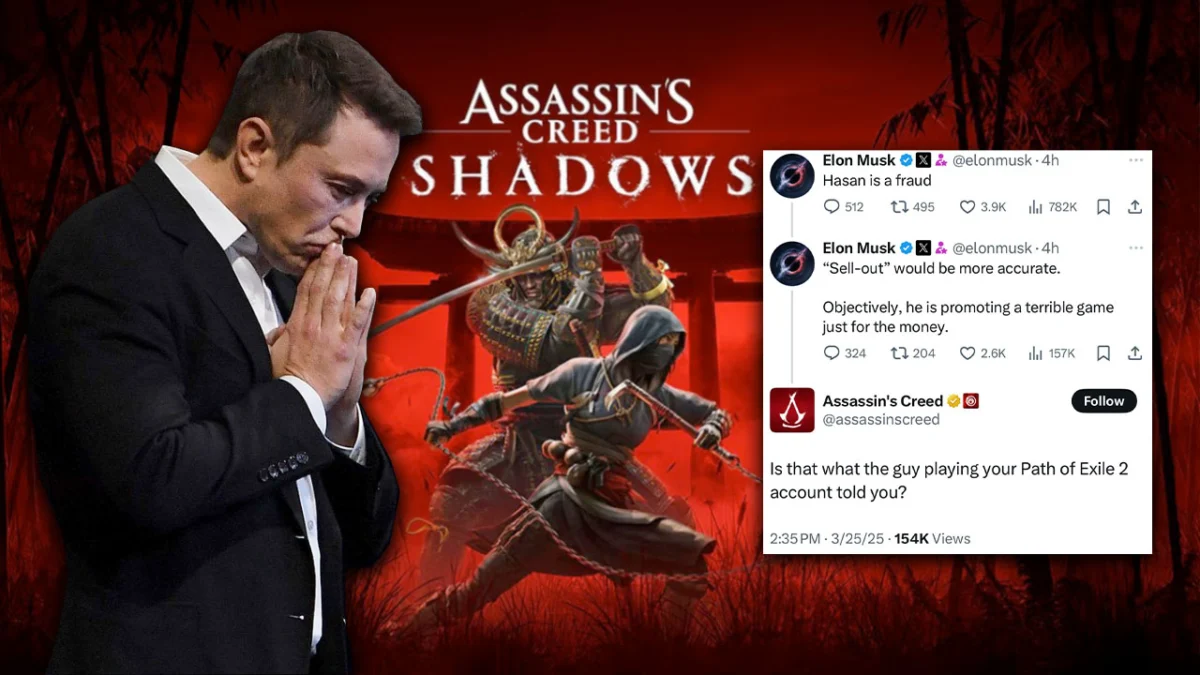
San Francisco, CA – Tech mogul Elon Musk, owner of X (formerly Twitter), once again finds himself at the center of a social media storm, his gaming credibility publicly questioned and widely mocked. This latest controversy erupted when the official Assassin’s Creed account delivered a scathing, viral "ratio" on Musk’s own platform, drawing widespread attention and sparking a fresh wave of memes and jokes at his expense. The incident reignites scrutiny of Musk’s past claims within the gaming community, particularly a prior "fraud gamer" scandal involving the action RPG Path of Exile 2.
The episode underscores the volatile nature of online discourse, the power of brand social media engagement, and the recurring challenges Musk faces in cultivating an authentic connection with various subcultures, including the often-skeptical gaming community.
The Catalyst: A Feud Ignited by a Sponsored Stream
The dramatic online confrontation began not with Musk directly, but with a critical comment from a prominent figure within the gaming sphere. Notorious video game critic, known online as "Grummz," initiated the current wave of contention. Grummz publicly criticized Ubisoft, the developer behind the venerable Assassin’s Creed franchise, for its decision to sponsor leftist Twitch streamer Hasan Piker to play the upcoming title, Assassin’s Creed: Shadows.
Piker, a highly influential political commentator and streamer known for his progressive viewpoints and substantial online following, regularly engages in sponsored content. However, his political leanings often make him a controversial figure among certain segments of the internet. Grummz’s criticism seemingly leveraged this existing polarization, framing the sponsorship as an endorsement of specific political ideologies rather than a mere marketing collaboration.
Elon Musk, a frequent participant in online debates and known for his own strong political opinions, quickly weighed in on the burgeoning discussion. Echoing Grummz’s sentiment and amplifying the criticism, Musk publicly denounced Hasan Piker, labeling him a "fraud" and a "sell out." Musk’s accusation stemmed from Piker’s promotion of what Musk implicitly deemed a "terrible game," suggesting that Piker’s motivation was solely financial gain, devoid of genuine enthusiasm for the product. This direct attack from Musk, directed at a popular streamer and an upcoming title, immediately elevated the dispute to a much larger platform, drawing in millions of X users.
The Retort Heard ‘Round the Internet: Assassin’s Creed Strikes Back
What followed was an unexpected and highly impactful intervention from an official corporate account. The X account for Assassin’s Creed (@AssassinsCreed), managed by Ubisoft, was remarkably swift in its response. Instead of issuing a generic defense of their marketing strategy or ignoring Musk’s comments, the account chose a more direct, audacious, and ultimately viral approach.
Responding directly to Musk’s "fraud" accusation against Piker, the Assassin’s Creed account delivered a sharp, pointed jab that immediately resonated across the gaming community and beyond. The tweet read: "Is that what the guy playing your Path of Exile 2 account told you?"
This single, concise tweet was a masterclass in social media engagement. It not only directly challenged Musk’s moral authority to accuse others of "fraud" in gaming but also cleverly referenced a prior, highly embarrassing controversy involving Musk himself. The response garnered an astounding level of engagement, accumulating over 400,000 likes overnight and rapidly becoming a prime example of a "corporate ratio" – a situation where a reply receives significantly more engagement than the original post it’s responding to, signaling widespread disapproval or mockery of the original poster. The internet exploded with memes, jokes, and expressions of shock and amusement at the audacity and effectiveness of the Assassin’s Creed account’s retort.
Chronology of a Gamer’s Gaffe: The Path of Exile 2 Precedent
To fully appreciate the impact of the Assassin’s Creed tweet, it is essential to delve into the "fraud gamer controversy" it so deftly invoked. Earlier this year, Elon Musk was embroiled in a highly public and embarrassing incident that severely undermined his attempts to portray himself as a legitimate or skilled gamer. This controversy centered around his supposed gameplay of Path of Exile 2, a highly anticipated and notoriously complex action role-playing game (ARPG).
Musk had been livestreaming his gameplay, presenting himself as an adept player navigating the challenging world of Path of Exile 2. However, his performance quickly raised red flags among the game’s dedicated and "chronically online" player base. Path of Exile is renowned for its intricate mechanics, steep learning curve, and the deep understanding required to effectively pilot high-level characters. Veterans of the game are intimately familiar with optimal builds, movement patterns, and combat strategies.
Eagle-eyed Path of Exile 2 veterans swiftly noticed glaring inconsistencies in Musk’s gameplay. Despite operating what appeared to be a high-rank character, his movements, decision-making, and overall combat effectiveness were strikingly amateurish. He was observed "blundering across the map," making basic mistakes that would be uncharacteristic of someone genuinely playing at the character’s displayed level. It was as if a novice had suddenly taken control of an endgame-ready avatar, completely out of their depth.
Further investigation by the community revealed more damning evidence. Players discovered that publicly available game data indicated Musk was "playing from Asia or using a VPN to play from Asia." This geographic anomaly was particularly suspicious, as it strongly suggested that Musk was not the one primarily grinding the character’s progression. The prevailing theory, which quickly gained traction, was that Musk had hired someone – likely a professional "booster" often found in competitive online gaming scenes – to play the game for him, leveling up his character and acquiring powerful gear. This practice, known as "account boosting" or "piloting," is widely frowned upon in gaming communities as it undermines fair play and authenticity.
Under mounting pressure and irrefutable evidence, Musk eventually admitted to the practice. In a rather unconvincing justification, he wrote, "It’s impossible to beat the players in Asia if you don’t, as they do!" This statement, intended to explain his actions, only further solidified the perception that he was attempting to circumvent the legitimate challenge and effort required to excel in the game. His admission effectively confirmed the community’s suspicions: Elon Musk was not the skilled Path of Exile 2 player he had pretended to be, and his high-level character was the product of paid services, not personal achievement.

This prior incident cemented Musk’s reputation among many gamers as a "fraud gamer" – someone who projects an image of gaming prowess without genuinely earning it. It became a significant stain on his attempts to connect with the gaming demographic, making the Assassin’s Creed account’s callback particularly potent and devastating.
Official Responses and Escalating Barbs
The Assassin’s Creed tweet was not the only significant response to Musk’s initial comments. Hasan Piker himself engaged directly with Musk in a series of exchanges, mediated somewhat by screenshots shared by Grummz. Piker, known for his confrontational style, challenged Musk to a "duel" in the popular FromSoftware title, Elden Ring. This challenge, a common way for gamers to settle disputes or test skill, was met with a dismissive response from Musk, who branded Piker "chickenshit" for allegedly blocking him on X. Grummz, the original instigator, continued to fan the flames, seemingly reveling in the escalating argument between the two prominent figures.
While the personal exchange between Piker and Musk provided further entertainment for online spectators, it was the official Assassin’s Creed ratio that undeniably "stole the show." Its conciseness, historical context, and public nature made it an instant classic in the annals of corporate social media. The fact that a major video game franchise, owned by a multinational corporation, would directly and publicly "roast" the owner of the platform they were using was unprecedented and highly effective.
Supporting Data and Widespread Online Reaction
The sheer volume of engagement on the Assassin’s Creed tweet serves as crucial supporting data for its impact. Over 400,000 likes overnight, coupled with tens of thousands of retweets and replies, indicate a viral phenomenon. This level of organic reach and positive reception from the online community far outstripped Musk’s initial criticism, cementing the Assassin’s Creed account’s victory in the public’s eye.
The online community’s reaction was swift and overwhelmingly in favor of the Assassin’s Creed account. Many internet users "conceded" to the corporate ratio, adopting a popular meme phrase: "I owe you an apology, I wasn’t really familiar with your game." This phrase, often used ironically to admit one’s underestimation of a person or entity, perfectly captured the surprise and admiration for the Assassin’s Creed team’s bold move.
Beyond general amusement, the ratio even translated into potential commercial benefit for Ubisoft. X user @soundaholism explicitly stated their intention to buy AC: Shadows without waiting for a sale, motivated "solely by them ratioing Musk." This anecdotal evidence highlights the potential for viral social media moments to directly influence consumer behavior, especially when a brand aligns with the prevailing sentiment against a controversial public figure.
Other users piled on with jokes about Musk’s predicament, particularly the irony of him being "cooked" (a slang term for being thoroughly defeated or ridiculed) on his own platform. The recurring sentiment was that Musk had paid an exorbitant $44 billion to acquire X, only to become the target of its most effective and humiliating "ratio" to date, delivered by one of the very brands he sought to criticize. Memes depicting Musk in various states of chagrin or defeat flooded timelines, further solidifying the narrative of his public humiliation.
Implications: Authenticity, Corporate Branding, and the Future of Online Feuds
The incident carries several significant implications for Elon Musk’s public image, corporate social media strategy, and the broader landscape of online discourse.
For Elon Musk, this episode is another blow to his attempts to project an image of authenticity and expertise, particularly within the gaming community. His repeated stumbles in this arena, from the Path of Exile 2 controversy to this latest exchange, suggest a disconnect between his self-perception and how he is perceived by genuine enthusiasts. His willingness to engage in public feuds, often with a perceived lack of self-awareness regarding his own past missteps, continues to generate mockery and erode his credibility in certain circles. While his core audience may remain loyal, these incidents chip away at his broader appeal and provide ammunition for his critics.
For corporate branding and social media engagement, the Assassin’s Creed ratio represents a bold and successful strategy. In an increasingly crowded digital landscape, brands are constantly seeking ways to cut through the noise and connect with consumers. The Assassin’s Creed team demonstrated that strategic audacity, combined with a deep understanding of internet culture and a willingness to engage directly with high-profile figures, can yield immense viral success. However, such a strategy is not without risks. A miscalculated "roast" or an ill-timed joke could easily backfire, leading to a public relations nightmare. The success here lies in the impeccable timing and the undisputed factual basis (Musk’s prior admission) that underpinned the retort. This incident may encourage other brands to be more daring in their social media interactions, particularly when targeting polarizing figures.
The incident also highlights the enduring importance of authenticity in gaming culture. The core of both Musk’s "fraud gamer" controversy and his criticism of Piker revolved around perceived authenticity. Gamers often value genuine passion and skill, and any hint of faking or "boosting" is met with strong disapproval. Piker’s "sell out" accusation, while politically charged, also taps into this vein of authenticity – questioning whether his promotion is genuine or purely transactional. The Assassin’s Creed response leveraged this cultural value, turning Musk’s own criticism back on him by highlighting his documented lack of gaming authenticity.
Finally, the incident reflects the evolving nature of online feuds and "cancel culture." X, under Musk’s ownership, has become an even more volatile arena for public disagreements. This episode demonstrates how quickly a casual comment from a public figure can escalate into a full-blown viral phenomenon, particularly when a brand decides to enter the fray with a well-aimed jab. The commercial impact, with users vowing to buy the game, also points to the potential for these online skirmishes to have tangible real-world consequences, both positive and negative, for the individuals and entities involved.
As the dust settles on this latest online skirmish, one thing remains clear: in the ever-watchful and unforgiving eye of the internet, past actions, especially those involving perceived dishonesty, can quickly resurface to haunt even the most powerful figures, often at the most inconvenient times. And sometimes, the most effective counter-attack comes not from a rival personality, but from a corporate social media account with a keen sense of irony and a historical receipt.
 Nila Kartika Wati
  Azzam Bilal Chamdy