
 By Raul Delapena Setiawan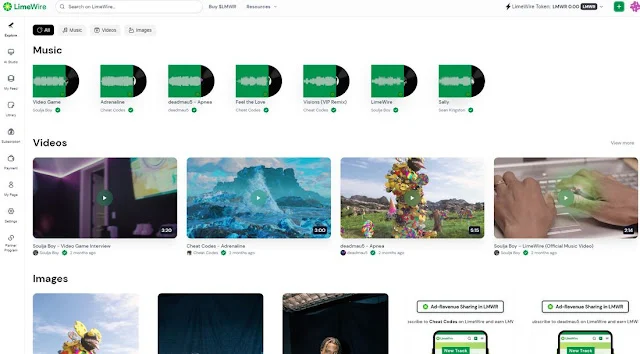
In the early 2000s, the name "LimeWire" was synonymous with the digital revolution of peer-to-peer file sharing. It was a household name that defined an era of internet consumption. Today, however, the brand has undergone one of the most radical corporate pivots in tech history. Re-emerging as a sophisticated AI content publishing platform, the new LimeWire has traded pirated MP3s for blockchain-verified, AI-generated art. This article explores how the platform has repositioned itself as a cornerstone for digital creators, blending generative AI technology with Web3 monetization models.
Main Facts: The New Architecture of LimeWire
LimeWire is no longer an application for downloading music; it is a comprehensive, browser-based ecosystem designed for the modern creator economy. The platform currently functions as a generative AI studio that allows users to create, publish, and monetize digital assets.
At its core, LimeWire provides access to industry-leading AI models, including Stable Diffusion 2.1, Stable Diffusion XL, and DALL-E 2. By providing a streamlined interface for these high-powered models, LimeWire lowers the barrier to entry for users who wish to create professional-grade visual content without the need for complex prompt engineering or expensive hardware. Once content is generated, the platform handles the technical heavy lifting of minting these creations as Non-Fungible Tokens (NFTs) on the Polygon or Algorand blockchains, effectively turning creative output into tradeable digital assets.
A Chronology of Transformation
The journey of LimeWire from a legal pariah to a Web3-integrated AI platform is a story of strategic rebranding.
- The Early 2000s: LimeWire gains massive popularity as a P2P file-sharing client, eventually facing legal challenges that led to its permanent shutdown in 2010.
- 2022: The brand is acquired by new owners who announce a pivot toward the NFT and digital collectibles space, leveraging the brand’s massive name recognition.
- 2023: LimeWire officially launches its "AI Studio," marking a definitive shift toward generative AI. This move allows users to generate images, with a roadmap set for audio and video capabilities.
- Present Day: The platform has expanded its monetization suite, introducing ad-revenue sharing models for creators, paid subscription tiers, and a native cryptocurrency, the LMWR token, to facilitate an internal economy.
Supporting Data: Monetization and Creator Economics
The defining feature of the "New LimeWire" is its emphasis on creator sustainability. Unlike many free-to-use AI platforms that retain the rights to user content, LimeWire positions the creator as the owner.
The Revenue Sharing Model
LimeWire distinguishes itself by allowing creators to earn revenue through multiple streams:
- Ad Revenue Sharing: When creators publish content, they are eligible for a percentage of the ad revenue generated by that content. Depending on the user’s subscription tier, creators can earn between 50% and 70% of the revenue generated by their posts.
- Royalties: By minting content as NFTs, creators retain a 2.5% royalty on every subsequent secondary sale of their digital assets.
- Subscription Tiers: Creators can set their pages to "Premium," allowing fans to pay a monthly subscription fee for exclusive access to high-resolution content, behind-the-scenes assets, or early access to new projects.
The Role of the LMWR Token
The platform operates on the LMWR token, a utility cryptocurrency that functions as the lifeblood of the LimeWire ecosystem. Earnings are paid out in LMWR, which can be swapped on major exchanges like Kraken and ByBit. Furthermore, users can utilize these tokens to purchase additional "credits," which are required to run intensive AI generation tasks, creating a circular economy where the platform’s utility token is constantly in circulation.
Official Stance and Strategic Vision
In official communications, the LimeWire team emphasizes "democratization." The leadership views the current AI landscape as fragmented and overly technical. By centralizing high-level models under one interface, they aim to provide a "one-stop-shop" for creators who want to build a brand, generate high-quality media, and find an audience—all in one place.
The inclusion of high-profile creators like Deadmau5 and Soulja Boy serves as a strategic validator for the platform. By attracting established artists to mint their content on the site, LimeWire signals that its tools are not just for hobbyists, but for professionals looking to engage with their fanbases in new, blockchain-verified ways.
Implications for the Future of Generative AI
The transition of LimeWire has significant implications for the broader tech industry.
1. The Death of the "Free" Model
LimeWire highlights the inevitable shift in AI tools toward tiered subscription models. While the platform offers a free entry point—10 credits per day—the limitations on ad revenue and output volume clearly nudge users toward the $9.99 to $99.00 monthly tiers. This suggests that as AI compute costs remain high, platforms are moving away from the "infinite free trial" model that characterized the early launch of tools like Midjourney or ChatGPT.
2. Integration of Web3 and AI
LimeWire is among the first platforms to successfully fuse generative AI with blockchain technology. The implication is that "provenance" will become the next major hurdle for AI content. By automatically minting content as NFTs, LimeWire provides a timestamped, decentralized record of ownership. In an era where AI-generated images are increasingly difficult to distinguish from human-made art, this blockchain integration offers a way to verify the "original" source of a piece of digital media.
3. The Future Roadmap: Beyond Images
The platform’s ambition to introduce AI music and video generation is the next logical step. If LimeWire can replicate the success of its image generator in the music space, it could fundamentally disrupt how independent musicians distribute their work. Allowing an artist to generate a track, mint it as an NFT, and place it behind a paywall—all within a single interface—would streamline a process that currently requires three or four different platforms.
A Balanced Perspective
While the potential is vast, the platform faces challenges. The AI image generation market is incredibly crowded, with giants like Adobe Firefly, Midjourney, and Canva integrating AI into their existing, massive user bases. LimeWire’s success depends on its ability to maintain a superior user experience while competing with these tech conglomerates.
Furthermore, the volatility of the crypto market presents a potential barrier for mainstream adoption. Relying on LMWR tokens for revenue means that creators are subject to the fluctuations of the digital asset market, which may be less attractive to traditional artists than standard fiat currency payouts.
Conclusion: The Path Ahead
LimeWire has successfully shed the skin of its past, reinventing itself for an era where content creation is powered by algorithms and owned via the blockchain. Whether it can sustain its momentum depends on its ability to innovate faster than its competitors.
For the average user, LimeWire offers an accessible, low-friction entry into the world of AI art. For the serious creator, it offers a robust toolkit to build a community and monetize digital assets. As the platform prepares to launch its proprietary AI models and expand into music and video, the industry will be watching closely. If LimeWire can continue to bridge the gap between complex AI technology and user-friendly monetization, it may very well define the next decade of the creator economy just as effectively as its predecessor defined the last.
For those looking to get involved, the platform is currently open for registration, offering a compelling look at the intersection of creativity, artificial intelligence, and decentralized finance.
 Iffa Jayyana
  Nila Kartika Wati
  Nana
Nana 