
 By Dwi Wanna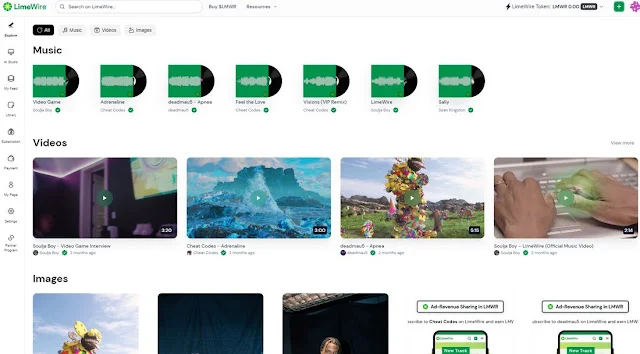
Main Facts
LimeWire—a brand universally recognized from the golden age of 2000s peer-to-peer file sharing—has completed one of the most unexpected pivots in tech history. Today, it operates as LimeWire Studio, a cutting-edge generative AI content publishing platform. Moving far beyond static image generation, the platform integrates advanced artificial intelligence models, blockchain-based digital asset minting, a robust subscription ecosystem, and a native cryptocurrency reward structure.
Major mainstream artists and influencers, including Deadmau5, Soulja Boy, and Sean Kingston, have already leveraged the platform to publish exclusive NFT-based music, videos, and artwork. LimeWire’s core value proposition rests on three pillars: accessibility through state-of-the-art AI creation tools, decentralized ownership through automated NFT minting on Polygon and Algorand, and direct creator monetization via ad-revenue sharing and the platform’s native token, LMWR.
Chronology of Transformation
The 2000s: The Peer-to-Peer Pioneer
In its original iteration, LimeWire was a household name synonymous with the early digital music revolution. Launched in 2000 as a Java-based peer-to-peer file-sharing client, it became the primary vehicle for millions of users to download MP3s, software, and media. However, the platform became embroiled in catastrophic copyright infringement litigation, culminating in a 2010 federal court injunction that ordered the service to permanently shut down its file-sharing operations.
The Rebirth: Transitioning to Web3 and AI
Following a decade of dormancy, the intellectual property was acquired by new ownership with a vision to repurpose the trusted brand name for the modern decentralized web. Initially exploring Web3 and NFT infrastructure, the platform systematically pivoted toward the exploding market of generative artificial intelligence.
The Launch of LimeWire Studio
LimeWire Studio officially debuted as an AI-focused creative platform. It combined foundational AI models—such as Stable Diffusion and DALL-E—with automated blockchain minting. This evolution transformed LimeWire from a passive distribution network into an active, end-to-end creation, publishing, and monetization ecosystem for digital artists, designers, and musicians.
Supporting Data & Platform Mechanics
AI Model Integration and Customization
LimeWire AI Studio supports some of the industry’s most sophisticated image-generation architectures, including Stable Diffusion 2.1, Stable Diffusion XL, and DALL-E 2. The platform caters to all skill levels, allowing users to generate complex artwork using simple textual prompts or highly granular instructions.
Key technical and stylistic features include:
- Style Switching: Users can effortlessly toggle between distinct aesthetic styles, including cinematic, digital art, pixel art, anime, and analog film.
- Advanced Controls: Integration of custom samplers, prompt guidance sliders, and resolution adjustments gives creators precise control over output quality.
- Proprietary Models: LimeWire is actively developing its own proprietary AI generation models to reduce reliance on third-party technologies and expand its creative toolkit.
- Upcoming Expansions: While current capabilities center primarily on image generation, the platform has announced near-term roadmaps to introduce AI-driven music and video creation suites.
Automated NFT Minting
Once a piece of content is generated and approved for publication, LimeWire automates the process of minting the creation as a Non-Fungible Token (NFT) on either the Polygon or Algorand blockchains.
- Public vs. Exclusive Distribution: Creators can choose to make their AI-generated assets publicly searchable—enabling community trading—or restrict access exclusively to paying, tier-based subscribers.
- Perpetual Royalties: Whenever a creator’s minted asset is traded on the secondary market, the original creator automatically earns a 2.5% royalty fee, establishing a passive income stream from digital collectibles.
Revenue Sharing and the LMWR Token Economy
LimeWire breaks away from traditional creator-economy platforms by offering an aggressive ad-revenue sharing model alongside cryptocurrency incentives.
- Ad-Revenue Split: Creators receive up to 70% of all advertising revenue generated when other users view their published images, music, and videos on the platform.
- LMWR Cryptocurrency: Earnings are disbursed monthly in LMWR (LimeWire’s native token). These tokens can be traded on major centralized and decentralized crypto exchanges, including Kraken, ByBit, and Uniswap, or reinvested directly into the platform to purchase additional prompt credits.
Pricing Tiers and Credits
LimeWire operates on a freemium model designed to scale with user needs:
- Free Tier: Provides 10 complimentary credits daily (permitting up to 20 image generations) and a 50% ad revenue share.
- $9.99/Month Plan: 1,000 credits/month (up to 2,000 generations), early access to new AI models, and a 50% ad revenue share.
- $29.00/Month Plan: 3,750 credits/month (up to 7,500 generations), early access to AI models, and a 60% ad revenue share.
- $49.00/Month Plan: 5,000 credits/month (up to 10,000 generations), early access, and a 70% ad revenue share.
- $99.00/Month Plan: 11,250 credits/month (up to 22,500 generations), early access, and a 70% ad revenue share.
- All premium tiers include a Pro profile badge, comprehensive creation history, accelerated processing speeds, and an ad-free browsing experience.
Official Responses and Industry Reception
The resurrection of the LimeWire brand has elicited a fascinating mix of nostalgia and cautious optimism from the tech and creative sectors. Industry analysts point out that repurposing a once-infamous brand name is a high-risk, high-reward marketing strategy.
In public statements accompanying the launch of LimeWire Studio, platform executives emphasized that the modern infrastructure is built with legal compliance, creator empowerment, and transparency at its core—a stark contrast to the unregulated peer-to-peer sharing ecosystem of the 2000s. The early adoption of the platform by established entertainment figures like Deadmau5 and Soulja Boy has served as a critical endorsement, signaling to the broader music and art communities that Web3-integrated AI platforms can serve as legitimate, revenue-generating distribution channels rather than speculative novelties.
Implications
1. Democratization of Digital Art and Multimedia Production
By lowering technical barriers and offering free entry-level access, LimeWire empowers amateur and professional creators alike to experiment with high-end generative AI tools. The elimination of expensive software overhead allows grassroots designers to produce high-caliber visual assets instantly.
2. The Convergence of AI and Web3 Monetization
LimeWire represents a growing trend of platforms merging artificial intelligence with blockchain infrastructure. By automating the tokenization of AI art, the platform addresses one of the modern creator economy’s greatest pain points: establishing provable ownership and digital scarcity in an age where AI-generated content can be infinitely replicated with a single click.
3. Sustainable Creator Economies
The combination of subscription models, secondary-market royalties (2.5%), and direct ad-revenue sharing (up to 70%) creates a diversified financial model for digital artists. By paying out yields in a liquid cryptocurrency (LMWR), LimeWire bridges the gap between traditional fiat web services and decentralized finance (DeFi), offering creators global earning potential free from regional banking restrictions.
4. Future Outlook for Cross-Media AI Generation
As LimeWire prepares to roll out its dedicated AI music and video production suites, the implications for the broader entertainment industry are profound. If successful, the platform could evolve into a comprehensive, all-in-one studio where independent creators can conceptualize, produce, market, and monetize multimedia campaigns entirely within a single decentralized ecosystem.
 rifanmuazin
  Jia Lissa
  Iffa Jayyana