
 By Neng Nana
In the modern marketing landscape, the "creator experiment" is effectively over. The question of whether creator content can drive engagement, build brand affinity, and move product has been answered with a resounding "yes." Most major brands have successfully moved past the initial phase of skepticism, proving that the creator-led model works.
However, a new, more existential crisis has emerged. Brands that have successfully validated their creator programs are now hitting a formidable ceiling. As they attempt to transition from boutique, high-performing pilots to massive, always-on engines, many programs are collapsing under the weight of their own complexity. The industry is currently facing a fundamental shift: the realization that a "creator program" is a fragile, temporary arrangement, while a "creator system" is a robust, scalable business asset.
The Inflection Point: When Success Becomes a Liability
The breakdown of creator programs typically occurs at a predictable juncture. It happens after the "proof of concept" phase, where leadership has signed off, budgets are allocated, and the mandate is to scale.
At this inflection point, three compounding problems emerge: the inability to track full-funnel performance, the exponential growth of operational complexity, and the persistent, industry-wide measurement gap. When these factors converge, programs that once generated excitement begin to stagnate, fragmenting into disconnected campaigns that lack a cohesive strategic backbone.
The Full-Funnel Performance Gap
For years, the creator economy has been obsessed with "vanity metrics"—reach, impressions, and engagement rates. While these are useful for top-of-funnel awareness, they are increasingly insufficient for brands operating in a mature digital economy.
Today’s CMOs are asking harder questions: Does this creator content drive conversions at our retail partners? Does it improve the ROAS of our paid media stack? Is it actually moving the needle on bottom-line revenue?
Most creator agencies are ill-equipped to answer these questions. They operate in a vacuum, focusing on creative delivery rather than the technical infrastructure required to track the customer journey across platforms. To bridge this gap, brands need to integrate first-party data, utilize advanced media-buying infrastructure, and establish measurement configurations that track the user from the first impression to the final purchase. When this infrastructure is absent, the creator program remains a silo, disconnected from the broader omnichannel marketing machine.
The Complexity of Scale: Beyond the Pilot
The mechanics that support a pilot program—three creators, one product line, and a single platform—do not scale linearly. When that model is stretched to include thirty creators, four social platforms, and a diverse portfolio of products, the traditional agency approach breaks down.
The briefing process, once a collaborative, high-touch endeavor, becomes a bottleneck. Vetting for brand safety and quality assurance becomes an administrative nightmare. Amplification decisions—which posts to boost, which to leave organic, and which to iterate upon—become too fragmented to manage manually.
Without a centralized operating system, these programs drift. They devolve into a series of disconnected executions. Instead of a powerful, unified brand narrative, the consumer sees a disjointed array of content that fails to add up to a coherent brand strategy. The result is "creative fatigue" and, eventually, a decline in efficiency.
The Measurement Crisis: The Industry’s Top Hurdle
For the first time in five years, budget scarcity has been relegated to a secondary concern. According to CreatorIQ’s State of Creator Marketing 2026 report, the primary obstacle facing brand marketers is no longer finding budget or creators—it is measurement.
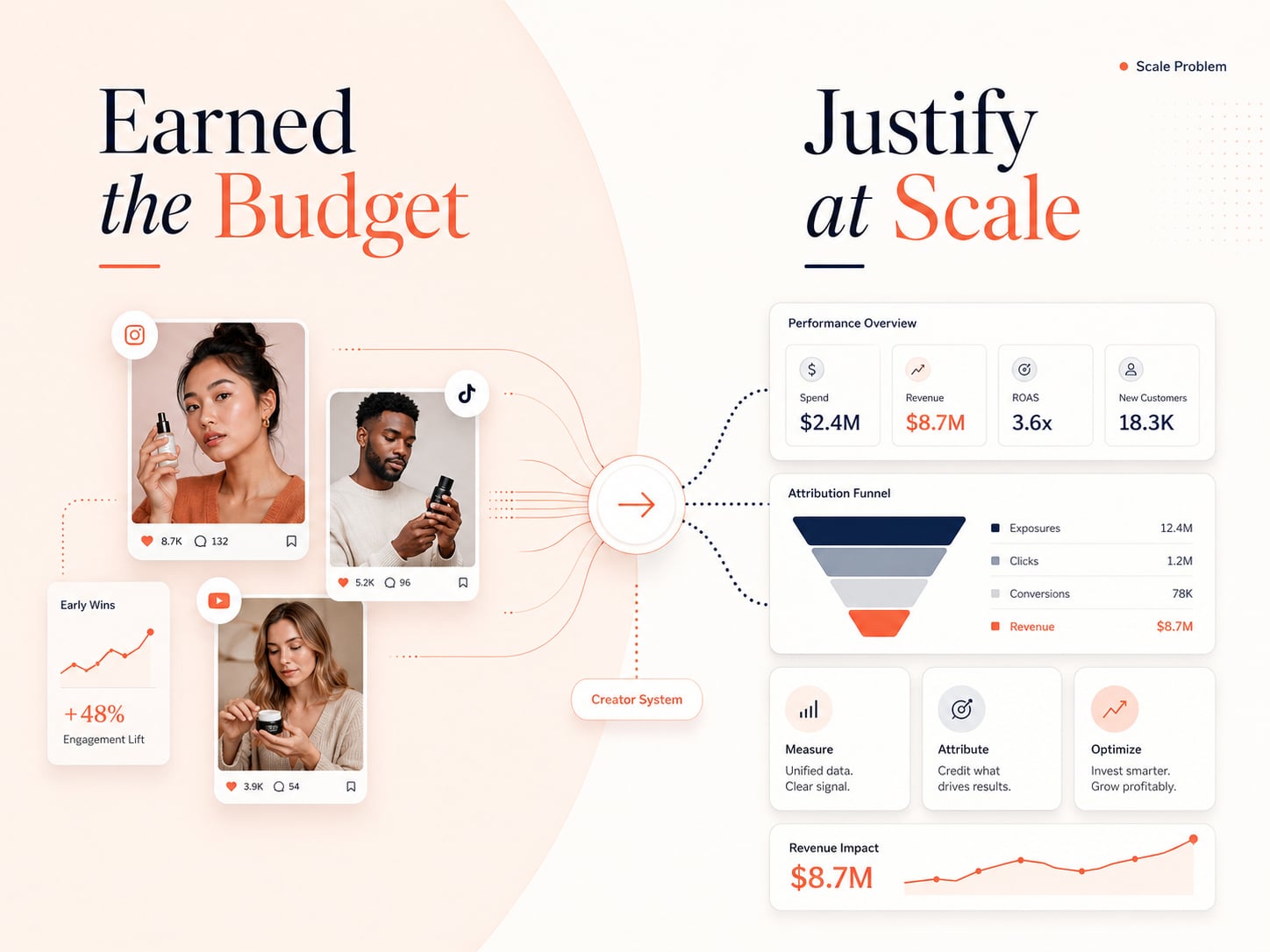
The lack of a "single source of truth" in creator marketing is the industry’s original sin. Platform analytics are notoriously siloed, and last-click attribution models are fundamentally broken. They fail to account for the "halo effect" of creator content—the consumer who watches a video, researches the brand, and buys the product three days later through a direct search or a different channel.
When tracking is not configured before the campaign launches, brands lose the baseline data required to prove incremental lift. Consequently, when the time comes to defend budgets, marketers are left with incomplete stories. This structural gap—between what the program actually contributes and what the data can prove—is where most creator programs die.
Chronology of a Program Evolution
To understand how these programs typically evolve, we must look at the lifecycle of a mature creator strategy:
- The Discovery Phase (Months 1-6): Brands focus on individual creator relationships and content quality. The goal is validation.
- The Pilot Phase (Months 6-18): The program demonstrates success. The brand secures a dedicated budget and begins testing multiple creators and platforms.
- The Complexity Wall (Months 18-24): The sheer volume of content and stakeholders creates operational friction. The program begins to feel like a "project" rather than a system.
- The Optimization Pivot (Months 24+): Successful brands move to an "Always-On" model. They integrate tech stacks, establish clear attribution frameworks, and shift from manual management to systematic operations.
The Imperative: Building a "Creator System"
Closing the gap between a successful pilot and a durable system requires a shift in how brands view their partners. Currently, there is a bifurcation in the market: creative shops provide compelling content but lack technical infrastructure, while performance agencies offer attribution but often lack the creative nuance that makes creator marketing successful in the first place.
Brands that are winning are those that stop searching for a "silver bullet" tool and start building a comprehensive system. This requires:
- Operational Systems: Always-on execution frameworks that standardize the briefing, vetting, and content-approval processes.
- Integrated Media Buying: A strategy where creator content is treated as a foundational asset for all paid media, not just as an organic play.
- Layered Measurement: A hybrid approach using brand lift studies, UTM/pixel tracking, and post-purchase surveys. Crucially, this must be configured before the content goes live.
Implications for the Future: The Compounding Advantage
The most significant competitive advantage in the creator economy is not a proprietary algorithm or a massive budget; it is retention.
Brands that retain the same strategic partners and internal teams over multiple years build a "compounding advantage." They accumulate institutional knowledge about what creative resonates, how to navigate platform shifts, and how to refine their measurement models to capture value that their competitors miss.
This institutional memory allows for a "flywheel effect." Every campaign makes the attribution model smarter. Every deepened relationship with a creator leads to higher-quality, more authentic content. Every budget cycle becomes easier to justify because the data is robust, the infrastructure is proven, and the ROI is transparent.
Conclusion: The Race to Institutionalize
For the majority of brands, the transition from a creator program to a creator system is still in its infancy. Many are currently trapped in the "complexity wall," struggling to justify budgets because they lack the measurement infrastructure to prove their impact.
However, the path forward is clear. Those that successfully institutionalize their creator marketing—treating it as a foundational performance channel rather than an experimental marketing tactic—will build an insurmountable lead. As the industry matures, the divide between those who simply "run creators" and those who have built a "creator system" will define the leaders of the next decade. The brands building that infrastructure today are not just solving a short-term problem; they are building a durable, scalable engine for long-term growth that will be significantly harder for their competitors to catch tomorrow.
 Muslim
  Lina Irawan