
 By Nana Wu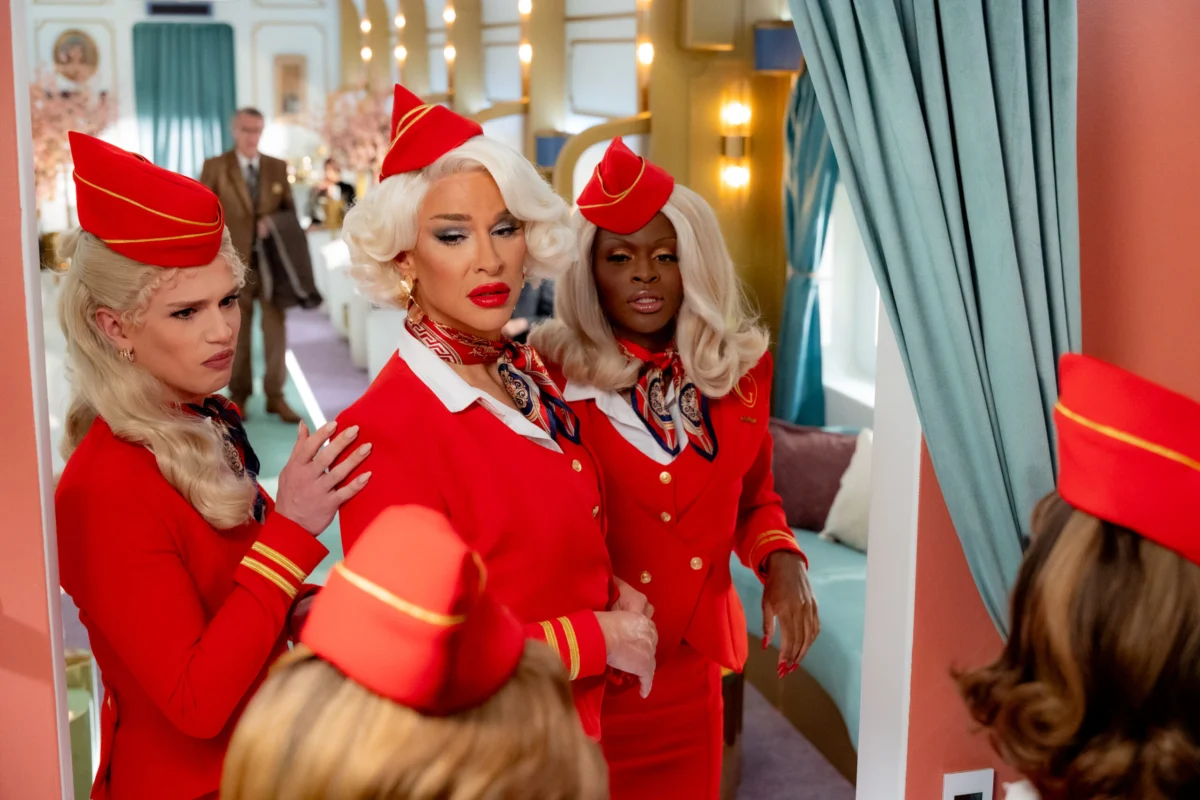
In an era where cinematic universes are often defined by capes, multiverses, and CGI-heavy spectacle, the arrival of Stop! That! Train! offers a refreshing—albeit entirely absurd—alternative. Billed as a “true story” that unfolds “exactly as it happened in real life,” the film is a masterclass in tongue-in-cheek camp, blending the high-stakes tension of a 1970s disaster epic with the razor-sharp, pop-culture-obsessed humor that has become the hallmark of the RuPaul’s Drag Race franchise. Directed by Adam Shankman, the feature-length project serves as both a parody and a love letter to the reality phenomenon, proving that even a train hurtling toward a “stormaganza” can be saved by the right amount of charisma, uniqueness, nerve, and talent.
The Core Narrative: A Disaster in the Making
At the heart of the film are Tess (Ginger Minj) and DeeDee (Jujubee), two veteran stewardesses for the now-defunct Stank Rail. After a decade of service and a dream of seeing the American landscape, the duo finds their path to travel blocked by the reality of unemployment. The opportunity of a lifetime arises when they discover that two staff members of the ultra-opulent Glamazonian Express have gone AWOL. In a classic act of improvisational chaos, Tess and DeeDee fabricate uniforms to infiltrate the high-end rail line, immediately finding themselves at odds with the establishment: the icy, disapproving head stewardess Amber (Brooke Lynn Hytes) and her sycophantic lieutenants, Ali (Marty Lauter) and Ayshleiygh (Symone).
As the journey begins, the film weaves together two diverging plot threads. While DeeDee engages in a flirtatious subplot with the hunky co-conductor Cal (Brian Jordan Alvarez), the technical side of the voyage descends into catastrophe. Lead conductor Davenport (Chris Parnell) discovers that the train’s braking system is fundamentally compromised, while traffic controller Donna Dusk (Rachel Bloom) identifies an unprecedented, century-defining weather event—the “stormaganza”—barreling directly toward their tracks. As corporate bureaucracy ignores the impending doom, the situation reaches the highest office in the land: President Judy Gagwell, portrayed with scene-stealing gravitas by RuPaul Charles.
Chronology of Chaos: From Boarding to Braking
The film’s pacing is relentless, mimicking the forward momentum of the locomotive itself.
- The Infiltration: The first act establishes the stakes for Tess and DeeDee, highlighting their desperate desire to escape the mundanity of their former jobs. Their success in "passing" as Glamazonian staff sets the tone for the film’s exploration of identity and performance.
- The Technical Failure: Once the train departs, the tension shifts from social maneuvering to survival. The discovery of the faulty brakes, combined with the emergence of the weather anomaly, provides the classic "ticking clock" narrative device essential to the disaster genre.
- The Presidential Intervention: As news of the potential tragedy breaks, the film shifts to the Oval Office. President Gagwell’s introduction is marked by a paralyzing bout of PTSD, stemming from her past service in the U.S. Rail Force. This vulnerability provides a rare humanizing moment for the character, anchoring the absurdity in a pseudo-psychological reality.
- The Climax: The final act sees the stewardesses forced to take control of the train, navigating not only the mechanical failures and the storm but also the internal power dynamics of the crew. They must prove their worth to Amber and the skeptics before the train reaches the impact zone.
Supporting Data and The "Drag Race" Ecosystem
While Stop! That! Train! functions as an action comedy, its primary appeal lies in its meta-textual layer. The film is produced by World of Wonder, the powerhouse behind RuPaul’s Drag Race, and it operates as a self-contained ecosystem. The decision to cast reality stars in major roles—many of whom play exaggerated versions of their public personas—creates a shorthand with the audience.
The film’s script, penned by Christina Friel and Connor Wright, functions as a collection of "scalpel-precise" references. From equating presidential approval ratings to the public perception of Lea Michele in 2020, to the running gag of characters failing to recognize Sarah Michelle Gellar, the humor is designed for a hyper-online, pop-culture-literate demographic.
The production’s willingness to hold nothing sacred is its greatest asset. The use of traditional thriller tropes—the intense "give it to me straight" dialogue, the "can you read me" interrogations—are repurposed through an LGBTQ+ lens, transforming boilerplate script cliches into subversive, wink-and-nod moments that keep the audience engaged even when the plot becomes intentionally transparent.
Official Responses and Creative Vision
Adam Shankman, known for his work in both musical theater and film, brings a "workmanlike proficiency" to the director’s chair. Despite the chaotic premise, the film maintains a surprisingly cohesive visual language. In interviews, the creative team has emphasized that the goal was never to revolutionize the disaster genre, but to celebrate it.
RuPaul Charles’ performance as President Judy Gagwell has been singled out for its balance of high-camp swagger and melodramatic flair. By embodying the campaign slogan "She Fun!", RuPaul effectively bridges the gap between the film’s narrative stakes and its comedic heart. Supporting performances by Jesse Tyler Ferguson and Natasha Leggero add further layers of star power, even in roles that require them to, quite literally, "phone it in."
The Implications: A New Genre of "Burlesque Realness"
The existence of Stop! That! Train! raises significant questions about the future of niche-streaming content. Traditionally, projects born from reality franchises are relegated to spin-offs or documentary specials. By producing a scripted, high-concept feature film, World of Wonder is testing the limits of its audience’s appetite for "Drag Race" content.
The film’s success—or lack thereof—in reaching beyond the core fan base will be an indicator of whether this "queer-friendly lexicon" can sustain a broader cinematic footprint. Critics have noted that while the film is heavily reliant on "Drag Race" lore, its accessibility is higher than one might expect. By striking a balance between "burlesque realness" and the familiar structure of a disaster movie, the film manages to be both an inside joke and a standalone piece of entertainment.
Furthermore, the film challenges the traditional barriers between the "elite" and the "niche." By billing the project as a "true story" despite its overtly fictionalized and campy nature, the creators are playing with the concept of "truth" in the digital age. In a media landscape where reality TV has become a primary form of cultural currency, Stop! That! Train! suggests that the most compelling stories are the ones that don’t take themselves too seriously.
Final Verdict: Why It Works
Ultimately, Stop! That! Train! is a triumph of tone. It is a film that knows exactly what it is: a fast-paced, self-aware, and unabashedly queer spectacle that refuses to apologize for its own excesses. The chemistry between Ginger Minj and Jujubee serves as the emotional anchor, providing a sweet, grounded core to a film that might otherwise float away on its own vanity.
Whether one is a die-hard fan of the "Drag Race" universe or simply someone looking for a film that features a President, a "stormaganza," and a cast of characters who treat every situation like a runway walk, Stop! That! Train! is a ride worth taking. It is a testament to the idea that even in the face of a disaster, there is always room for a little glamour, a lot of wit, and the indomitable spirit of two stewardesses who just wanted to see the country. As the credits roll, one is left with the distinct impression that while the train may have been on a collision course, the film itself is right on track.
 Asep Darmawan
  Azzam Bilal Chamdy