
 By Neng Nana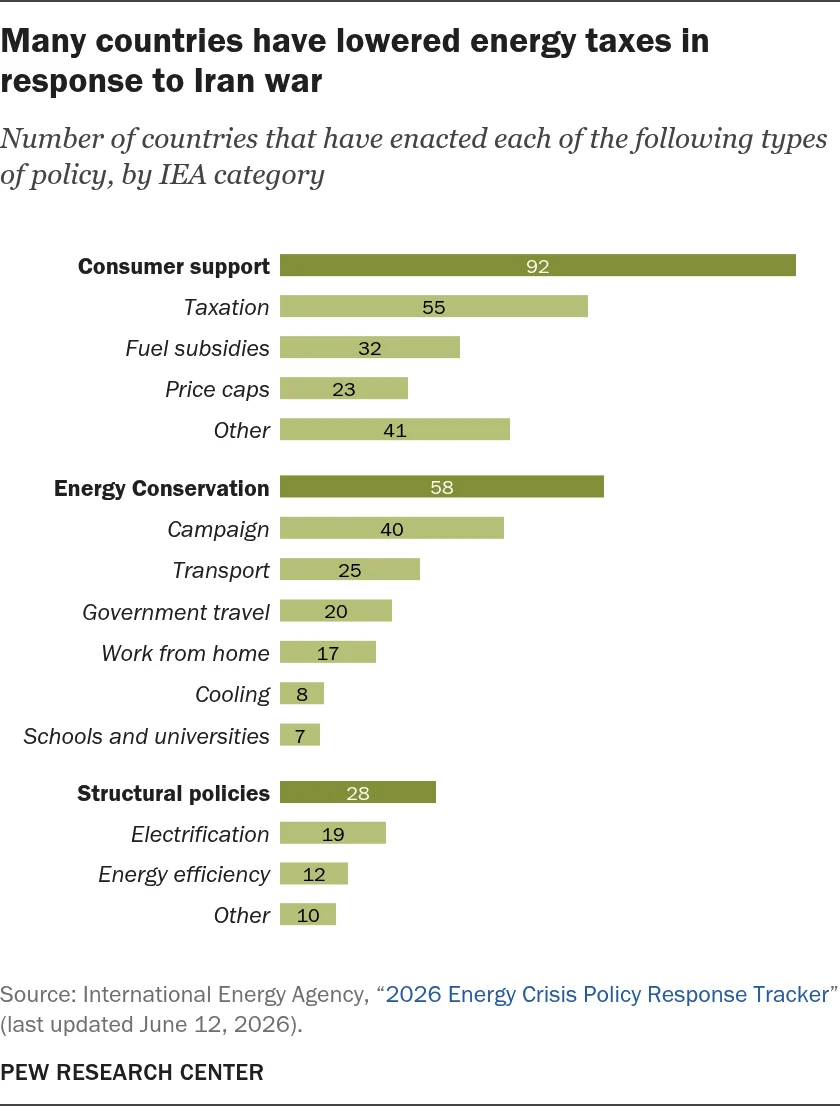
As the conflict in the Middle East continues to reshape global geopolitical and economic landscapes, the world is grappling with a profound energy crisis. According to the latest data from the International Energy Agency (IEA), the reverberations of the Iran war have prompted over 100 countries—alongside the European Commission—to intervene in their domestic energy markets. These policy shifts, ranging from aggressive taxation overhauls to radical conservation mandates, reflect a desperate global scramble to stabilize fuel prices and secure energy independence in an era of heightened volatility.
The Global Response: A Landscape of Intervention
The IEA’s 2026 Energy Crisis Policy Response Tracker, updated as of June 12, 2026, reveals a staggering scale of government activity. A total of 113 nations have enacted at least one major policy change to mitigate the fallout of the war. These interventions are broadly classified into three categories: consumer support, energy conservation, and structural policy changes.
The primary focus has been on the consumer. With energy prices spiking as a direct result of supply chain disruptions and fear-driven market speculation, 92 countries have implemented some form of consumer support. This includes direct financial aid, tax reductions, and, in some cases, the implementation of price caps to prevent hyper-inflation at the pump and the utility meter.
Chronology of the Crisis and Policy Implementation
The timeline of the conflict has dictated the rhythm of these policy responses. Following the initial eruption of hostilities in the Middle East, the first wave of policy action focused on immediate relief. Governments, particularly in the Asia-Pacific region, acted swiftly to prevent domestic unrest stemming from soaring costs.
By early 2026, the focus began to shift from simple relief to structural adjustment. As it became clear that the disruption to oil and gas supply chains would not be resolved in the short term, nations began to implement long-term conservation mandates.
- Early Phase (Q1 2026): Focus on immediate consumer relief, including the suspension of fuel taxes and the introduction of temporary subsidies.
- Mid-Phase (Q2 2026): Shift toward conservation, with countries introducing "work-from-home" incentives, restricted public building cooling, and public awareness campaigns.
- Structural Phase (Present): A pivot toward long-term energy security, with significant investments in electrification and energy efficiency projects designed to decouple national economies from volatile fossil fuel markets.
Supporting Data: The Anatomy of Government Action
The data provided by the IEA underscores the varying intensity of these interventions. While 92 countries have offered consumer support, the depth of these interventions varies significantly.
Consumer Support Measures
Taxation remains the most popular tool, with 55 countries choosing to lower energy taxes. Fuel subsidies have been adopted by 32 nations, while 23 have gone further by imposing strict price caps. An additional 41 countries have utilized "other" mechanisms, which often include targeted vouchers for low-income households or tax rebates for businesses heavily reliant on transport.

The Rise of Conservation
Perhaps the most notable trend is the widespread adoption of energy conservation policies. Fifty-eight countries have enacted mandates to reduce consumption. This is not merely a financial decision but a strategic one. By reducing demand, these nations are attempting to lower their vulnerability to global supply shocks.
- Campaigns: 40 countries have launched public awareness campaigns.
- Transport & Logistics: 25 nations have overhauled public transport priorities.
- Workplace Shifts: 17 countries have formally promoted work-from-home models to reduce commuter energy usage.
- Climate Control: 8 countries have introduced strict regulations on cooling, reflecting the intersection of energy security and seasonal demand management.
Regional Snapshots: Asia-Pacific and Europe
The Asia-Pacific region stands out as the most proactive in its policy response. Twenty-nine countries in this region have collectively enacted 124 distinct policy changes. In Bangladesh, for instance, the government has taken a multi-pronged approach: limiting air conditioning, closing universities to reduce campus energy loads, capping fuel purchases for individual vehicles, and aggressively promoting public transit.
Laos leads the region—and arguably the world—in the sheer variety of its interventions, having enacted nine distinct types of policies. Other nations, including India, Indonesia, and Vietnam, have each enacted at least six types of initiatives.
Europe, meanwhile, has taken a more systemic approach. Thirty countries, working in tandem with the European Commission, have enacted 86 policy changes. Sweden serves as a prime example of this integrated strategy, having halved public transport fares while simultaneously accelerating the electrification of public sector vehicles and providing targeted electricity bill subsidies for the agricultural and fishing sectors.
The American Exception: A Domestic Debate
While the rest of the world has engaged in widespread government intervention, the United States presents a unique case. As of mid-2026, the federal government has not enacted a nationwide energy policy shift in response to the war.
This is not to say the topic has been ignored. President Donald Trump famously floated the idea of suspending the federal gas tax in May 2026, a move that sparked significant debate regarding its potential impact on the Highway Trust Fund and long-term infrastructure investment. At the state level, however, some regions have taken action. States such as Georgia, Indiana, Kentucky, and Utah have moved to provide relief from state-level gas taxes, creating a patchwork of energy policy that contrasts sharply with the centralized, top-down responses seen in Europe and Asia.
Implications for the Future
The current crisis has served as a catalyst for a global transition that might have otherwise taken decades. The move toward electrification—already gaining momentum as a climate policy—has been accelerated by the necessity of national security. As countries look to decrease their reliance on imported, conflict-prone energy sources, the structural policies categorized by the IEA (which include 19 countries focused on electrification and 12 on broader energy efficiency) are likely to become the new baseline for economic planning.

Economic Consequences
The economic implications are twofold. In the short term, the fiscal burden of subsidies and tax cuts has strained national budgets, particularly in developing economies. However, the long-term shift toward energy efficiency and electrification could create a more resilient, less volatile economic framework.
Geopolitical Realignment
The war has highlighted the fragility of global energy supply chains. For countries that have historically relied on single-source energy imports, the push for diversification is no longer a choice but an existential requirement. We are witnessing the emergence of a new "energy sovereignty" movement, where nations prioritize the ability to produce or efficiently manage their own energy as a primary pillar of national defense.
Conclusion
The 2026 energy crisis, triggered by the war in the Middle East, has forced a global re-evaluation of energy dependency. While the immediate concern remains the cost of fuel and electricity for the average consumer, the long-term response is shifting toward a structural transformation of how nations consume energy.
Whether through the aggressive conservation measures seen in Bangladesh, the tax-heavy strategies of Europe, or the state-level adjustments in the United States, the world is clearly in the midst of a significant transition. As the IEA’s tracker continues to update, it serves as a chronicle of a global community learning to navigate a more unstable world—one where energy policy is now irrevocably linked to national security and global stability.
About this research:
This analysis relies on data from the International Energy Agency’s 2026 Energy Crisis Policy Response Tracker. For the purposes of reporting, countries are counted once per occurrence per category, even if they have enacted multiple specific policies within that category. For example, a country that cuts VAT on fuel, suspends hydrocarbon excise duties, and cuts electricity taxes is counted as having implemented one "Taxation" policy.
 Pevita Pearce