
 By Suro Senen
Main Facts
In an era where digital spaces increasingly shape social interaction, public discourse, and culture, understanding where and how Americans gather online has never been more critical. To address this evolving landscape, the Pew Research Center—acting through the Pew-Knight Initiative, a research program jointly funded by The Pew Charitable Trusts and the John S. and James L. Knight Foundation—released comprehensive methodological documentation detailing its latest nationwide study.
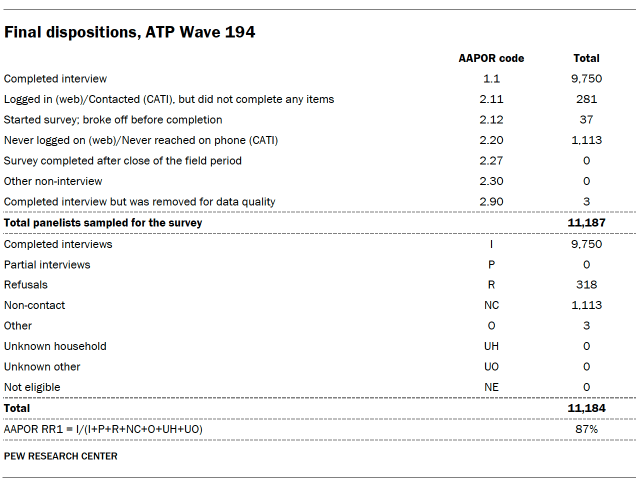
The report centers on Wave 194 of the American Trends Panel (ATP), a nationally representative, probability-based panel of randomly selected U.S. adults. Conducted between May 26 and June 1, 2026, the survey gathered insights from 9,750 respondents out of 11,184 sampled individuals, achieving an impressive survey-level response rate of 87%.
Beyond traditional survey metrics, Wave 194 stands out for its pioneering integration of Artificial Intelligence in open-end coding. Utilizing advanced large language model technology (GPT-5.2) paired with human validation, researchers systematically categorized thousands of unstructured responses detailing the focus of Americans’ most-visited online communities. This hybrid human-AI approach marks a significant methodological evolution in how major research institutions process complex qualitative data at scale.

Chronology of the Study
The execution of Wave 194 followed a rigorous, multi-week timeline designed to maximize response rates, maintain data integrity, and ensure rigorous quality control.
Pre-Fieldwork and Preparation (May 22 – May 25, 2026)
- May 22: Prenotification postcards were mailed to panelists selected for live telephone interviews to prepare them for upcoming outreach.
- May 25: Survey instruments, web programs, and logic randomizations underwent final stress-testing by project teams from SSRS (the survey vendor) and Pew Research Center. Testing was executed across both PC and mobile devices, with simulated datasets analyzed in SPSS to guarantee technical flawless execution before public deployment.
Fieldwork Deployment (May 26 – June 1, 2026)
- May 26 (Launch Day):
- Postcard notifications were dispatched to a subset of online panelists.
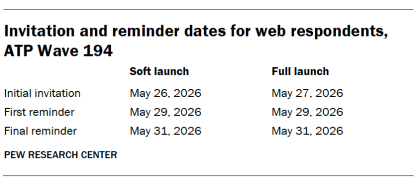
- A soft launch commenced for online respondents, incorporating 60 panelists to test system stability.
- Phone interviewing soft-launch activities began, continuing until a benchmark of seven completed interviews was achieved.
- May 27: The full launch for online respondents took place. Invitation emails and SMS messages (for opted-in participants) were distributed to all remaining English- and Spanish-speaking sampled panelists.
- Late Field Period (May 28 – June 1): Automated reminder systems deployed up to two email and two SMS follow-ups for non-responding web panelists. Meanwhile, trained live telephone interviewers from SSRS executed up to six placement calls to phone-based respondents.
- June 1: Data collection officially closed.
Post-Collection and Analysis (June 2026 and Beyond)
Following the close of field operations, Pew researchers performed exhaustive data-cleaning protocols, removing three respondents due to satisficing patterns (such as straight-lining or excessive missing answers). Weighting, calibration, and AI-assisted open-end text classification were subsequently executed, leading to final publication in late 2026.
Supporting Data and Survey Methodology
The reliability of Pew Research Center’s findings rests on a sophisticated infrastructure combining decades-old demographic weighting practices with state-of-the-art sampling frames.
Sample Design and Recruitment
The target population for Wave 194 comprised noninstitutionalized U.S. adults aged 18 and older. To capture this demographic accurately, the American Trends Panel relies on Address-Based Sampling (ABS), introduced in 2018.
- Sampling frames are drawn from the U.S. Postal Service’s Computerized Delivery Sequence File, which covers an estimated 90% to 98% of the U.S. population.
- Within each sampled household, the adult with the "next birthday" is selected to eliminate intra-household selection bias.
- To maintain longitudinal health, national recruitment sweeps occur roughly once per year, occasionally employing oversampling strategies (such as targeted oversamples of Hispanic adults in 2019, Black adults in 2022, and Asian adults in 2023) to ensure robust sample sizes for historically underrepresented communities.
Response Rates and Statistical Margins
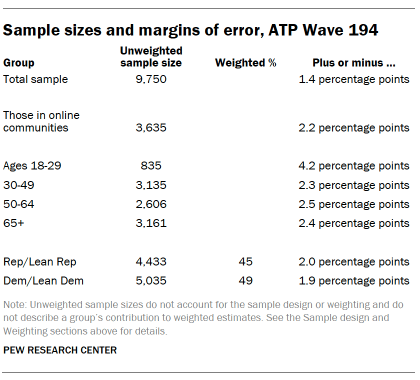
- Sampled Panelists: 11,184
- Completed Responses: 9,750 (9,464 online, 286 via live telephone)
- Survey-Level Response Rate: 87%
- Cumulative Response Rate (accounting for recruitment non-response and panel attrition): 3%
- Break-off Rate: Less than 1% among those who logged on and completed at least one item.
- Full Sample Margin of Sampling Error: Plus or minus 1.4 percentage points at the 95% confidence level.
To mitigate non-response bias among hard-to-reach populations, respondents were offered post-paid incentives ranging from $5 to $20, redeemable via check or digital gift codes for major platforms like Amazon, Target, and Walmart.
Weighting and Calibration
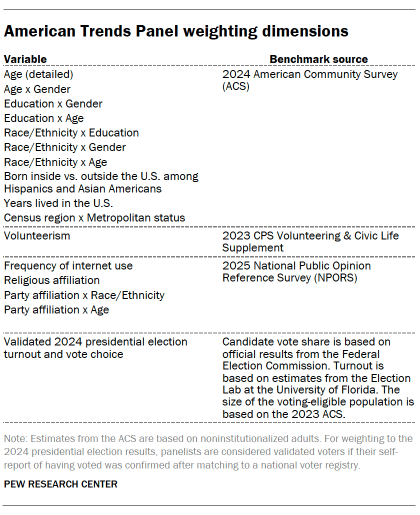
Data weighting corrects for differential probabilities of selection, recruitment nonresponse, and panel attrition. The multi-stage weighting process involves:
- Base Weighting: Reflecting the initial probability of a household being recruited into the panel.
- First Calibration: Aligning panelists with U.S. Census Bureau population benchmarks to counteract panel attrition.
- Wave-Specific Adjustments: Accounting for subsampling variations if specific panel segments were exclusively invited.
- Final Calibration and Trimming: Weights are recalibrated to population benchmarks and trimmed at the 1st and 99th percentiles to protect statistical precision against variance loss.
Official Responses and AI Coding Integration
One of the most notable technical achievements highlighted in the Wave 194 methodology is the deployment of AI-assisted text classification to decode open-ended survey responses regarding Americans’ favorite online communities.
The Challenge of Open-End Coding
Historically, analyzing open-ended text—where respondents type free-form answers about their favorite online spaces—required massive teams of human coders reading thousands of individual entries. This process, while thorough, is labor-intensive and susceptible to human fatigue and drifting interpretations.
The Hybrid AI-Human Workflow
Pew Research Center implemented a rigorous, transparent model-assisted protocol that bridges machine efficiency with human qualitative oversight:
- Unsupervised Theme Discovery: Researchers combined manual review of a pilot sample with an unsupervised theme-discovery method known as HypotheSAEs (Movva et al., 2025), utilizing sparse autoencoders and large language model interpretations to surface latent thematic categories.
- Codebook Establishment: A formal codebook was constructed, establishing 17 discrete categories to classify online community types.
- Model Training and Validation: The codebook was provided to GPT-5.2, alongside explicit prompting instructions to assign the single best-fit category (or the first referenced category if multiple were mentioned). To validate the AI, human coders independently evaluated a stratified sample of 210 responses without seeing the automated tags.
- Performance Metrics: Following minor iterative adjustments to the codebook, the automated coding system achieved an outstanding micro-averaged F1 score of 0.86, demonstrating high alignment between machine classification and human judgment.
- Human-in-the-Loop Oversight: Once the LLM categorized all 3,635 valid open-end responses, Pew researchers conducted a secondary audit to review, validate, and make minor corrections where necessary.
In strict adherence to institutional transparency, Pew Research Center published its complete AI prompt publicly, reinforcing its institutional policy that AI should augment—rather than blindly replace—rigorous human intellectual oversight in social science research.
Implications of the Research
The methodological framework deployed in Wave 194 carries profound implications for both survey research methodology and the broader sociological understanding of digital life.
For Survey Methodology
The successful integration of GPT-5.2 into open-end qualitative coding establishes a new benchmark for public opinion polling. By proving that large language models can achieve high-fidelity classification (F1 score of 0.86) when paired with strict human-in-the-loop validation, Pew has demonstrated how survey organizations can process qualitative data faster and more comprehensively without sacrificing academic rigor. Furthermore, the transparent disclosure of prompt design, error rates, and weighting adjustments addresses growing academic demands for algorithmic accountability in computational social science.
For the Study of Digital Communities
By combining probability-based sampling (the American Trends Panel) with advanced text categorization, the Pew-Knight Initiative ensures that insights regarding Americans’ online habits are not skewed toward hyper-online subcultures. Because the underlying sample is nationally representative and weighted against official U.S. benchmarks, policymakers, tech platforms, and sociologists can rely on these findings to understand how ordinary citizens—across diverse age brackets, socioeconomic statuses, and geographic regions—build social cohesion, seek support, and spend their time in virtual spaces.
Ultimately, Wave 194 serves as a masterclass in modern survey operations: blending classical demographic science with cutting-edge artificial intelligence to map the contours of 21st-century American life.
 Ammar Sabilarrohman
  Evan Lee Salim
  Ali Ikhwan