
 By Nana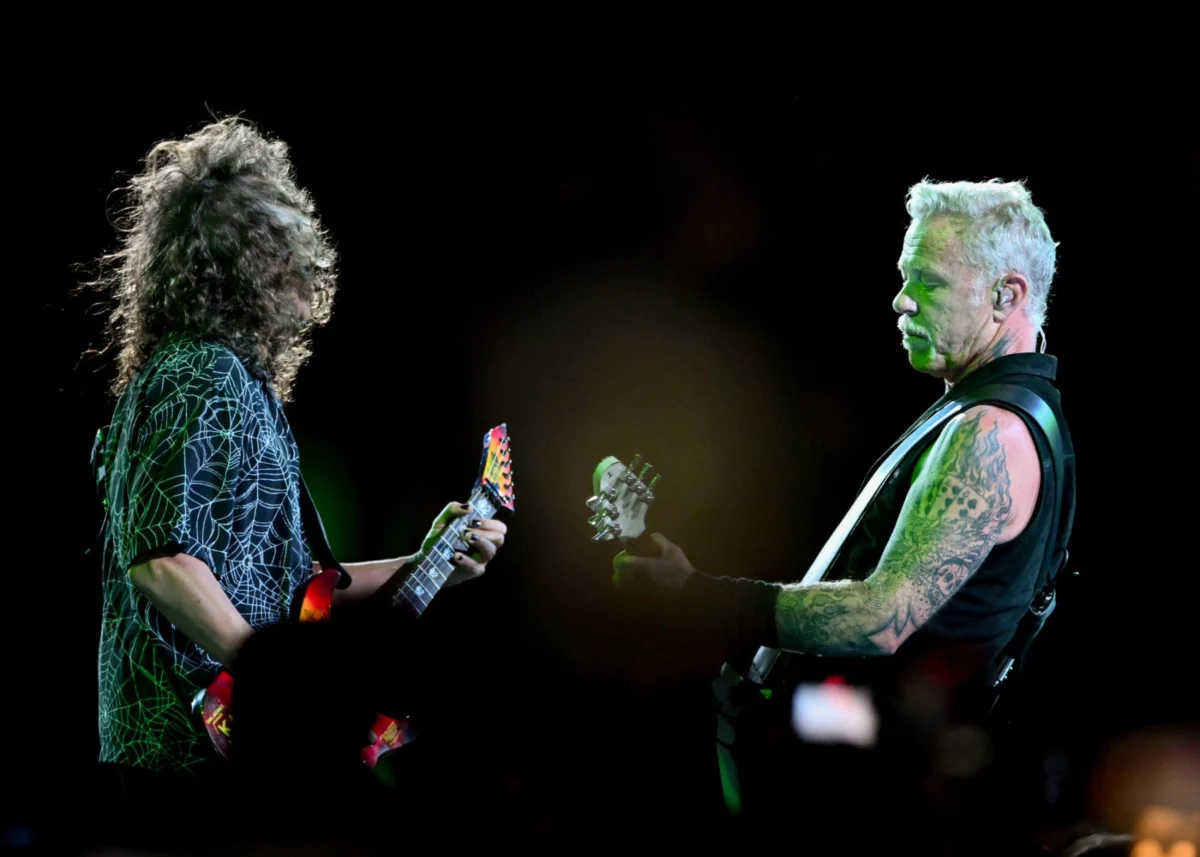
Metallica has long cultivated a reputation for breaking the traditional boundaries of heavy metal. Known for their unpredictable setlists and deep engagement with local cultures, the legendary thrash outfit transformed the Principality Stadium in Cardiff, Wales, into a focal point of cultural debate this past Sunday, June 28. During their ongoing, multi-year M72 world tour, the band continued their tradition of the “doodle” segment—a nightly interlude where bassist Robert Trujillo and guitarist Kirk Hammett perform a localized musical tribute. In Cardiff, the duo chose to honor Welsh icon Tom Jones with a rendition of his 1968 hit, “Delilah.” However, the performance immediately ignited a firestorm of controversy due to the song’s status as a “banned” anthem within the very walls of the venue.
The Performance: A Nod to Local Legend
The “doodle” segment has become a cornerstone of the M72 tour, serving as a palate cleanser between the high-octane thrash anthems that define a Metallica show. In previous stops, the band has paid homage to local musical heritage by covering Rammstein in Berlin, ABBA in Sweden, A-ha in Norway, The Pogues in Dublin, and The Proclaimers in Glasgow.
For the Cardiff date—the band’s first appearance in Wales in over three decades—the selection of Tom Jones was seen by many as a natural, if risky, choice. Robert Trujillo took lead vocal duties, commanding the massive crowd as the familiar, haunting melody of “Delilah” filled the stadium. The audience, well-versed in the song’s history, joined in with thunderous enthusiasm, singing the chorus: “Why, why, why, Delilah? / So before they come to break down the door / Forgive me, Delilah, I just couldn’t take any more.”
Chronology of the “Delilah” Controversy
To understand why a seemingly celebratory cover sparked such a volatile reaction, one must look at the recent history of the song at the Principality Stadium.

- 1968: Tom Jones releases “Delilah,” which peaks at No. 15 on the Billboard Hot 100 and becomes an enduring global hit.
- Decades of Tradition: The song becomes a staple for Welsh rugby fans, frequently belted out by choirs and crowds during matches at the national stadium.
- 2023: The Welsh Rugby Union (WRU) officially bans the performance of “Delilah” by official stadium choirs. The decision is rooted in the song’s lyrics, which depict a man murdering his wife after discovering her infidelity.
- July 2023: During a performance at Cardiff Castle, Tom Jones publicly defies the ban, telling his audience, “You can’t stop us singing ‘Delilah.’ They may stop the choir from singing it, but they haven’t stopped the crowd. Keep on singing it.”
- June 28, 2026: Metallica performs the song at the Principality Stadium, effectively breaking the unspoken social embargo placed on the track by the venue’s governing body.
The Lyrics and the Societal Shift
The controversy surrounding “Delilah” is not merely about musical taste; it is about the intersection of pop culture and the modern discourse on domestic violence. The lyrics, penned by songwriter Barry Mason, tell the story of a man’s descent into a murderous rage after witnessing his partner with another man.
In its 2023 announcement, the WRU stated clearly: “We condemn domestic violence of any kind.” The union consulted with subject matter experts, concluding that the song’s subject matter is “problematic and upsetting to some supporters.” The ban specifically targeted the choirs—the official representatives of the stadium’s atmosphere—to signal a shift in the venue’s stance on what is considered appropriate public entertainment.
Critics of the ban, including Tom Jones himself, argue that the song is a work of fiction and a cultural artifact that should not be subject to modern censorship. Supporters of the ban, however, maintain that in the context of a stadium environment, normalizing lyrics about femicide is inappropriate, regardless of the song’s historical popularity. By performing the song, Metallica inadvertently thrust themselves into the middle of this “culture war,” proving that even a global metal juggernaut is subject to the local sensitivities of the territories they visit.
Official Responses and Public Reaction
The reaction to Metallica’s performance has been sharply divided. Social media platforms were flooded with commentary, ranging from praise for the band’s defiance to criticism for their perceived insensitivity.

Metallica’s camp has remained silent regarding the controversy, focusing instead on the successful completion of the show and their philanthropic efforts. In an act that bridged the gap between the stadium controversy and community support, the band announced a significant donation to the Cardiff Foodbank via their All Within My Hands foundation.
The charity reported that the donation, totaling more than $26,000, would be instrumental in replenishing their warehouse. “This contribution will help us support around 1,000 people with the equivalent of 9,000 meals,” the organization noted in an Instagram post. This act of generosity served to shift the narrative, refocusing attention from the lyrical controversy to the band’s tangible impact on the local community.
Implications for Future Performances
The incident in Cardiff raises broader questions about the responsibility of touring artists. When a band travels internationally, are they expected to abide by the specific cultural or administrative bans of a venue, or is their role to act as a mirror for the audience’s desires?
For Metallica, the "doodle" segment is intended to be a moment of connection. By selecting a song that the venue itself has attempted to suppress, the band inadvertently created a political statement. This may prompt concert promoters and venue operators to be more explicit in their requirements for guest artists in the future, or it may lead to a more relaxed enforcement of such bans, as the audience’s vocal support for the song demonstrates that the “ban” is largely ineffective against the collective will of a crowd.

Looking Ahead: The M72 Tour and Beyond
The Cardiff show was merely one stop on a relentless schedule. Metallica is slated to perform at the London Stadium for two shows on July 3 and July 5, before taking a brief respite for the remainder of the summer. The break is a necessary recovery period before the band embarks on one of the most ambitious undertakings of their career: a 24-date residency at the Sphere in Las Vegas, beginning October 1.
The “Life Burns Faster” residency is expected to utilize the cutting-edge technology of the Las Vegas venue, promising a visual and auditory experience that will contrast sharply with the raw, acoustic-leaning “doodles” of the M72 world tour.
As the band moves forward, the Cardiff incident serves as a reminder of the power of live music to stir deep-seated emotions and spark public dialogue. While the lyrics of “Delilah” remain a point of contention, the event demonstrated that Metallica continues to command a level of influence that extends far beyond the stage. Whether they intended to be provocative or simply appreciative of a Welsh legend, the band has ensured that their return to Wales will be remembered for its complexity as much as its musicality.
In an era where artists are increasingly cautious about their public image, Metallica’s willingness to walk into the center of a local debate—even if unintentionally—highlights the enduring, unpredictable nature of their live performances. As they prepare to take on the technological marvel of the Sphere, fans can only wait to see if the band will continue to push boundaries, both in their production and in their engagement with the ever-changing cultural landscape of the cities they visit.
 Ali Ikhwan
  Suro Senen
  Reynand Wu