
 By Ali Ikhwan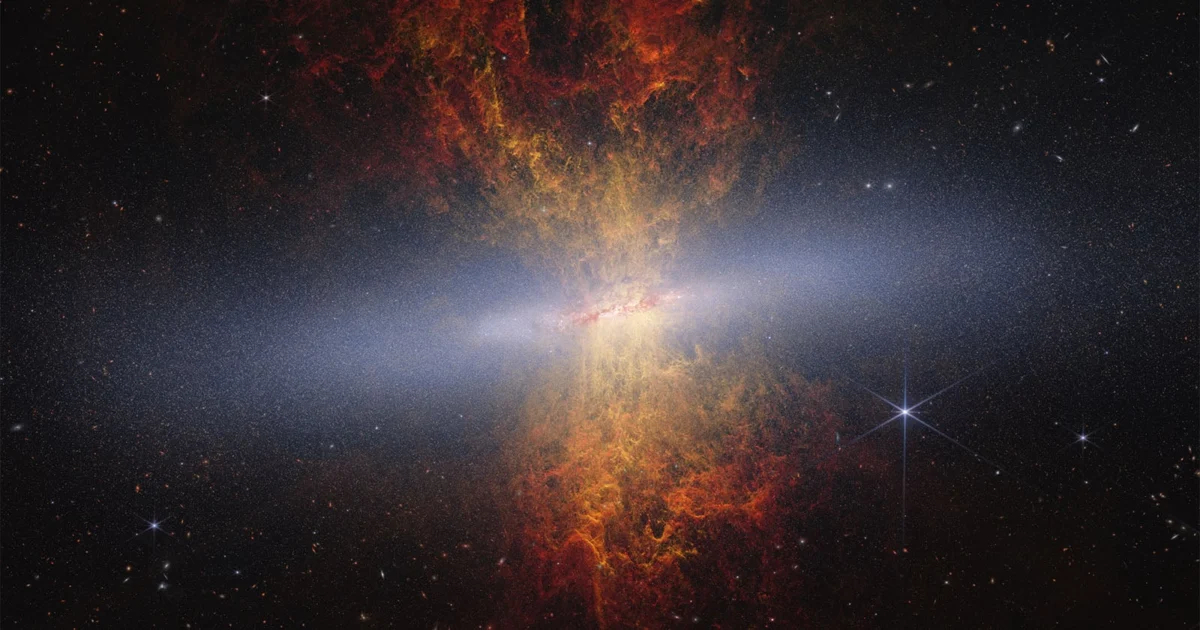
In a monumental achievement for modern astrophysics, the James Webb Space Telescope (JWST) has turned its infrared gaze toward Messier 82 (M82), the enigmatic "Cigar Galaxy." By dedicating 65 hours of observation time to this turbulent starburst galaxy, researchers have captured a staggering 223-megapixel mosaic that resolves 16.5 million individual stars—a feat of clarity that provides an unprecedented "fossil record" of galactic evolution.
This new data, which combines Webb’s Near-Infrared Camera (NIRCam) observations with archival imagery from the Hubble Space Telescope, is not merely a collection of breathtaking astronomical art. It serves as a critical diagnostic tool, allowing scientists to strip away the dense veils of dust and gas that have long obscured the mechanics of M82’s violent star formation.
The Main Facts: A Laboratory of Chaos
Messier 82, located in the constellation Ursa Major, has long been a favorite subject for astronomers due to its proximity and its extreme physical properties. Classified as an "edge-on" starburst galaxy, M82 is currently undergoing a period of intense star formation that proceeds at a rate approximately ten times faster than that of our own Milky Way.
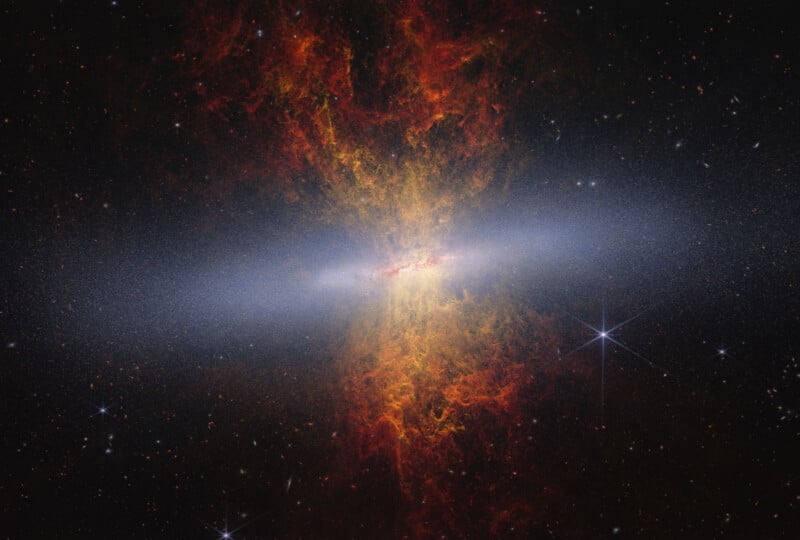
The recent JWST imaging campaign has revealed the galaxy’s "distended disk structure" with startling precision. Where previous telescopes saw only a blurred, glowing mass, Webb has identified individual stars, allowing researchers to map the distribution of stellar populations across the galactic plane. The resulting composite image features a vibrant spectrum of data: blue-white points representing the 16.5 million resolved stars, while red-orange hues highlight the dense dust grains and ionized hydrogen gas that characterize the galaxy’s turbulent environment.
A Chronology of Discovery: From Hubble to Webb
To understand the significance of this new data, one must look at the progression of our observational capabilities. For decades, the Hubble Space Telescope provided the gold standard for M82 imaging. Hubble’s strengths lie in the visible and ultraviolet spectrums, which are excellent for capturing the complex, sweeping plumes of ionized hydrogen gas being ejected from the galaxy’s center.
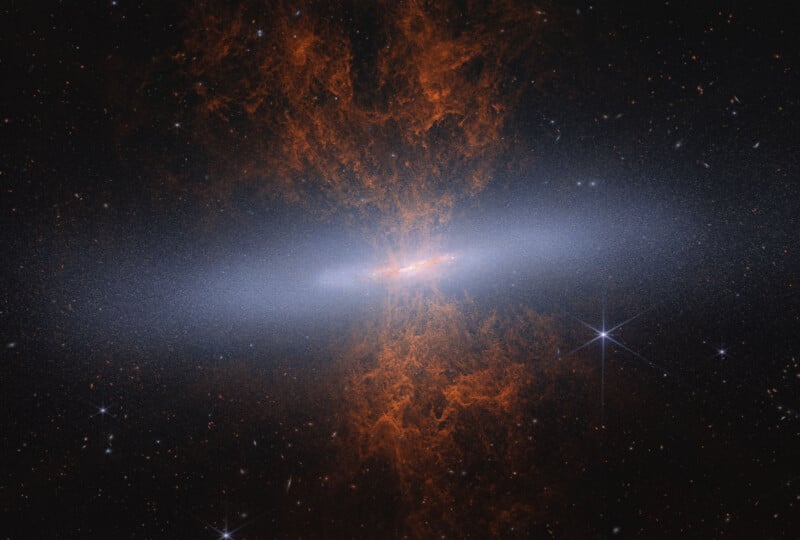
However, visible light is easily scattered and absorbed by the interstellar dust that permeates the Cigar Galaxy. This is where the James Webb Space Telescope shifts the paradigm. Because Webb operates primarily in the near-infrared, it functions like a cosmic set of night-vision goggles. Infrared light travels through dust clouds that would otherwise act as an impenetrable wall to Hubble.
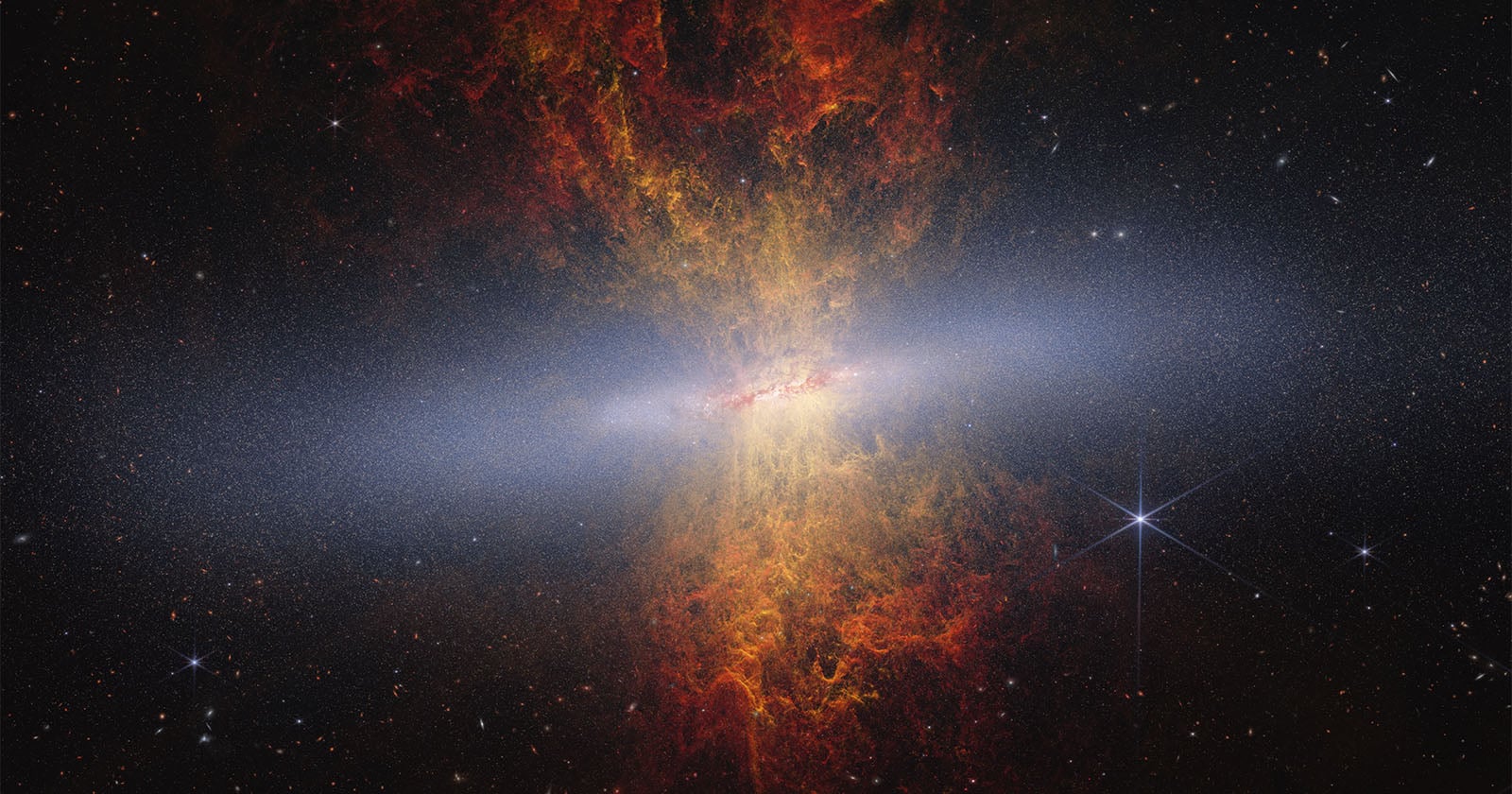
By layering these two datasets, scientists have created a "multi-messenger" view of the galaxy. The recent 65-hour observation period represents the culmination of a long-term strategy to synthesize data from different missions. This integration allows astronomers to witness both the "gaseous outflows"—the material being blown out of the galaxy—and the stellar "engines" that drive these processes, providing a cohesive timeline of M82’s current epoch.
Supporting Data: Decoding the Stellar Fossil Record
The sheer density of information contained within the 223-megapixel image is staggering. By resolving 16.5 million individual stars, the research team has gained the ability to conduct "stellar archaeology." Each star acts as a data point, recording the conditions of the environment at the time of its birth.
"The sheer number of stars that we were able to resolve with Webb is incredible," says Benjamin Williams of the University of Washington, a core member of the observation team. "It’s a whole different world from what we’ve been able to see with other telescopes. All of these stars collectively provide a detailed fossil record of the formation and evolution of M82."
The data highlights a unique phase in the galaxy’s lifespan. Scientists believe M82’s current state of hyper-activity was triggered by a past galaxy merger, an event that compressed gas clouds and sparked a massive wave of stellar birth. However, this phase is finite. Astronomers estimate that M82 will remain in this state for only a few hundred million years—a mere blink of an eye in the cosmic timescale. Once the reservoir of cold gas is exhausted, the starburst will cease, and the galaxy will transition into a more quiescent, albeit aged, structure.
Official Perspectives: Navigating the "Beautiful Mess"
The scientific community is currently grappling with the complexity of these findings. Adam Smercina, a NASA Hubble Fellow at the Space Telescope Science Institute and incoming Assistant Professor at Tufts University, captures the sentiment of the team with a touch of candid academic humility.
"M82 is a mess, but it’s a beautiful mess," Smercina explains. "We don’t fully understand what’s going on, especially concerning its evolutionary history. What could have triggered such an elevated rate of star formation? How long has this galaxy been driving plumes of material away from its center?"
These questions are at the heart of the research. M82 serves as a "galaxy evolution laboratory" because it presents an exaggerated version of processes that occur in smaller, less observable galaxies. By studying the extreme, scientists can develop more accurate models for galaxy formation in the early universe.
Kristen McQuinn, also of the Space Telescope Science Institute, emphasizes that this discovery is a testament to the power of inter-mission collaboration. "Galaxies are such intricate ecosystems that if you truly want to understand them, you have to pull datasets from different missions together," she notes. "When you marry the datasets, you expand what you can probe, and the questions that you can pose are even more complex."
The Broader Implications: Understanding Galactic Mortality
The implications of the M82 study extend far beyond the Cigar Galaxy itself. By analyzing how a starburst galaxy lives, evolves, and eventually burns out, researchers are gaining insight into the lifecycle of the universe’s most vital structures.
1. Galactic Outflows and Feedback
The high-resolution imagery allows researchers to better understand "galactic feedback"—the process by which intense star formation creates winds that push gas and heavy elements out of the galaxy. This material eventually enriches the intergalactic medium, providing the raw ingredients for future generations of stars and planets.
2. Refining Cosmological Models
The data collected by NIRCam provides a benchmark for simulations. If our current computer models of how galaxies merge and grow cannot replicate the density and distribution of stars seen in the Webb image, then those models must be revised. This constant cycle of observation and refinement is the engine of astrophysical progress.
3. A Precursor to Future Observations
The success of this 65-hour observation proves that JWST is the ideal instrument for "nearby" galactic studies. While Webb is famous for its ability to look back to the dawn of time, its contribution to local galactic physics is arguably just as profound. The ability to resolve millions of stars in a neighboring galaxy allows us to test the laws of physics in our own cosmic backyard before applying them to the distant, light-faint galaxies at the edge of the observable universe.
Conclusion: A New Era of Clarity
The Cigar Galaxy, once a blurry smudge in the lens of 20th-century telescopes, has been transformed by the James Webb Space Telescope into a high-definition map of galactic history. The image is more than just a testament to the engineering prowess of the global scientific community; it is a profound reminder that we are living in a golden age of astronomy.
As the team at STScI and their partners continue to parse the 16.5 million stars captured in this survey, the "beautiful mess" of M82 will slowly begin to yield its secrets. We are no longer guessing at the mechanics of the Cigar Galaxy; we are now measuring them, counting them, and mapping them with a precision that was once the stuff of science fiction. In the coming years, the data harvested from these 65 hours will undoubtedly form the basis for dozens of new papers, each one bringing us a step closer to understanding the life and death of galaxies in our vast, unfolding universe.
Credits and Acknowledgments:
The study and imaging of M82 were made possible by a collaborative effort involving NASA, the European Space Agency (ESA), and the Canadian Space Agency (CSA). Key contributors included Adam Smercina (STScI, Tufts University) and Thomas Williams (University of Manchester). The intricate image processing was performed by Alyssa Pagan of the Space Telescope Science Institute.
 Laily UPN
  Reynand Wu
  Lina Hope