
 By Nila Kartika Wati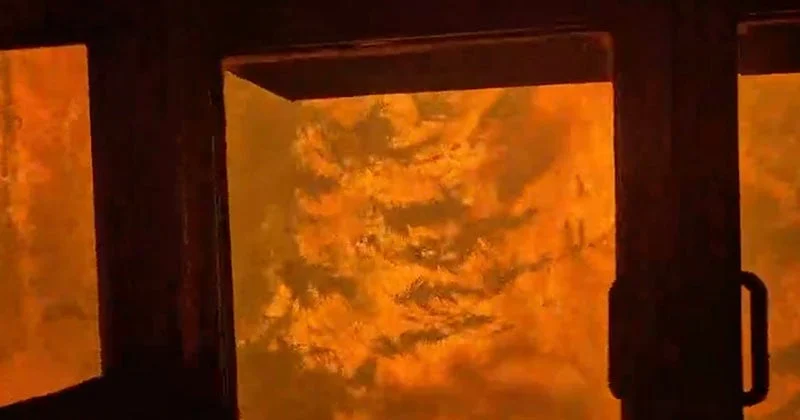
Introduction: A Descent into the Inferno
In a chilling display of the escalating climate crisis currently gripping the Canadian north, a harrowing video has emerged from the cabin of a Canadian National (CN) Rail freight train. The footage, which has since gone viral, captures the terrifying reality of a train crew trapped amidst a fast-moving, high-intensity forest fire near Armstrong, Ontario.
As the video progresses, the view from the cabin window shifts from a typical forest landscape to an apocalyptic vista of searing orange flames and thick, suffocating smoke. The footage—which includes understandably panicked dialogue from the crew—serves as a stark reminder of the volatile intersection between industrial infrastructure and the increasingly unpredictable behavior of climate-driven wildfires. While all employees were eventually accounted for and safely evacuated, the incident has ignited a firestorm of its own regarding corporate safety protocols, the management of critical rail corridors, and the vulnerability of northern communities in an era of extreme weather.
Chronology of a Crisis
The incident, which took place on Monday, July 13, 2026, occurred against a backdrop of record-breaking temperatures and persistent drought conditions that have plagued the region throughout the summer.
The Standoff
The CN Rail train was moving through a remote stretch of track near the town of Armstrong, Ontario—a hub historically significant for its rail activity—when it encountered an rapidly advancing fire front. According to preliminary accounts, the blaze, spurred by high winds and dry underbrush, jumped the tracks or encroached upon the corridor with such velocity that the train was forced to come to an abrupt halt.
For a period that has yet to be fully defined by official timelines, the train crew found themselves sitting in a steel vessel surrounded by a wall of fire. The video captured by one of the crew members, and later shared by Ontario politician Sol Mamakwa, reveals the visceral reality of the situation. As the sky turned a sickly, bruised orange and visibility dropped to near zero, one crew member is heard remarking, “This could potentially overtake us here. This is getting a little scary.”
The Evacuation
The realization of the danger led to an immediate emergency response. By the time the train was immobilized, the surrounding forest was already fully engulfed. Coordination between the train crew, CN’s dispatch centers, and local emergency services in Armstrong facilitated an evacuation. By the early hours of Tuesday, all rail personnel had been successfully extracted from the area. The town of Armstrong itself, facing the same encroaching threat, also underwent an overnight evacuation, as provincial authorities declared the wildfire situation in the region to be a critical emergency.
Supporting Data: The Context of Northern Ontario’s Fire Season
To understand why a train would be caught in such a precarious position, one must look at the broader environmental data surrounding the summer of 2026.
Meteorological Factors
Northern Ontario has experienced an anomalous season characterized by persistent high-pressure ridges that have trapped heat over the boreal forest. The Boreal Shield, which covers much of the province, is highly susceptible to "crown fires"—intense blazes that move through the tops of trees—particularly when humidity levels drop below 20%. The fires in the Armstrong region were classified as high-intensity, meaning they possess the capability to generate their own weather patterns, including lightning and localized wind gusts that can push flames across containment lines with terrifying speed.
Infrastructure Vulnerability
Rail lines in Northern Ontario are often isolated, cutting through dense forest tracks where road access is limited or non-existent. These corridors act as arteries for the Canadian economy, transporting everything from lumber and ore to consumer goods. However, these same arteries are now proving to be high-risk zones. The fire season of 2026 has seen a surge in "interface fires," where natural wildfires meet industrial or residential zones. The incident near Armstrong highlights a systemic challenge: how to maintain the continuity of supply chains when the very geography they traverse is physically burning.
Official Responses and Corporate Accountability
The viral nature of the video placed immediate pressure on the Canadian National Railway Company to account for the safety of its staff and the decision-making process that led to the train’s proximity to the fire.
CN Rail’s Stance
In a formal statement released to Global News and other media outlets, CN Rail confirmed the incident and the subsequent evacuation. The company stated: “CN has temporarily suspended rail operations near Armstrong, ON as a precaution due to wildfire activity in the area. As a safety measure, CN employees in the area and residents of the Town of Armstrong were evacuated overnight.”
The company emphasized that the safety of its workforce and the local community remains its “top priority.” They further clarified that they are working in close cooperation with the Canadian Ministry of Natural Resources and local municipal emergency coordinators. Despite these assurances, the company has remained tight-lipped regarding the specifics of the train’s movement orders—specifically, whether there were warnings of the fire’s progression that were overlooked or miscalculated by dispatchers prior to the train entering the danger zone.
Political Oversight
Sol Mamakwa, the Member of Provincial Parliament (MPP) who brought the video to public attention, has demanded greater transparency. By sharing the footage on X (formerly Twitter), Mamakwa challenged the company directly: “When will the Canadian National Railway Company make a statement about this incident?” His involvement underscores the political weight of the situation, as he represents the very communities—often First Nations—that are disproportionately affected by the loss of forests and the smoke-choked air accompanying these mega-fires.
Implications: A New Reality for Rail and Resilience
The Armstrong incident is more than a singular news story; it is a case study in the new reality of the 21st century.
Safety Protocols in Flux
Industry analysts suggest that the standard operating procedures for freight trains in fire-prone regions may need a radical overhaul. If a train can be trapped by a fire moving at high speed, the "wait and see" approach of current dispatch protocols may be insufficient. Future operations may require real-time satellite thermal monitoring and the implementation of "no-go zones" that are adjusted hourly based on fire weather indices.
The Human Toll
Beyond the immediate danger to the crew, the environmental and economic impacts are staggering. Dozens of active wildfires are currently ravaging the region, creating a plume of smoke that has stretched across the border, affecting air quality as far south as the northern United States. For the local First Nations and residents of northern settlements, these fires are not just a logistical inconvenience—they are an existential threat to their homes, their traditional hunting grounds, and their health.
The Climate-Infrastructure Nexus
The incident forces a difficult conversation about the resilience of critical infrastructure. As the climate continues to warm, the frequency and intensity of wildfires in boreal regions are projected to increase. Protecting rail lines, power grids, and highways from these events will require massive investments in vegetation management, fire-resistant materials, and perhaps even the strategic rerouting of critical lines away from high-risk corridors.
Conclusion: A Warning from the Tracks
The video from inside the CN Rail train is a haunting testament to the power of nature and the fragility of human systems. While the crew escaped the flames, the questions left in the wake of the fire remain unresolved. Why was the train in the path of such a rapidly moving fire? How can we better protect the workers who keep our economy moving when the wilderness they travel through turns against them?
As of late July 2026, the fires in Northern Ontario continue to burn. For the residents of Armstrong and the surrounding communities, the focus remains on survival and the eventual containment of the blazes. For the rest of the country, the incident serves as a stark, fiery wake-up call that the environmental landscape has changed, and our approach to safety and infrastructure must evolve just as quickly to keep pace with the flames.
 Raul Delapena Setiawan
  rifanmuazin
  Ammar Sabilarrohman