
 By Sagoh
Market behavior is shifting, but most brands are looking in the wrong direction. For years, the marketing playbook has focused on "discovery"—how to get a brand in front of a consumer’s eyes. However, the rise of artificial intelligence has fundamentally altered the second, and arguably more critical, phase of the purchase funnel: the decision.
AI is no longer just a tool for content creation or automated customer service. It has become a cognitive proxy, a digital concierge that summarizes options, weighs pros and cons, and influences outcomes before a consumer ever visits a brand’s website. For marketers, the realization is sobering: your brand is being interpreted, filtered, and ranked by algorithms you do not control.
To survive in this new landscape, brands must decode how different generations delegate their decision-making to AI. The technology remains constant, but the relationship with it is radically different across the age spectrum.
1. The New Consumer Funnel: The Rise of the AI Intermediary
The traditional marketing funnel—Awareness, Interest, Desire, Action—is being compressed. Consumers are increasingly bypassing direct brand interaction in favor of AI-generated summaries. Recent data indicates that over 60% of consumers now rely on AI for product research.
When a consumer asks an AI model, "What is the best running shoe for high arches?" they aren’t visiting a dozen websites. They are receiving a curated list of recommendations based on a model’s training data and real-time synthesis. If your brand isn’t present in that synthesized answer, you are effectively invisible to that shopper.
The Fragmentation of Discovery
Discovery is no longer centralized. While Google remains a pillar, search behavior has fragmented across platforms like TikTok, Instagram, and Reddit, with AI-powered results now layered into each. For Gen Z, the shift is particularly pronounced: 40% are already utilizing social media platforms as their primary search engines, opting for the visual and social proof of TikTok over the traditional blue-link search results of the past.
2. Chronology: The Evolution of Decision-Making
To understand where we are, we must look at how the "search for truth" has evolved over the last decade:
- 2015–2018: The Era of SEO Dominance. Brands focused on keyword density and technical SEO. The consumer journey was linear: Search Query → Click → Website → Conversion.
- 2019–2022: The Social Search Shift. Influencer marketing became the new SEO. Consumers looked to peers and creators on platforms like Instagram and TikTok to validate products before purchasing.
- 2023–2025: The Rise of Conversational AI. The launch of generative AI models shifted the paradigm again. Consumers began using chat interfaces to perform "zero-click" research.
- 2026 and Beyond: The Predictive Layer. We are now entering an era where AI doesn’t just answer questions; it anticipates needs based on cross-platform data, integrating into smart devices, CTV, and mobile ecosystems to guide decisions before the consumer even realizes they have a problem.
3. Generational Nuances: How Trust Differs
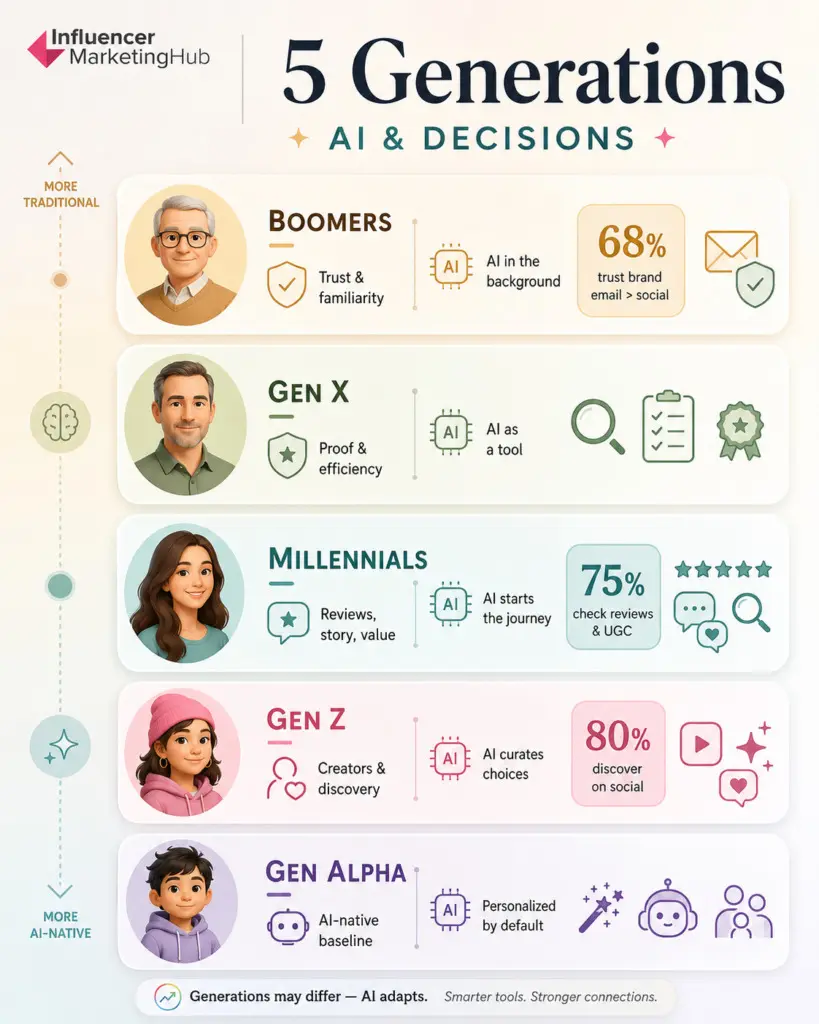
The integration of AI into the decision-making process is not uniform. Different generations treat the "AI layer" with varying levels of skepticism and reliance.
Gen Z: The AI-Native Shoppers
For Gen Z, AI is a utility for efficiency. They are the most likely to trust AI-generated summaries because they have grown up with algorithmic feeds. They use AI to bypass the "fluff" of traditional marketing, seeking raw, summarized facts.
Millennials: The Validation Seekers
Millennials use AI to aggregate data, but they remain heavy users of social proof. They are likely to use an AI tool to generate a "shortlist" of products, but they will cross-reference those results with Reddit threads or influencer reviews before finalizing a decision.
Gen X and Boomers: The Efficiency Adopters
These generations are the fastest-growing demographic for AI adoption. They often use AI to simplify complex purchasing decisions (e.g., healthcare, financial services, or home appliances) where the volume of information is overwhelming. For them, AI acts as a trusted advisor, reducing the mental fatigue associated with research.
4. Supporting Data: The Multi-Screen Reality
The modern consumer journey is profoundly fragmented. Research shows that 87% of consumers utilize a "second screen" while watching television. This behavior creates a chaotic, multi-platform environment where brands must maintain a consistent presence.
- Conversion and Intent: 70% of consumers state that in-person or high-touch digital experiences significantly increase their purchase intent. However, AI is now the gatekeeper determining which of those experiences a consumer is exposed to.
- Personalization Power: 75% of consumers are more likely to purchase from brands that provide personalized offers. AI has moved beyond simple "if-then" logic to sophisticated predictive modeling, allowing brands to serve the right offer at the precise moment of decision.
5. Official Perspectives: The Strategic Pivot
Industry leaders have begun to acknowledge that the old guard of digital marketing is failing. In recent discussions, analysts have noted that "generic offers are dying." The "discount-at-all-costs" mentality is being replaced by "value-based personalization."
The consensus among market researchers is that brands must move toward "Algorithmic Presence Management." This involves:
- Semantic Optimization: Moving beyond keywords to ensure brand concepts are correctly understood by large language models (LLMs).
- Platform Neutrality: Ensuring that a brand’s value proposition is equally compelling on TikTok as it is in a ChatGPT response or a Google snippet.
- Data Integrity: Providing high-quality, structured data to AI crawlers so that the brand’s features and benefits are accurately summarized.
6. Implications for Brands: The Path Forward
If your brand is not showing up accurately in AI-generated summaries, you are losing ground before the customer even lands on your site. The implications are clear:
Precision is the New Scale
In the past, marketing was about reaching as many people as possible. Now, it is about being the most relevant answer to a specific, AI-mediated query. This requires a shift in budget allocation from broad-reach awareness campaigns to high-precision content strategies that feed the "AI layer."
The "Black Box" Challenge
Brands must accept that they cannot fully control the AI-generated output. Instead, they must influence the inputs. By creating content that is highly cited, frequently referenced in credible social conversations, and structured for machine readability, brands can increase their "authority score" within AI models.
Integrating the Funnel
The most successful brands of 2026 are those that have unified their search, social, and AI strategies. They don’t treat SEO as a separate silo from social media marketing. They understand that a TikTok viral moment can trigger an AI to include the brand in a research summary, which then drives traffic to a highly personalized landing page.
Conclusion: The Era of AI-Assisted Intent
The fundamental shift we are witnessing is the movement from brand-led discovery to AI-assisted decision-making.
For the modern CMO, the goal is no longer just to build a message. It is to understand the audience’s decision-making process at a granular level. Ask yourself: Who am I trying to reach? How do they make decisions? And what is the AI layer telling them about my brand before I even enter the conversation?
Conversion in 2026 is a byproduct of precision. By mastering the intersection of human psychology and artificial intelligence, brands can stop chasing the consumer and start being the answer they are looking for—no matter how, or where, they choose to ask.
About the Author:
Nadica Naceva is a veteran content strategist and researcher at Influencer Marketing Hub. With a keen eye for market trends and a commitment to stripping away marketing jargon, she focuses on how emerging technologies like AI are reshaping the digital landscape. Her work is dedicated to helping brands navigate the transition from traditional marketing tactics to the data-driven, machine-influenced reality of the modern age.
 Iffa Jayyana
  Siti Muinah
  Asro
Asro 