
 By Laily UPN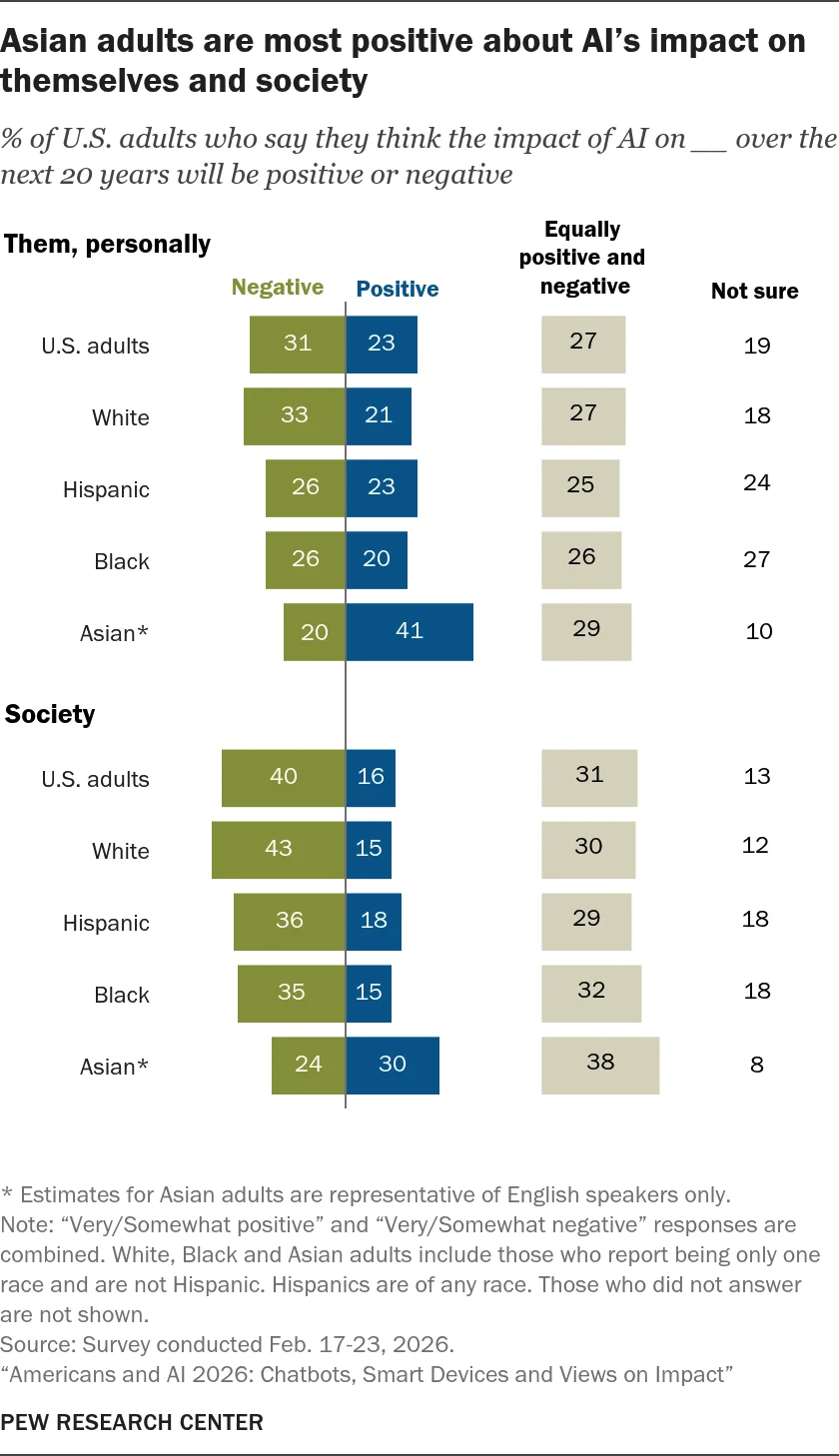
Artificial intelligence is no longer a futuristic concept relegated to science fiction; it is a fundamental component of the modern American experience. From the ubiquity of generative chatbots like ChatGPT, Gemini, and Copilot to the integration of smart home features, AI is weaving itself into the fabric of daily life. However, a new comprehensive study from the Pew Research Center reveals that the adoption, utilization, and perception of these powerful tools are far from uniform across the American population.
The data, derived from a survey of U.S. adults conducted in February 2026, highlights a striking "AI divide." While familiarity with these technologies is widespread, race and ethnicity have emerged as significant predictors of how Americans interact with AI and how they envision its future impact on society and their own lives. Among these demographic shifts, Asian Americans consistently stand out, reporting higher rates of usage, greater technical integration in their professional and personal lives, and a more pronounced optimism regarding the trajectory of artificial intelligence.
Main Facts: A Disparate Landscape of Adoption
The core finding of the research is that while roughly half of all U.S. adults have engaged with AI chatbots, this headline figure masks deep disparities. When broken down by race and ethnicity, the data reveals that Asian adults are significantly more likely to utilize these tools. Seven-in-ten Asian adults report using AI chatbots, a figure that dwarfs the participation rates among Black, Hispanic, and White counterparts, which hover around or below the 50% mark.
This isn’t merely a matter of occasional experimentation. The frequency of use is where the gap widens further. Nearly half (47%) of Asian adults report using chatbots on a daily basis—a category defined by researchers as using these tools "almost constantly," "several times a day," or "about once a day." In stark contrast, only about a quarter or less of Hispanic, Black, and White adults report such high-frequency engagement.
This adoption gap is mirrored by a gap in awareness. When asked about their familiarity with AI chatbots, the majority of Americans across all groups express some level of knowledge. However, Asian Americans are uniquely likely to have "heard a lot" about these tools, with 68% reporting deep familiarity, compared to roughly 41% to 44% for other racial groups.

Chronology: The Evolution of the AI Sentiment
To understand where we are, one must look at the trajectory of the past few years. The 2026 findings are not an outlier; rather, they represent a continuation of trends identified by the Pew Research Center as early as 2024.
During the initial surge of generative AI into the public consciousness, adoption was largely characterized by curiosity and early experimentation. As the technology matured between 2024 and 2026, the initial "hype cycle" transitioned into a phase of utility. The 2024 data showed the beginnings of this demographic divide, but by early 2026, the gap had solidified into a behavioral norm.
The chronology of this shift suggests that as AI tools became more integrated into workplace software suites and educational platforms, specific segments of the population—particularly those in tech-heavy industries or academic environments—began to lean into AI as a productivity multiplier. The persistent nature of these differences over the last two years indicates that the "AI divide" is not merely a transient phase but a structural development in how different communities interface with emerging digital infrastructure.
Supporting Data: The Utility of AI in Daily Life
The depth of the divide becomes most apparent when examining how these tools are being used. The survey provides a granular look at the practical applications of chatbots across racial lines, and in almost every category, Asian Americans report higher usage.
- Professional Productivity: Among employed adults, 60% of Asian Americans report using chatbots to assist with tasks at work, compared to roughly 36-37% for White, Black, and Hispanic workers.
- Information Retrieval: Perhaps the most significant utility is the use of AI as a search engine surrogate. Approximately 66% of Asian adults use chatbots to search for information, compared to approximately 40% for other demographic groups.
- Specialized Tasks: The survey highlights that Asian adults are also leading the charge in using AI for complex tasks such as creating or editing visual media (38%), seeking medical advice (39%), and obtaining news (29%).
While White, Hispanic, and Black adults use chatbots for similar purposes, the intensity of use among Asian adults suggests a higher degree of reliance. Interestingly, White adults report the lowest levels of engagement across several categories, including news consumption and diet/fitness advice, suggesting a more conservative approach to integrating AI into personal health and information habits.

Official Perspectives and Public Sentiment
The research does more than track usage; it captures the underlying sentiment that drives these behaviors. One of the most telling findings is that Asian adults are the only group in which perspectives on the personal impact of AI tilt more positive than negative.
When asked about the potential impact of AI on their lives over the next 20 years, 41% of Asian adults expect a positive outcome, compared to only 20% who expect a negative one. This net-positive outlook is unique. For other groups, the prospect of AI’s long-term impact on their personal lives is viewed with more trepidation, or at best, ambivalence.
When the scope is widened to society at large, the contrast remains. While the prevailing mood among most Americans is one of concern, Asian adults are significantly more likely to see the societal potential of AI. However, this does not mean there is an uncritical embrace of the technology. Across all demographic groups, there is a unified consensus: AI is advancing too quickly. Even among the more optimistic Asian demographic, a majority (roughly 60%) believe that the pace of AI development is excessive, a sentiment shared by similar majorities of White and Hispanic adults, and more than half of Black adults.
Implications: A Future Defined by Unequal Access
The implications of these findings are profound for policymakers, educators, and technology developers. If AI is to be the primary engine of economic productivity and information access in the coming decade, the current "AI divide" suggests a future where certain populations are structurally disadvantaged—or advantaged—based on their level of engagement with these tools.
1. The Economic Divide
If 60% of one group is using AI to enhance their workplace efficiency while others are not, we are likely to see an exacerbation of existing economic disparities. Organizations must consider whether their training programs are equitable or if they are inadvertently leaving large swaths of the workforce behind as AI-assisted workflows become the standard.

2. The Information Ecosystem
The fact that a significant portion of the population relies on AI for medical, nutritional, and news-related information raises critical questions about digital literacy and the "hallucination" problem inherent in current AI models. If certain groups are using these tools more frequently for high-stakes decisions, they are also disproportionately exposed to the risks of algorithmic bias and misinformation.
3. Policy and Regulation
The widespread agreement that AI is moving "too fast" is a clear signal to lawmakers. The data suggests that regardless of race, there is a public appetite for guardrails. The challenge for policymakers will be to create regulations that slow the pace of development enough to ensure safety without stifling the innovation that early adopters are currently leveraging to such great effect.
4. Designing for Inclusivity
For tech developers, the challenge is clear: if adoption is lower among certain groups, is it due to a lack of interest, or is it because the current tools are not designed to be culturally or linguistically relevant to those populations? Developers must look beyond the "average user" and consider how different communities interact with their interfaces.
Conclusion
The Pew Research Center’s 2026 study provides a sobering look at the reality of the AI revolution. While artificial intelligence is often presented as a universal tool that will lift all boats, the evidence suggests that its impact is being filtered through the lenses of race and ethnicity.
The data does not suggest that Asian Americans are inherently more inclined to use AI, but rather that the current ecosystem of tools, work environments, and societal conditions has fostered a environment where they are the primary drivers of this technological transition. As we move further into the age of AI, the focus must shift from merely tracking usage to understanding the barriers—whether social, professional, or psychological—that prevent a more equitable engagement with the technology.

Ultimately, the goal for a fair digital society is not to ensure that everyone uses AI at the same frequency, but to ensure that everyone has the same opportunity to decide how these tools serve them. As the debate over the pace of AI development continues, this demographic data will be essential for ensuring that the future of intelligence is inclusive, equitable, and ultimately, beneficial to all.
 Muslim
  Nana Muazin
  Siti Muinah