
 By Jia Lissa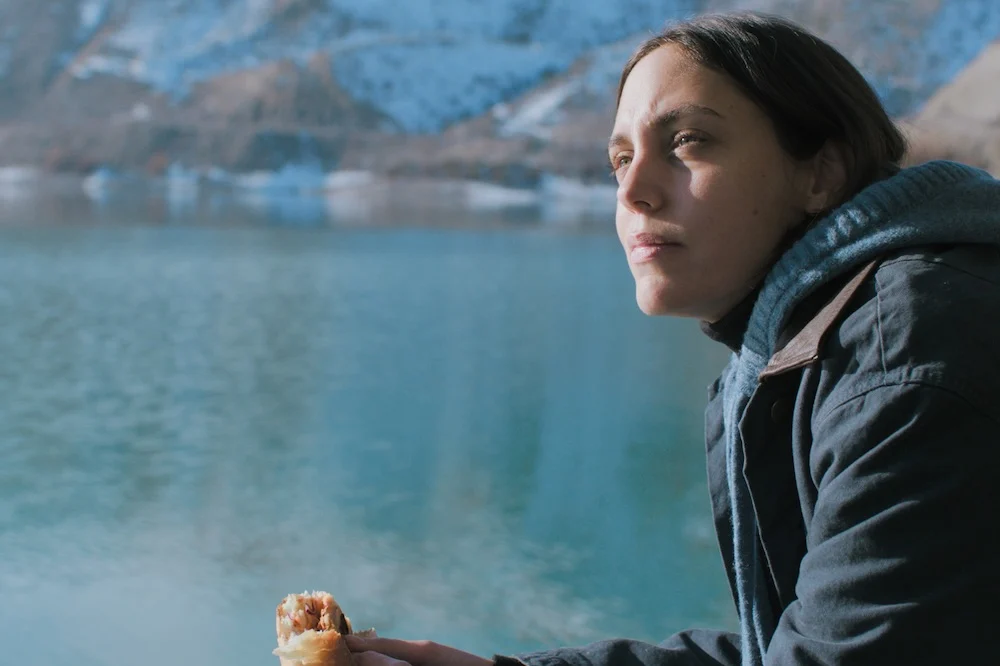
The age-old adage suggests that if you love something, you should set it free; if it returns, it is yours forever. But what if the purpose of letting go is not the eventual reunion, but the reclamation of one’s own fractured identity? This is the central, haunting inquiry of Yeşim Ustaoğlu’s latest cinematic achievement, What Remains. A work of delicate, observational precision, the film asserts a gently revolutionary premise: some relationships are not defined by proximity, but by the vast, airy space between two people. In Ustaoğlu’s vision, distance does not necessarily erode affection; rather, it creates a vacuum that allows love to breathe, evolve, and ultimately, survive.
The Anatomy of a Creative Stagnation
At the heart of What Remains is Elif (played with luminous, nuanced restraint by Öykü Karayel), a celebrated poet living in Istanbul. To the casual observer, Elif’s life appears to be a bohemian idyll. She shares a home with her partner, Mehmet (Metin Akdülger), an experimental musician, and their precocious young son, Selim (Ali Kayra Kul). Their days are defined by long walks through the city’s hilly, historic streets, the care of a jar of cocooning butterflies, and the construction of elaborate Rube Goldberg machines in their living room.
Yet, behind this picturesque façade, a quiet crisis is unfolding. Elif, once a prominent voice in Turkish literature, has hit a profound creative wall. Her internal wellspring, once vibrant and fluid, has run dry, producing only brackish, stagnant output. This is not merely writer’s block; it is an existential paralysis. Elif belongs to that specific, often misunderstood archetype—the solipsist-writer—whose deepest, most essential self remains solitary, regardless of the strength of their interpersonal attachments. As the film progresses, it becomes clear that her inability to create is intrinsically linked to the encroaching domesticity that has, perhaps inadvertently, suffocated her internal landscape.
A Domestic Equilibrium Disrupted: The Chronology of Departure
For the first act of the film, the audience is invited to observe this privileged, if financially precarious, creative-class lifestyle. However, the equilibrium is shattered when Mehmet loses his teaching position at a local university. The loss of their sole steady income acts as a catalyst for a long-suppressed domestic collapse.
The ensuing tension culminates in a midnight argument—hushed and frantic to avoid waking their son. It is here that the couple’s dysfunction is laid bare. Elif’s unhappiness, long bottled up, spills out in fragmented, inarticulate bursts, met by Mehmet’s cold, analytical attempts to "solve" a problem that is fundamentally emotional. When Mehmet dismisses her struggle with a chilling, "I really didn’t understand the extent of your problem," the rift becomes absolute.
What follows is not a cinematic reconciliation, but a final, somber intimacy. After a night of lovemaking that feels more like a funeral rite for their partnership than a renewal, Elif departs before dawn. Her journey takes her away from the urban chaos of Istanbul and into the vast, ancient landscapes of the Turkish countryside. Through winding highways and tunnels, past citadels that seem plucked from fantasy epics, she travels toward her ancestral roots: a tiny, remote mountain village where her grandmother once lived.
Supporting Data: A Departure Without Abandonment
A striking feature of Ustaoğlu’s screenplay is its refusal to rely on the standard tropes of the "runaway mother" narrative. In many films, such a departure would be treated as an act of selfish abandonment, usually necessitating a third-act return or a tragic lesson in humility. What Remains defies these expectations.
Elif does not sever ties. She remains a constant, digital presence in her son’s life, utilizing Facetime to maintain their bond from the road. Simultaneously, the film shifts its focus to Mehmet, who, rather than descending into bitterness, assumes the role of primary caregiver. When his own father falls ill, Mehmet’s journey becomes a mirror to Elif’s; he learns to navigate the complexities of being a son, a father, and a man who refuses to replicate the failures of his own patriarch.
The cinematography by Kiril Prodanov plays an essential role in this narrative arc. The wild, rugged terrain of Turkey becomes more than a backdrop; it becomes a character. As Elif interacts with a series of solitary, self-sufficient women along her journey, her internal tension begins to dissolve. Karayel’s performance is masterfully calibrated; her face, which the audience learns to read like shifting weather patterns, gradually loses its defensive posture. The film subtly guides the audience to a realization: we begin to find Elif sympathetic at the exact moment she begins to practice self-compassion.
Official Perspectives and Thematic Implications
In an industry often obsessed with the binary of "together or apart," What Remains serves as a calm, intellectual manifesto for the necessity of self-acceptance. The film posits that self-love is the foundational prerequisite for all other forms of devotion. Without this internal stability, the love we offer to our partners, our children, and our art is inevitably tainted by our own unaddressed needs.
The film’s climax is marked by a poem, written by the celebrated Turkish poet Birhan Keskin, which Elif composes near the journey’s end. In it, she describes Mehmet as "my crooked tooth, my friend." It is a line of profound gratitude—not just for the love they shared, but for the space they were eventually able to grant one another.
Thematic Takeaways:
- The Myth of Completion: Ustaoğlu challenges the romantic ideal that a partner must "complete" the other, suggesting instead that two people can only truly coexist when they are independently whole.
- The Geography of the Self: The film suggests that certain environments are necessary to facilitate personal evolution. Elif’s journey from the cramped, cluttered apartment in Istanbul to the open, desolate mountains is a literal manifestation of her internal journey toward clarity.
- Reimagining Parenthood: By showing a father stepping into the primary caregiving role without the film framing it as a "sacrifice," Ustaoğlu presents a modern, equitable vision of domestic duty.
Conclusion: Releasing the Grip
What Remains is a rare, even-handed drama that manages to be both a critique of the creative class and a tender eulogy for a dying relationship. It does not offer a neat resolution; it does not promise that Elif and Mehmet will reunite. Instead, it offers something more honest: the acknowledgment that both parties have emerged stronger because they were forced to relinquish their grip on one another.
By letting go, they have liberated themselves from the suffocating expectations of their previous life. In the quiet, expansive silence of the Turkish mountains, Elif discovers that the most important thing that remains is not the relationship itself, but the version of herself she had long since abandoned. Through its lyrical pacing and deep emotional intelligence, What Remains stands as a poignant reminder that to love well, one must first learn to be comfortable in the silence of one’s own company.
 Nana Wu
  Lina Irawan
  Laily UPN