
 By Reynand Wu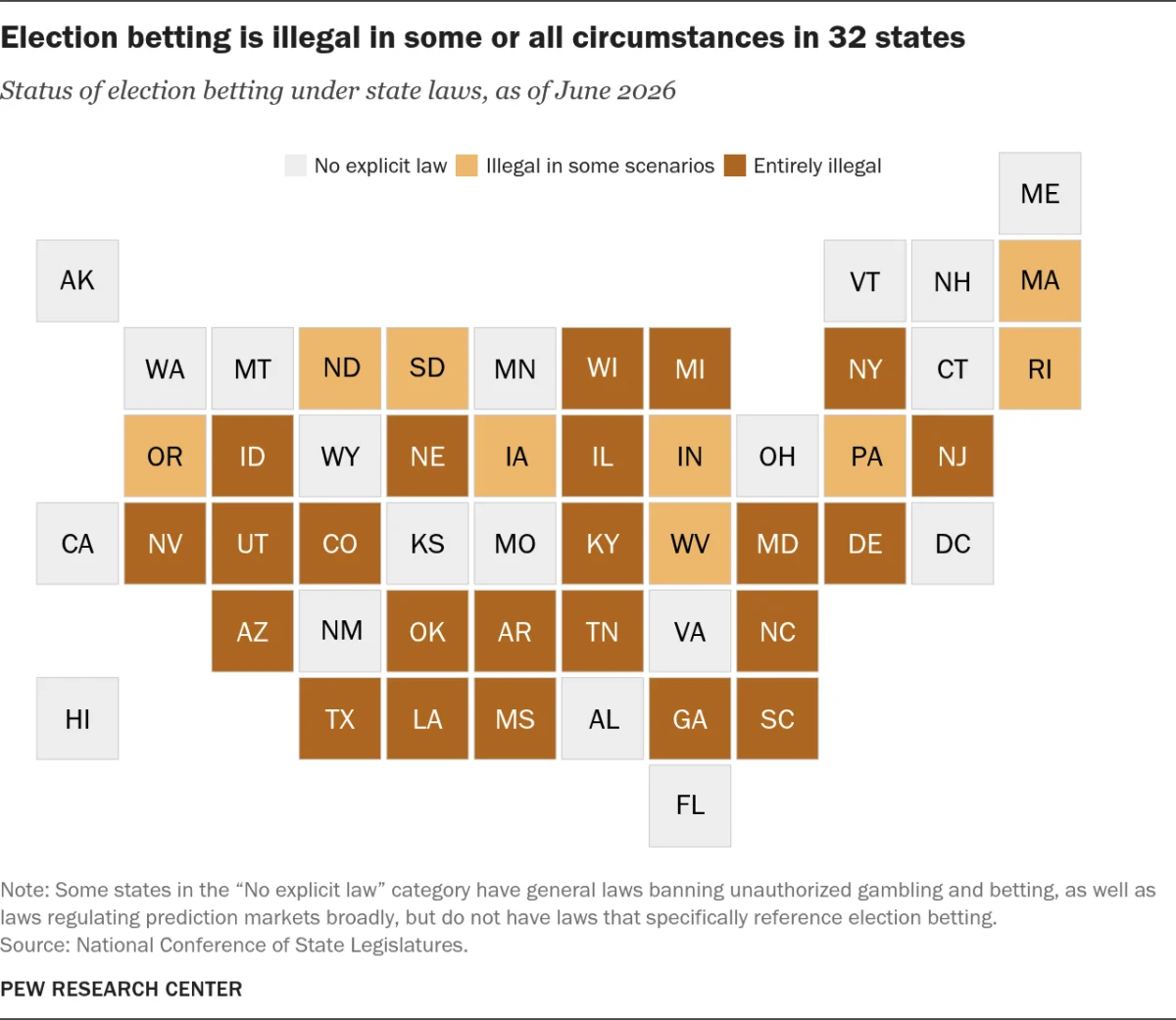
As the digital landscape evolves, the intersection of finance, technology, and democracy has produced a contentious new frontier: the rise of election prediction markets. Platforms like Kalshi and Polymarket have seen their trading volumes skyrocket in recent months, allowing users to stake capital on the outcomes of political races. However, this growth has triggered a swift and varied response from state governments, setting the stage for a high-stakes legal battle over the nature of betting, investing, and the sanctity of the democratic process.
A new analysis by the Pew Research Center, utilizing data from the National Conference of State Legislatures (NCSL), reveals that more than half of U.S. states have laws on the books that prohibit wagering on election outcomes. As these platforms grow in popularity, the friction between state-level bans and federal regulatory oversight is intensifying.
The Core Conflict: Financial Product or Illegal Gambling?
At the heart of this dispute is a fundamental disagreement over classification. Prediction market operators argue that they are not facilitating "gambling" in the traditional sense, where a "house" sets arbitrary odds and retains a mathematical edge. Instead, they position their platforms as exchanges for financial contracts, where users trade on binary "yes-or-no" outcomes of real-world events.
Federal regulators, primarily the U.S. Commodity Futures Trading Commission (CFTC), have generally maintained that these platforms provide legitimate financial hedging tools. By allowing users to trade on election outcomes, proponents argue that these markets provide a more accurate, aggregated forecast of public sentiment than traditional polling. Consequently, the federal government has pushed back against state efforts to restrict these platforms, even filing lawsuits to prevent states from imposing their own regulatory frameworks.
Conversely, state attorneys general and local legislators view these activities as a direct circumvention of long-standing gambling prohibitions. States like Arizona and Kentucky have taken aggressive legal action against prediction market companies, alleging that these "event contracts" are merely a digital-age veneer for traditional election betting, which many states have prohibited for over a century.
A Chronology of Restriction: From 19th-Century Statutes to Digital Bans
The legal resistance to election betting is not a new phenomenon. In many jurisdictions, the statutes used to combat modern prediction markets have deep roots.

- 1887: The Idaho territory, three years before achieving statehood, established a statute making election betting a misdemeanor. This legislative precedent remains a foundational piece of the state’s current legal framework.
- Early 20th Century: Throughout the 1900s, various states codified laws meant to preserve the integrity of the ballot box. These laws were largely aimed at preventing individuals from having a direct financial incentive to influence or disrupt voting processes.
- 2026 (May): Minnesota became the first state to implement a comprehensive, modern ban on platforms like Kalshi and Polymarket. This move sparked immediate federal intervention, with the CFTC filing suit to block the state’s enforcement, arguing that the ban exceeds state authority over federal financial products.
- 2026 (June): The current landscape shows that at least 16 states have introduced legislation this year alone to address, regulate, or outright ban the operation of prediction markets within their borders.
Supporting Data: The Landscape of Legal Prohibition
The Pew Research Center analysis provides a granular look at the current legal status of election betting across the 50 states and the District of Columbia. The data suggests that the "patchwork" of regulations is creating a confusing environment for both companies and users.
The Breakdown of State Laws:
- Entirely Illegal (23 States): In states such as Arkansas, Kentucky, and Nevada, the law explicitly prohibits any form of wagering on election results. These states often carry the most severe penalties, ranging from heavy fines to incarceration.
- Illegal in Some Scenarios (9 States): This category includes states like Oregon and Pennsylvania. In these jurisdictions, the illegality is often situational. For example, Oregon prohibits candidates from betting on their own races, while others focus on penalizing the "pool sellers" or organizers of the bet rather than the individual participant.
- No Explicit Law (18 States and D.C.): These states lack specific statutes referencing "election betting." However, officials in several of these states have warned that existing, broader anti-gambling laws are broad enough to cover these digital markets, creating a "gray zone" that leaves participants in legal uncertainty.
Severity of Penalties
The consequences for violating these laws vary significantly. In most states, the offense is treated as a misdemeanor. However, in states like Illinois, Nebraska, and Utah, the act can be prosecuted as a felony depending on the scale of the wager or the status of the individual involved.
Beyond financial and carceral penalties, some states impose civil consequences. Delaware and New York, for example, have provisions that could strip violators of their right to vote. Others, like Wisconsin, make it illegal for an individual who has placed a bet on an election to cast a ballot in that specific race, directly linking financial activity to the loss of civic participation.
Official Responses and Legislative Trends
The legislative activity in 2026 is robust, with at least 16 states actively pursuing bills to control the prediction market economy. These legislative efforts are not uniform; they reflect a variety of concerns:
- Market Restrictions: Some states are attempting to restrict who can participate, often imposing age requirements or requiring state-level licensing for operators.
- Insider Trading Bans: Several governors have taken executive action to prevent state employees from using their positions to engage in insider trading on these platforms. Maryland and New York have notably utilized executive orders to curb such conflicts of interest.
- Taxation and Regulation: Kentucky has moved beyond prohibition to impose specific taxes on operators, essentially treating them as regulated gambling entities, a move that clashes with the platforms’ claims of being "financial exchanges."
- Influencer Penalties: Tennessee recently passed a law making it a felony for any individual to attempt to influence the outcome of an event while holding a financial position on a prediction market related to that event. This represents a significant escalation in how states are addressing the potential for market manipulation.
Implications for the Future of Democracy and Markets
The clash between federal financial regulators and state legislatures carries profound implications.
The Integrity of the Vote
The primary concern of state lawmakers is the preservation of electoral integrity. There is a fear that if individuals have significant financial stakes in the outcome of an election, they may be incentivized to interfere with voting, intimidate poll workers, or spread misinformation to swing the "price" of their contract. By criminalizing these bets, states are attempting to create a "firewall" between the financial markets and the democratic process.

The "Financialization" of Civic Life
Proponents of prediction markets argue that the concerns are overblown and that these platforms are simply the next step in the evolution of information markets. They contend that by allowing people to "put their money where their mouth is," these markets provide a high-fidelity signal of public opinion that is more resilient to the biases of traditional polling.
However, the rapid expansion of these markets has outpaced the legal system’s ability to adapt. As the CFTC and state authorities continue their litigation, the courts will eventually be forced to decide whether a "bet on an election" is a protected form of speech and financial expression, or a form of gambling that states have a constitutional right to regulate—or ban entirely.
A Fragmented Future
For the average citizen, the immediate takeaway is a warning: the legality of participating in these markets is highly dependent on one’s physical location. As long as the conflict between state law and federal regulation persists, the "prediction economy" will remain in a state of flux. While some states look to fully integrate and tax these platforms, others are doubling down on 19th-century-style prohibitions, setting the stage for a prolonged constitutional and regulatory standoff.
Ultimately, this debate is about more than just money. It is a fundamental question of whether the outcomes of our democratic institutions should be treated as commodities to be traded, or whether they should remain insulated from the speculative impulses of the financial world. As the 2026 election cycle progresses, both the courts and the legislatures will play a critical role in defining that boundary.
 Muslim
  Nana Muazin
  Siti Muinah