
 By Azzam Bilal Chamdy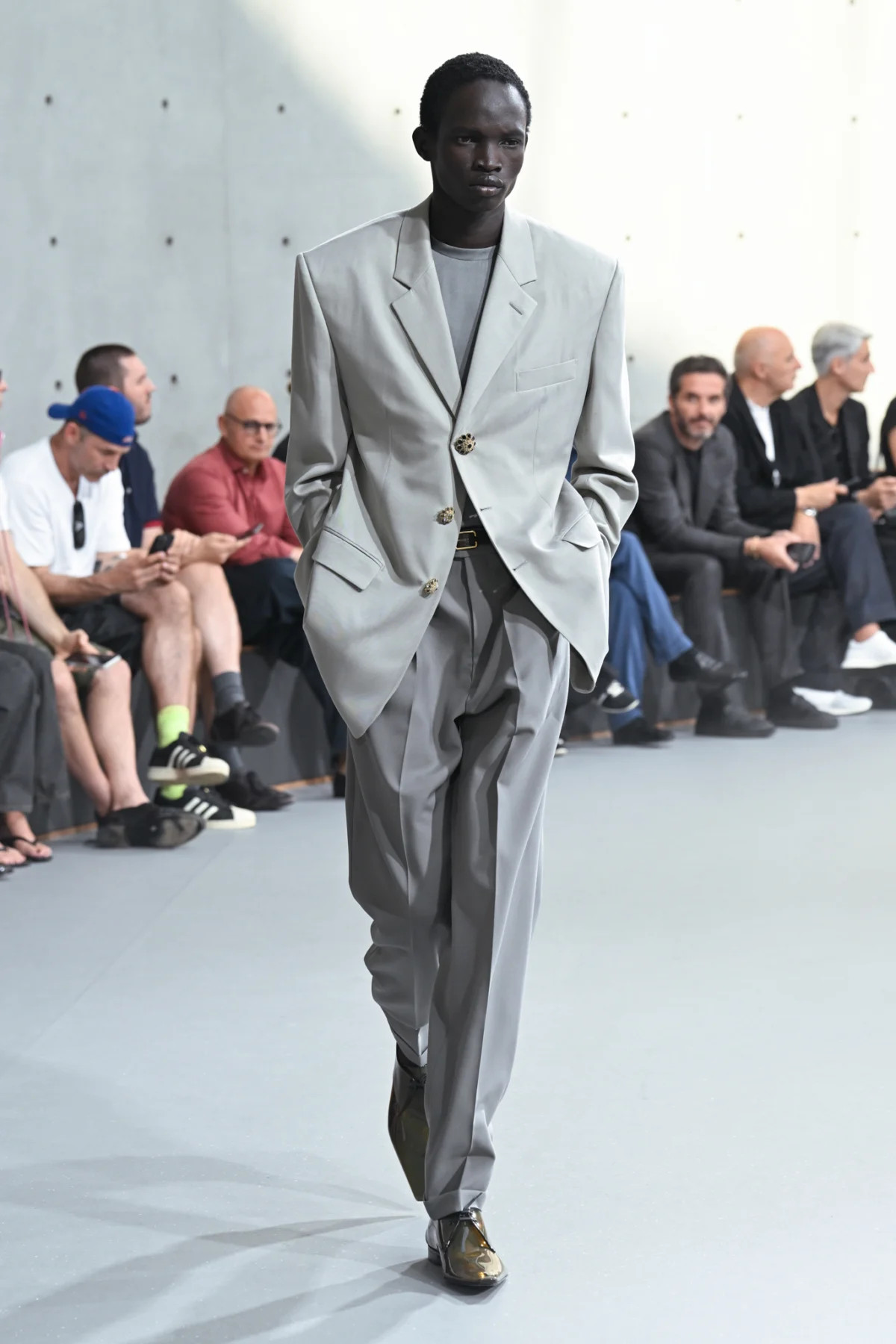
The rotunda of Paris’s Bourse de Commerce is no stranger to the ephemeral. As part of the museum’s critically acclaimed Clair-Obscur group exhibition, Fujiko Nakaya’s "Cloud #07145"—a mesmerizing fog sculpture—has become a siren song for the Instagram generation. For weeks, tourists and art aficionados alike have been wading into the museum’s center, hoping to capture the perfect, ethereal snapshot within the shifting vapor. Yet, on a sweltering Tuesday afternoon, the fog served a more sartorial purpose: it became the haunting, atmospheric runway for Anthony Vaccarello’s latest men’s collection for Saint Laurent.
As the vapor swirled, models emerged in a display of stark, sophisticated contrast to the moistened tourists who usually frequent the space. Vaccarello, ever the master of architectural precision, turned the installation into a meditation on restraint as a form of seduction, crafting a narrative where the clothing didn’t just sit on the body—it moved with it, obscured and revealed in equal measure by the climate-controlled haze.
The Architecture of the Atmosphere: A Chronology of the Show
The choice of the Bourse de Commerce for a runway show is a bold maneuver, even for a house as storied as Saint Laurent. The venue, an architectural marvel that bridges neoclassical grandeur with Tadao Ando’s stark, contemporary concrete interventions, provided the perfect foil for the collection.
As the show commenced, the density of the fog began to dictate the pace of the presentation. In the early segments, the mist thickened, effectively obscuring the models’ lower halves. This served to heighten the impact of Vaccarello’s signature pronounced shoulders, which appeared to float in the air like structural apparitions. When the fog receded, the full silhouettes were revealed: elongated jackets in languid, flowing fabrics, punctuated by jeweled buttons—a styling nod to the late, legendary fashion icon Tina Chow, whose portrait served as a grounding force on Vaccarello’s mood board.
The sensory experience was visceral. The Paris heat wave outside found its way into the rotunda, creating an ironic internal climate. Models navigated the slick floor in long, snout-nosed dress shoes, some of which were transparent, revealing feet already dampened by the ambient perspiration. It was a detail that felt intentional, bridging the gap between the high-fashion artifice of the runway and the reality of the human body under pressure.
Supporting Data: Deconstructing the Silhouette
Vaccarello’s approach this season was characterized by a deliberate "lightening" of the masculine form. By stripping away the heavy, rigid structures that have defined much of the recent history of tailoring, he aimed to achieve a fluidity that felt almost liquid.
The Return to Archetypes
After several seasons of viral, high-concept pieces—such as the leather hip waders that dominated social media feeds last year—Vaccarello pivoted toward what he described as "straightforward, quintessentially masculine archetypes." This shift toward the classic trench coat, the structured vest, and the sailor sweater was not a retreat, but an evolution.
- Fluidity and Fabric: The use of hammered satins for cape-back blousons and T-shirts provided a luminous, fluid quality that caught the dim light of the rotunda.
- The Nylon Experiment: In a striking juxtaposition, the collection featured colorful nylons fashioned into anoraks. These garments boasted "superhero shoulders" and couture-like ruched sleeves, rendered in sugary pastels.
- The Contrast Principle: These contemporary nylons were tucked into high-waisted gray trousers reminiscent of the classic tailoring once favored by Jacques Chirac. This deliberate tension between the "old-school" and the "very, very contemporary" defined the collection’s aesthetic arc.
Perhaps the most daring choice was the inclusion of leather briefs styled with jackets, a look that allowed the models to showcase bare, unadorned legs as they transitioned through the fog, emphasizing the vulnerability that lay beneath the heavy, sharp-shouldered outer layers.
Official Responses and Creative Philosophy
In a post-show conversation, Anthony Vaccarello was remarkably candid about his process and the evolution of his vision for the house. When asked about the transparency of the footwear and the discomfort of the models, he offered a grin that betrayed his mischievous intent. "I asked myself: ‘Why torture women with plastic shoes, but not men?’" he remarked, highlighting the equalizing, albeit slightly masochistic, nature of modern fashion.
His philosophy for this season was rooted in a dialogue with the past. Reflecting on the history of Yves Saint Laurent, the designer noted that the founder was a pioneer in taking everyday, ordinary garments and elevating them into the realm of high fashion. "Back then, sportswear wasn’t the street-style staple it is today," Vaccarello observed. "So I wondered how he would have interpreted or worked with sportswear now."
This led to a collection that felt grounded yet elevated. By easing up on the "gimmicks," Vaccarello succeeded in producing what is arguably his most diverse and approachable men’s collection to date. The final looks of the show—an array of trench coats, suits, and ribbed-knit sweaters finished in molten, gold-dipped lamé—were a testament to this, blending the house’s archival love for decadence with a modern, wearable ease.
The Implications: A New Era for Saint Laurent Men’s
The success of this show lies in its ability to reconcile the legacy of Yves Saint Laurent with the current, fragmented state of menswear. For years, the industry has been trapped in a binary: either hyper-masculine, rugged workwear or experimental, gender-fluid couture. Vaccarello has successfully navigated the middle ground, creating a collection that feels timeless yet urgently relevant.
The "Clair-Obscur" Effect
The choice of title for the group show at the Bourse de Commerce—Clair-Obscur (Chiaroscuro)—is perhaps the most apt description of the collection itself. The play between light and shadow, the known and the unknown, and the rigid and the fluid, suggests a shift in the Saint Laurent man. He is no longer defined merely by the armor he wears, but by the sensuality he is allowed to express.
The implications for the brand are significant. By stripping away the "noise" of viral accessories and focusing on the integrity of the cut and the quality of the fabric, Vaccarello has reinforced the brand’s position as a purveyor of "quiet luxury" that doesn’t sacrifice personality. This is a collection that speaks to the modern man who is comfortable with ambiguity—the man who can wear a sailor sweater with the same authority as a gold-dipped lamé trench.
Conclusion: The Persistence of the Fog
As the fog finally dissipated and the models exited the rotunda, the lingering impression was not one of spectacle, but of substance. While the Instagram influencers and tourists might return the following day to find the fog once again a static backdrop for their feeds, the fashion world will remember this afternoon for something more profound.
Anthony Vaccarello has managed to prove that even in a digital age obsessed with the fleeting image, the art of tailoring remains paramount. By integrating his work into Fujiko Nakaya’s sculpture, he transformed the Bourse de Commerce into a crucible of style. The collection was a reminder that the most compelling fashion does not compete with its environment—it becomes part of the atmosphere, shifting, changing, and eventually, revealing a new, more nuanced version of masculinity.
In the final assessment, the Saint Laurent men’s show was a triumph of restraint. In a world of maximalist noise, Vaccarello chose to whisper, and in the echoing, fog-filled halls of the Bourse de Commerce, that whisper was heard loud and clear.
 Nana Muazin
  Nana
Nana  Ali Ikhwan