
 By Jia Lissa
In the contemporary financial landscape, the traditional image of banking—imposing marble pillars and hushed lobbies—is rapidly being replaced by the vibrant, fast-paced world of digital feeds and short-form video. Social media has transitioned from a peripheral marketing experiment to a critical business imperative for financial institutions. As consumers increasingly turn to their screens for financial literacy, the banking sector is undergoing a profound transformation in how it builds trust, generates leads, and manages institutional reputation.

Main Facts: The Strategic Necessity of Social Engagement
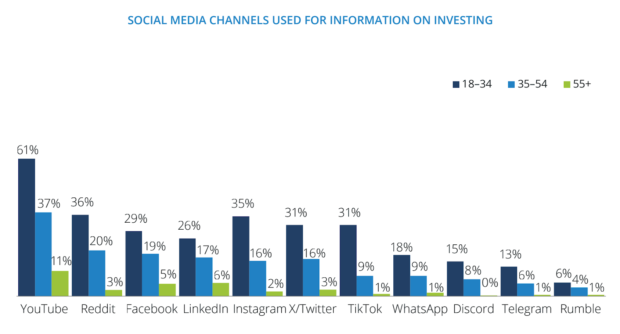
For modern banks, social media presence is no longer about mere visibility; it is about survival in a competitive digital economy. Recent industry data underscores a massive shift in consumer behavior. According to research from the FINRA Foundation, approximately 29% of investors now utilize social media and message boards to inform their investment decisions. This trend is even more pronounced among younger demographics, where the "finfluencer" (financial influencer) has replaced the traditional bank manager as the primary source of guidance.

Beyond simple engagement, social media drives tangible business outcomes. Digital marketing now commands nearly 62% of total bank marketing budgets. With consumer banking digital ad spend reaching nearly $370 million per quarter, the stakes are high. Banks are leveraging platforms like YouTube, LinkedIn, and Instagram not just to promote products, but to provide the financial education that modern consumers crave.
Furthermore, the competitive landscape offers no room for hesitation. An American Bankers Association (ABA) report reveals that 90% of banks consider social media important, with 88% actively maintaining their accounts. For any institution currently on the sidelines, the risk is not just a lack of followers, but the total surrender of their digital narrative to competitors.

Chronology: From Brick-and-Mortar to Social-First Banking
The journey of banking into the social sphere has evolved through three distinct eras:
- The Information Era (2000s–2010s): Initially, banks viewed the internet as a digital brochure. Social media was treated as a secondary channel for posting holiday hours or community service photos. Engagement was low, and regulatory fears kept most institutions from substantive interaction.
- The Service Era (2015–2020): Platforms like Twitter (now X) and Facebook became essential for customer service. Digital-native "neobanks" forced traditional institutions to speed up their response times. Social media became a "virtual teller window" where customers expected real-time resolutions to account issues.
- The Educational & Influence Era (2021–Present): Post-pandemic, a surge in retail investing and the rise of TikTok created a demand for bite-sized financial literacy. Banks realized that to capture Gen Z and Millennials, they had to stop "selling" and start "teaching." This era is defined by the integration of AI, the use of employee advocates, and a focus on transparency to bridge a widening "trust gap."
Supporting Data: Mapping the Platform Ecosystem
The choice of platform is a strategic decision that must be backed by demographic data rather than trends. As Leen Li, Chair of the Wealthsimple Foundation, notes, "You can have the best product and content, but if you can’t distribute to your audience on the proper platform, you’re not going to hit your goal."
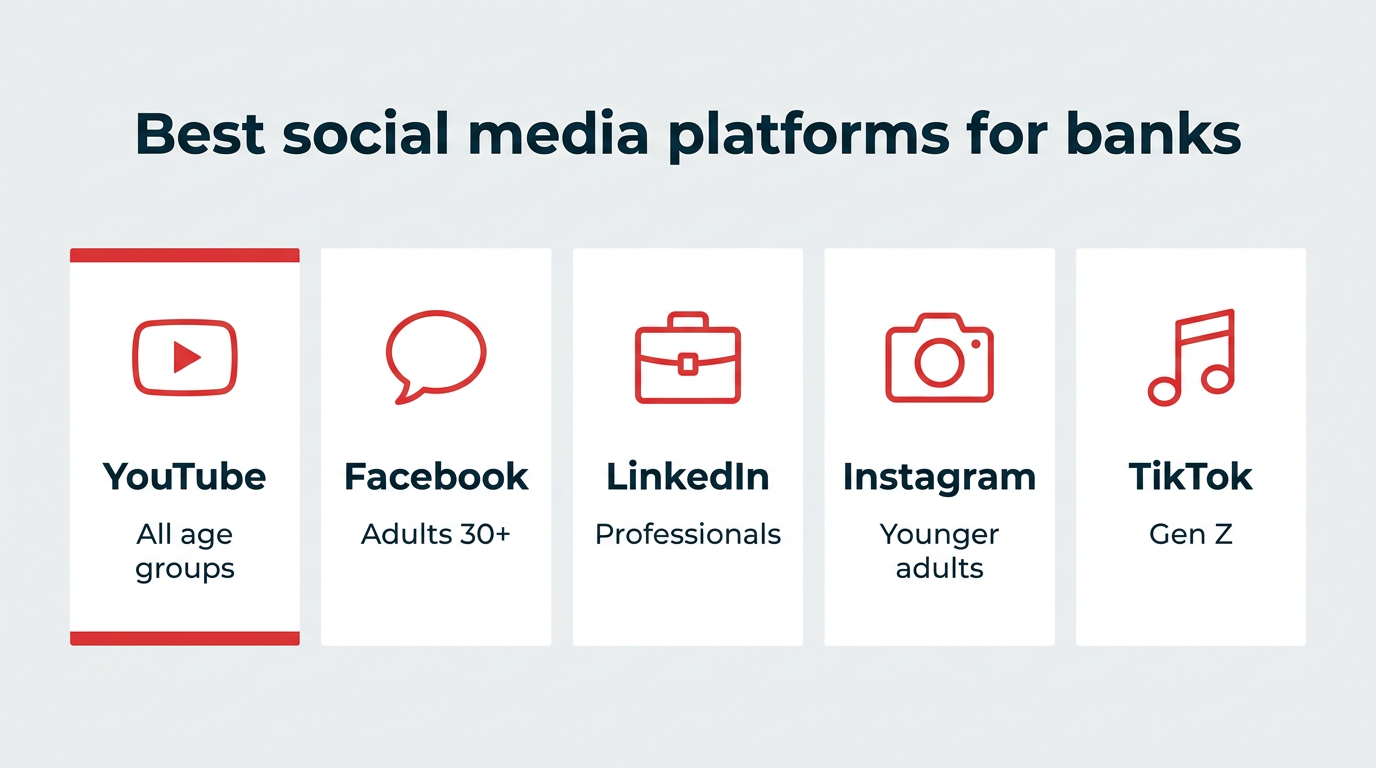
Audience Distribution by Platform
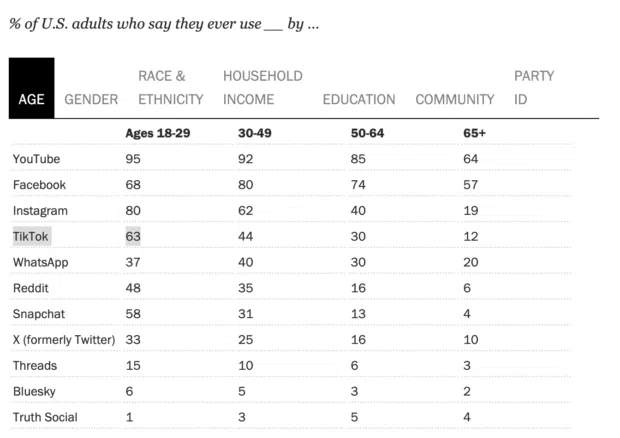
Data from the Pew Research Center highlights the necessity of a multi-channel approach:
- YouTube: Remains the titan of reach, used by 95% of adults aged 18–29. It is the primary home for long-form explainers, webinars, and deep-dive financial education.
- LinkedIn: The essential hub for B2B banking, recruitment, and thought leadership. It is where banks establish authority among professionals and high-net-worth individuals.
- Facebook: Continues to be a powerhouse for reaching adults aged 30 and older, making it ideal for community-based engagement and local branch updates.
- Instagram & TikTok: These are the frontiers for younger demographics. Gallup reports that 42% of Americans aged 18 to 29 turn to social media for financial advice, with 61% of investors under 35 acting on recommendations from social media influencers.
Performance Metrics that Matter
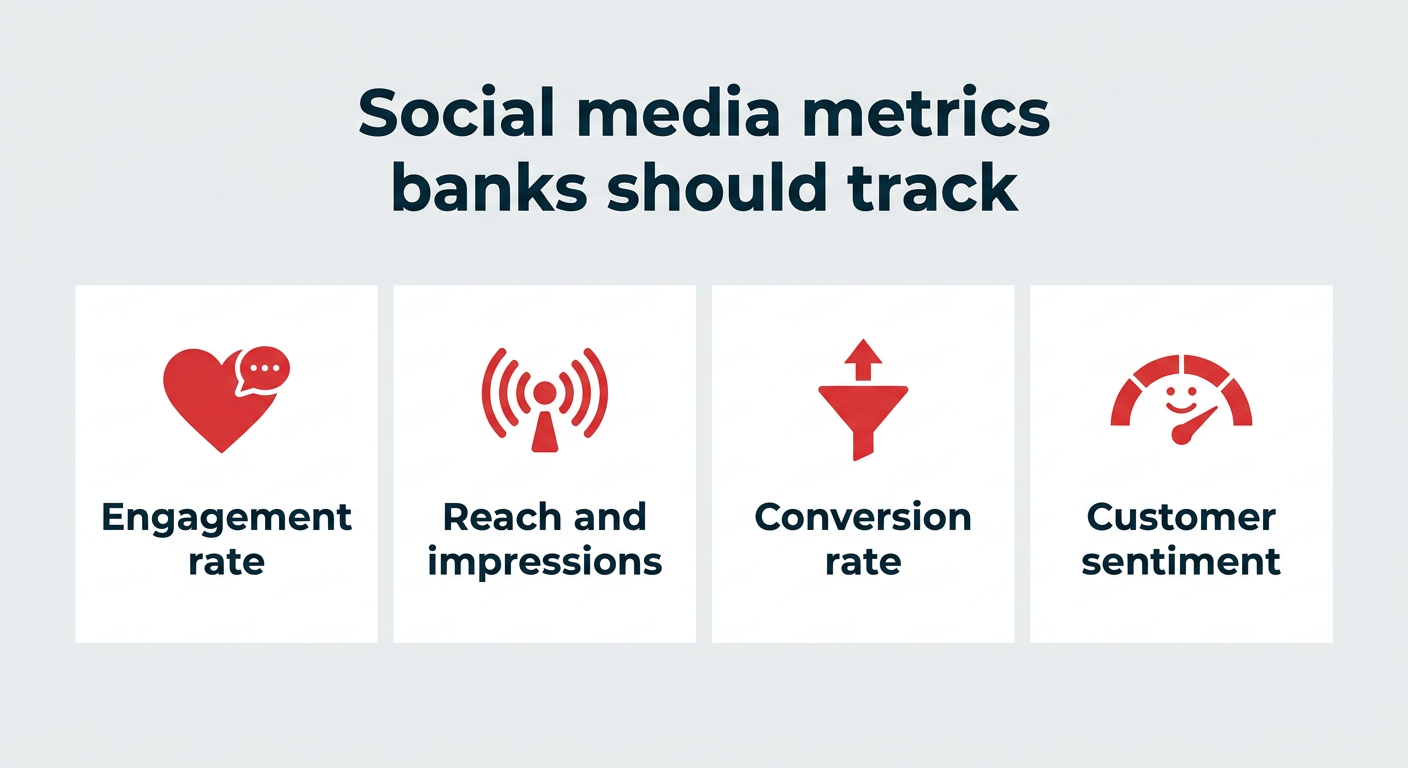
Financial institutions have moved beyond "vanity metrics" like likes and follows. Success is now measured through:

- Share of Voice (SOV): How much of the digital conversation a bank owns compared to its rivals.
- Conversion Rates: Tracking how social engagement leads to new account openings or loan applications.
- Customer Satisfaction (CSAT): Measuring the effectiveness of social media as a customer service channel.
Official Responses and Industry Perspectives: Navigating the Regulatory Minefield
The primary barrier to social media adoption for banks has historically been the complex web of regulation. Unlike other sectors, a bank’s social media post is a legal record. Regulatory bodies such as FINRA (Financial Industry Regulatory Authority) and the SEC (Securities and Exchange Commission) govern investment communications, while the FDIC and OCC set strict expectations for advertising and consumer protection.

Industry experts emphasize that compliance must be "baked into" the strategy, not added as an afterthought. Leading institutions are now employing sophisticated Social Operating Systems (Social OS) to manage these risks.

Case Study: SIX Group
SIX Group, a Swiss financial technology provider managing services for 130 banks, faced immense pressure regarding cyber threats and unauthorized profiles. By implementing automated governance layers—such as the "Vigil" and "Lumen" systems—they were able to monitor threats in real-time. This resulted in a 91% reduction in time spent on social media management and a 10% increase in social media following through secure, consistent engagement.

Case Study: MAPFRE
Global insurance giant MAPFRE conducted an audit and discovered over 80 fragmented social media pages. By consolidating these under a unified governance policy, they saw a 20% increase in social media community size and a 2.3x increase in total interactions. Their success demonstrates that centralizing control is key to maintaining a compliant brand voice.

Strategic Implications: Building the Bank of the Future
As we look toward 2026 and beyond, several implications emerge for the banking sector’s social media strategy.

1. The Humanization of the Institution
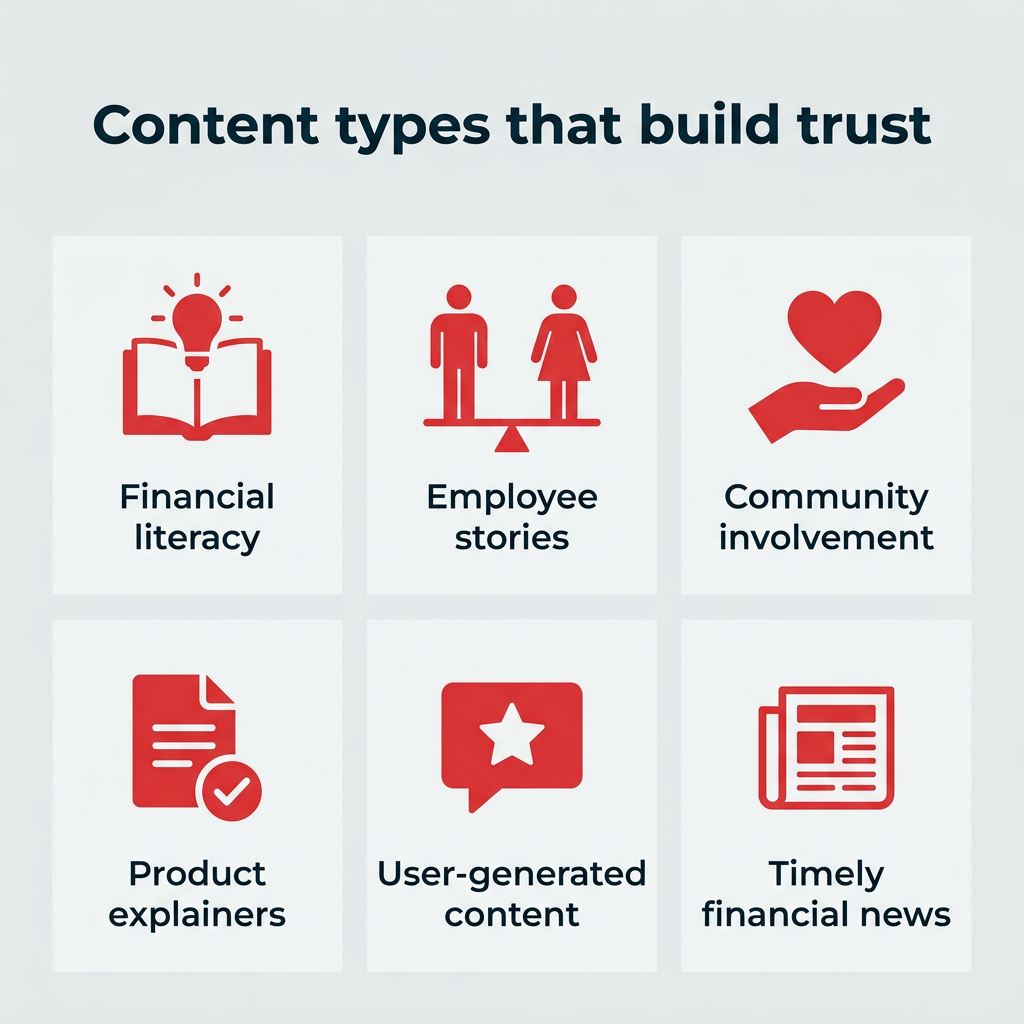
Banks are historically perceived as impersonal. To counter this, successful institutions are leaning into "people-forward" content. This includes sharing employee stories, behind-the-scenes glimpses of community initiatives, and client testimonials. Julius Baer, a Swiss private banking group, utilized employee advocacy programs to empower their staff as brand ambassadors. This human-centric approach led to a 10x increase in LinkedIn engagement and a 2x increase in the firm’s reach.
2. The Rise of AI and Transparency
As AI becomes more prevalent in content creation and customer service bots, transparency is becoming a new currency of trust. Banks that are upfront about their use of AI in customer-facing interactions will likely fare better in a low-trust environment.

3. The Necessity of Crisis Management
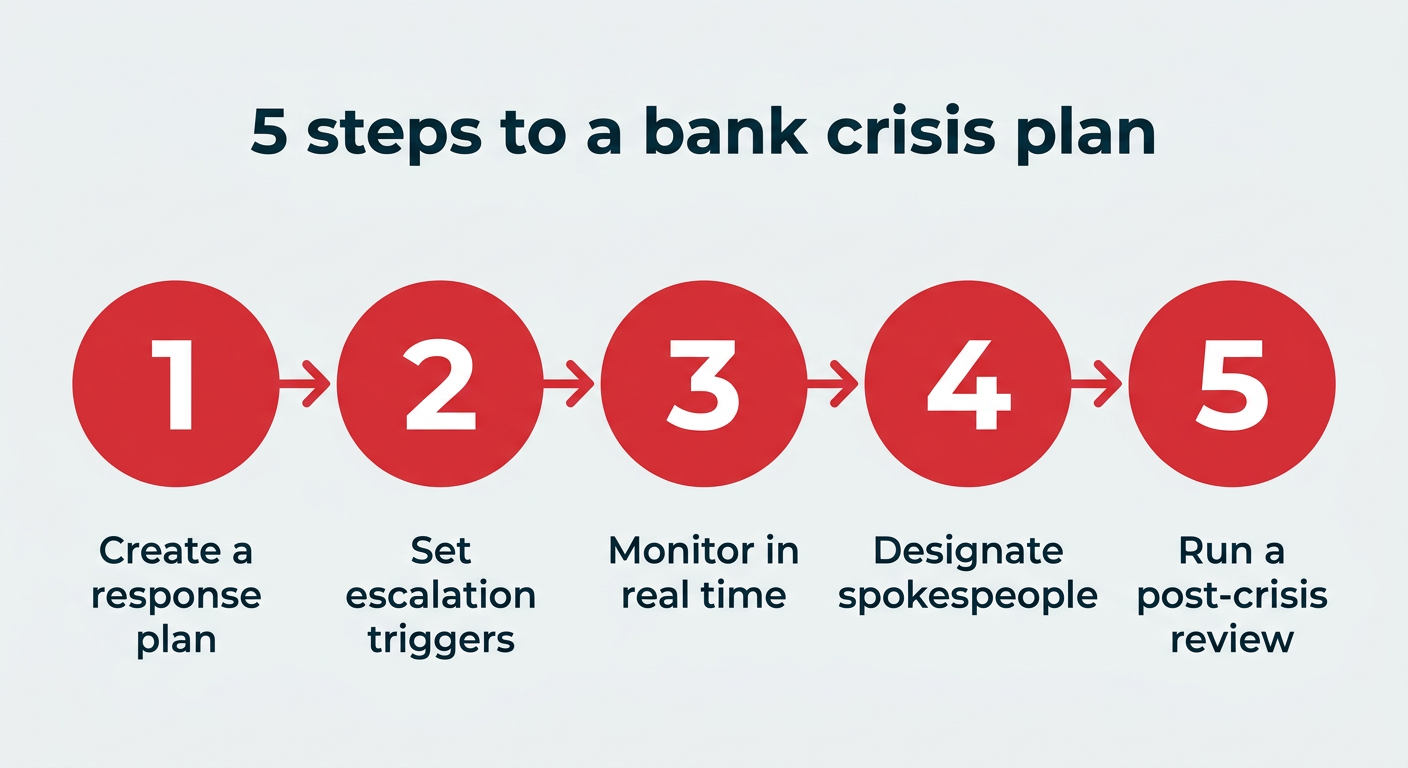
In a regulated industry, a single mishandled comment can escalate into a reputational disaster. Modern banks are now required to have robust "social media crisis plans" that include:

- Pre-approved messaging for various scenarios.
- Clear chains of command for emergency approvals.
- Social listening tools to detect sentiment shifts before they peak.
4. Education as a Lead Generator
The "hard sell" is dead on social media. The new model is "Education-First." By providing free, high-value financial literacy content—such as how to improve credit scores or the basics of mortgage applications—banks build a "trust reservoir." When the consumer is eventually ready for a financial product, the institution that provided the education is the one that gets the business.
Conclusion
The integration of social media into the banking sector is a reflection of a broader societal shift toward digital transparency and accessibility. While the risks of compliance and cyber threats are real, the data suggests that the risks of inactivity are far greater. By combining rigorous governance with human-centric, educational content, banks can transform their social media presence from a liability into a powerful engine for growth, trust, and community engagement. In the digital age, the most successful banks will be those that realize their most valuable asset isn’t just the capital in their vaults, but the quality of the conversations they have with their customers online.
 Basiran
  Nana Muazin
  Nila Kartika Wati