
 By Lina Irawan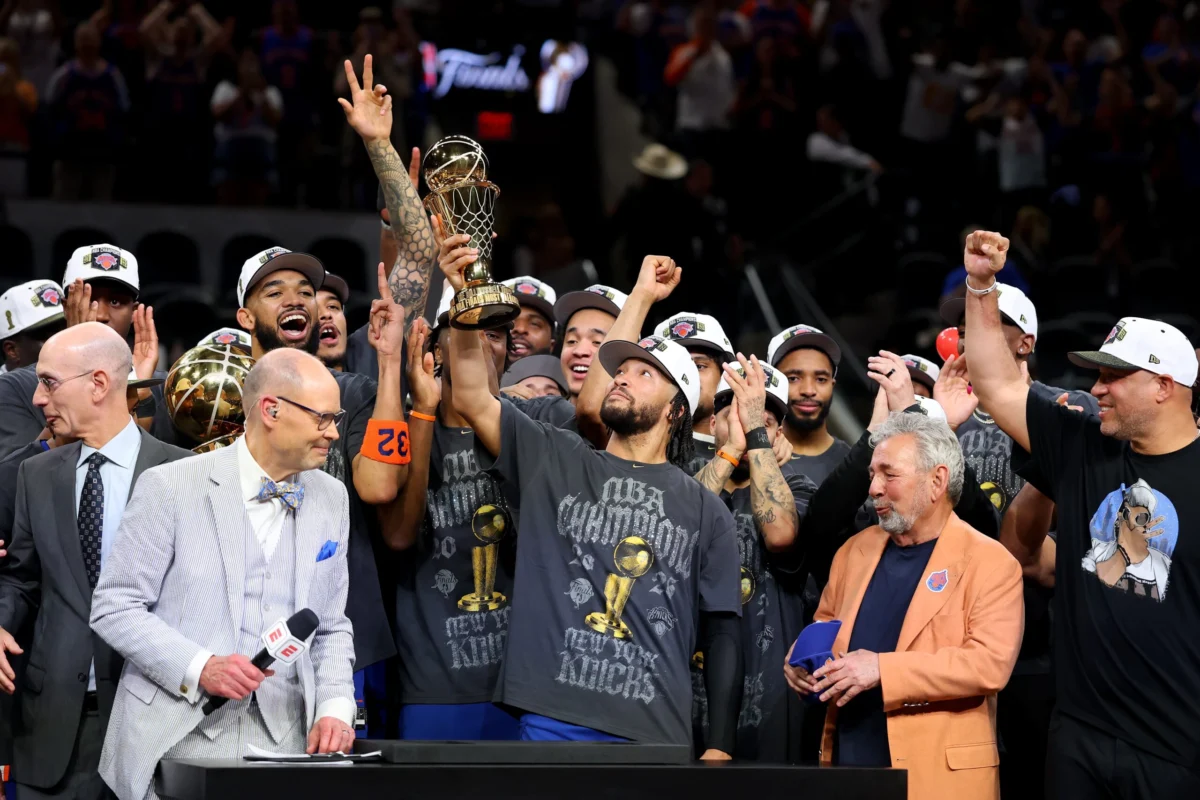
It does not feel real. For 53 years, the Madison Square Garden faithful have existed in a state of suspended animation, perpetually caught between the flickering memory of the 1973 championship and a relentless cycle of heartbreak, humiliation, and institutional dysfunction. But tonight, the narrative has shifted. The curse is broken. The New York Knicks are NBA champions.
For those who have bled orange and blue through decades of lean years, this victory over Victor Wembanyama—the generational anomaly who represents the future of basketball—feels less like a sports result and more like a spiritual reconciliation. At 41 years old, I have spent a lifetime waiting for this, witnessing the era of Michael Jordan’s dominance, the agony of John Starks’ 2-for-18 shooting performance in Game 7 of the 1994 Finals, the tragic injury of Patrick Ewing, and the front-office chaos that defined the 2010s. Tonight, those ghosts have finally been exorcised.
A Legacy of Heartbreak: The Long Road to Redemption
To understand the magnitude of this achievement, one must grapple with the sheer volume of trauma that preceded it. The history of the Knicks since 1973 has been a masterclass in "what ifs." There was the missed opportunity to draft Stephen Curry by a single pick; the brief, electric, and ultimately mismanaged "Linsanity" era; the catastrophic tenure of Phil Jackson; and the physical decline of Amar’e Stoudemire.
During the 2010s, the franchise reached a nadir so profound that the roster became a punchline. Fans recall the dark days of Louis Amundson, Mario Hezonja, Andrea Bargnani, and Langston Galloway—names that, for a time, served as shorthand for the organization’s lack of identity. For over half a century, the team was synonymous with instability, consistently making the wrong hire, the wrong trade, and the wrong cultural pivot.
However, the tide began to turn with a shift in front-office philosophy, prioritizing grit, chemistry, and homegrown development over the mercurial "superstar" chasing that had doomed previous regimes.
The Architect of the Miracle: Jalen Brunson’s Ascent
The face of this resurrection is Jalen Brunson, an undersized guard who was perpetually counted out by scouts and pundits alike. His journey to this title is almost mythic. Brunson grew up in the hallways of the Knicks organization, a toddler running around the practice facility while his father, Rick Brunson, competed for the team.
The symmetry is poetic: Rick Brunson played for the Knicks during their 1999 Finals loss, a five-game series against the San Antonio Spurs. Decades later, it was Jalen who navigated the team through a gauntlet to defeat the Spurs’ current crown jewel, Victor Wembanyama.
Brunson’s performance in the deciding game was the stuff of legend. He accounted for 45 of the team’s 94 points, operating with a level of clinical precision that silenced any remaining doubters. Beyond the statistics, his leadership was the glue. He famously sacrificed $113 million in potential earnings to ensure the team had the financial flexibility to build a winning roster. Alongside NCAA Championship teammates Josh Hart and Mikal Bridges, Brunson created a culture of accountability that proved infectious.
"I’ve got no words," a tearful Brunson muttered in the post-game chaos. "It’s everything I’ve ever dreamed of." In the eyes of the city, he has cemented his status as the greatest Knick to ever wear the uniform.

Chronology of a Championship Run
The 2026 postseason will be studied for years to come. The Knicks entered the playoffs as a battle-hardened squad, but few expected them to topple the Spurs’ dynasty in the Finals.
- The Early Rounds: The Knicks displayed a defensive tenacity that defined their season, grinding out victories against top-seeded opponents.
- The Finals Turn: The series against Wembanyama’s Spurs began with a narrow loss, raising fears of yet another "New York collapse." Instead, the team staged the greatest comeback in NBA Finals history in Game 3, shifting the momentum irrevocably.
- The Clincher: In the final game, the Knicks’ defense held firm against the Spurs’ relentless offensive pressure. Brunson’s scoring outburst in the fourth quarter ensured the team never relinquished the lead, closing the series in a 94-88 victory that will be etched into the city’s history.
The City’s Pulse: A Collective Catharsis
New York City has weathered profound storms over the last half-century—from the tragedy of 9/11 and the intensity of the COVID-19 pandemic to the daily grind of urban life. The city has a unique capacity for resilience, and the Knicks mirrored that spirit throughout this playoff run.
The atmosphere in the five boroughs over the past month has been transformative. It is a scene reminiscent of the most iconic moments in television history, such as the Mad Men moon landing episode, where the world paused to witness something monumental. Fire trucks have been honking in unison, strangers have been embracing on the subways, and the city’s iconic skyscrapers—the Empire State Building and the Chrysler Building—have been bathed in brilliant orange and blue.
For many fans, this championship is personal. It represents a connection to family, to the hours spent in living rooms watching games with parents who worked long, arduous shifts in the city. The victory is not just about the trophy; it is a shared memory, a generational bridge, and a moment of collective healing.
Implications for the NBA and Beyond
The implications of this win extend far beyond New York. The Knicks have proven that a team built on cohesion and self-sacrifice can topple a roster built around a singular, otherworldly talent.
- The Salary Cap Model: Jalen Brunson’s contract decision will likely change how players approach free agency and team-building. His willingness to leave money on the table for the sake of the roster is a rare example of "win-first" economics that may influence future collective bargaining discussions.
- The Wembanyama Effect: While the Spurs lost, the performance of Victor Wembanyama proved that the league is in good hands. The Finals served as a passing of the torch—or perhaps a challenge—to the next generation of superstars.
- The MSG Factor: The return of the Knicks to the pinnacle of the sport re-establishes Madison Square Garden as the true "Mecca of Basketball." With a stable front office and a championship-caliber core, the Knicks are poised to remain a contender for years to come.
A Final Reflection
As I sit here writing this, the sounds of celebration are still echoing through the streets of Manhattan. It is a sound that has been absent for 53 years.
Watching Jalen Brunson embrace his father on the court brought a flood of memories—not just of the team, but of my own father and the bond we forged through this often-frustrating, occasionally brilliant game. We may not have watched it together in the same room, but when he called me after the final buzzer, the distance between us vanished.
We finally did it. This was for the fans who stayed through the Bargnani era, for the people who endured the coaching carousel, and for the city that never stops believing. The drought is over, and for the first time in my life, the New York Knicks are the kings of the basketball world.
 Ammar Sabilarrohman
  Nana
Nana 