
 By Layla Zulfa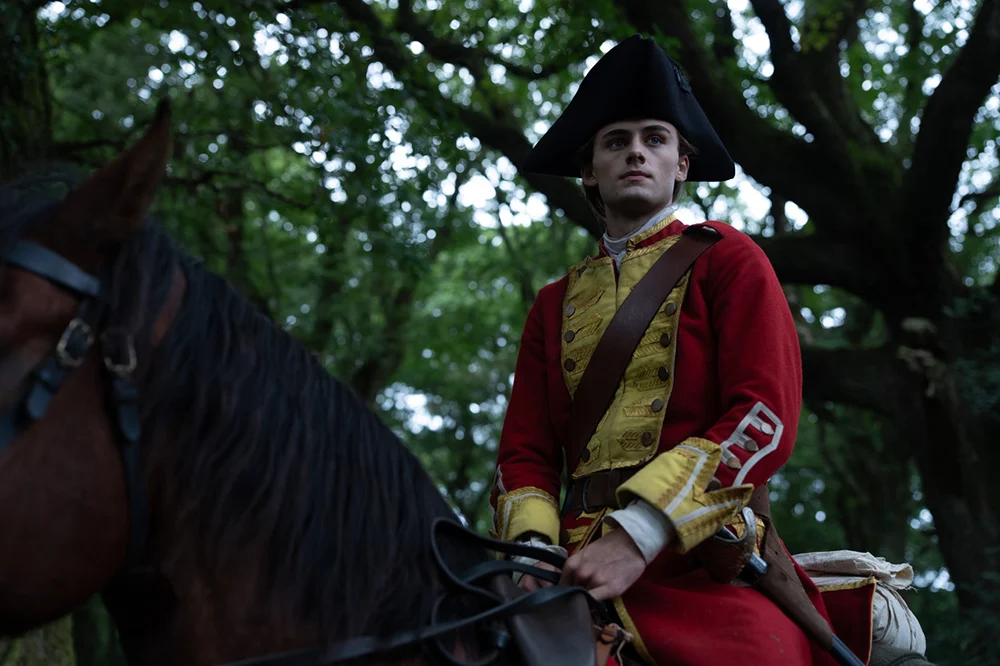
In the pantheon of American historical iconography, few figures loom as large—or as monolithically—as George Washington. He is often remembered in his final form: the stoic, marble-faced patriarch of the American experiment. However, Angel Studios’ latest cinematic endeavor, Young Washington, directed by Jon Erwin, attempts to dismantle that bronze statue to reveal the vulnerable, ambitious, and often reckless young man underneath. Released strategically to coincide with the Fourth of July, the film serves as a piece of neo-traditionalist counterprogramming, offering a reverent, “great-man” biography that feels plucked from the pages of a mid-century grade-school textbook.
While the film operates within the safe, square confines of classic historical hagiography, it succeeds in a singular, surprising way: it captures the sheer, agonizing difficulty of Washington’s ascent. By stripping away the powdered wig and the revolutionary gravitas, Erwin presents a portrait of a man who was not born a leader, but rather forged in the brutal, muddy crucible of the Ohio Territory.
The Crucible: A Chronology of Conflict
The narrative core of Young Washington is anchored in 1755, a pivotal moment at the dawn of the French and Indian War. At just 23 years old, Washington is depicted as an eager, if inexperienced, officer in the British Army. His entry into the military hierarchy is not born of prestige, but of desperation; he secures a commission leading a militia of 150 volunteers into the untamed Ohio Territory, a post shunned by seasoned regulars.
The film’s pacing accelerates during these early sequences, documenting Washington’s transformation from a frontier surveyor into a frontline combatant. The initial skirmishes are depicted with jarring brutality—a stark departure from the sanitized violence of colonial-era romanticism. Washington’s men are picked off by hidden musket fire, transforming the lush wilderness into a slaughterhouse. Amidst this chaos, the film leans into a nascent mythology: Washington survives through what appears to be a mystical layer of protection, a motif that threads through the narrative as he faces overwhelming odds.
The timeline follows Washington’s evolution through several key encounters:
- The Frontier Awakening: Washington’s early attempts to navigate the rigid, aristocratic hierarchy of the British colonial administration, particularly his clashes with the haughty Robert Dinwiddie (played with chilly detachment by Ben Kingsley).
- The Mentorship Phase: His alliance with Lord Fairfax (Kelsey Grammer), whose patronage provides the young Virginian with the social standing necessary to command respect.
- The Crucible of Defeat: The abject failure of his first military campaign, which serves as a catalyst for his maturing strategic mind.
- The Rise to Command: Serving as an aide-de-camp to General Braddock (Andy Serkis), where Washington finally sheds his civilian skin to embrace the role of a wartime commander.
Supporting Data: The Architecture of Irony
The brilliance of Young Washington lies in its layers of historical irony, which the screenplay deftly weaves into the dialogue. Central to this is the relationship between the British Empire and the indigenous Seneca population.
Tanacharison, a Seneca leader portrayed by Ryan Begay with a somber, haunting gravitas, serves as the film’s moral conscience. The irony is twofold: Washington, the future father of American independence, begins his career as a staunch, almost desperate, loyalist seeking to validate himself within the British imperial structure. Yet, he simultaneously chafes against the rigid class barriers that prevent a “colonial” from achieving true equality with the British elite.
The dialogue between Washington and Tanacharison provides the film’s most poignant moments. When the Seneca leader observes the Europeans fighting over territory that does not belong to them, he remarks, “While you kill each other, we wait to reclaim it.” It is a line that carries the weight of future tragedies, reminding the audience that the land being fought over—and the men fighting for it—are destined for a collision course that the characters themselves cannot foresee.
The Performance: Myth vs. Man
William Franklyn-Miller, cast as the titular protagonist, brings a striking, modern aesthetic to the role. Tall, lean, and possessing a model-like intensity, his Washington feels distinctly disconnected from the traditional portraits of the later, older statesman. Critics have noted that Franklyn-Miller feels more like a protagonist from a contemporary YA fantasy—a Jacob Elordi-esque figure—than the stiff, stoic general we know from history books.
However, beneath the model-handsome exterior, Franklyn-Miller delivers a performance defined by a quick, lashing temper and a visceral, instinctive sense of fairness. The film utilizes flashbacks to his boyhood—specifically the death of his father and the subsequent loss of his educational prospects—to ground his ambition. His older half-brother, Lawrence, provides the film’s thematic anchor: the chess-based aphorism, “Even a pawn can take the king.” This mantra fuels Washington’s trajectory, transforming his early failures into the necessary lessons for his eventual leadership.
The supporting cast provides the requisite gravitas to balance the youth of the lead. Ben Kingsley’s Dinwiddie is the embodiment of imperial arrogance, while Kelsey Grammer’s Lord Fairfax offers a weary, aristocratic warmth. Andy Serkis, meanwhile, brings a blustery, desperate energy to General Braddock, grounding the later, more “action-heavy” sequences in a tangible, if crumbling, military reality.
Official Responses and Creative Intent
Angel Studios has positioned Young Washington as a film for the “patriotic heart.” By focusing on the ragtag beginnings of the American military—the move away from the highly visible redcoats toward the blue uniforms that would eventually become synonymous with the Revolution—the film attempts to tap into a specific brand of school-day patriotism.
Director Jon Erwin has defended the stylistic choices of the film, noting that while the movie embraces a “feel-good” heroic narrative, it does not shy away from the cost of command. The shift toward guerrilla tactics—the American preference for cover and concealment over the open-field European style—is highlighted as a metaphor for the shifting power dynamics of the 18th century.
Critics have noted that the film feels like a relic of a bygone era of “Masterpiece Theatre” productions, echoing the sensibilities of Ted Turner Pictures circa 2004. This is a deliberate choice; the film aims to provide comfort and clarity rather than the moral ambiguity that dominates much of modern historical cinema.
Implications: A New Lens on History?
Does Young Washington succeed as a piece of history, or is it merely a well-produced fantasy? The implications of such films are significant in an era of deep cultural division. By presenting Washington as an action hero—a man who alternates between sword slashes and calculated musketry—Erwin bridges the gap between the historical document and the modern blockbuster.
However, the film walks a fine line. By focusing on the "mystical protection" of Washington, the narrative risks alienating viewers who prefer a secular, evidence-based approach to biography. Yet, it is exactly this sense of providence that creates the “crisp tug” of patriotism the filmmakers are aiming for.
The film’s ultimate success, or lack thereof, may not be found in its historical accuracy—which remains debatable—but in its ability to humanize a figure who has become too large to relate to. If the audience walks away viewing Washington not as a marble statue, but as a young man who was once lost, afraid, and struggling to find his place in an unfair system, then the film achieves its purpose.
As a piece of counterprogramming, Young Washington offers a clear, unapologetic vision of leadership. It invites the audience to look at the “pawn” and see the “king” in the making. While it may not rewrite the history books, it provides a compelling, if idealized, look at the fires that forged the American identity. For the viewer looking for a reflection of traditional heroism, the film provides a sturdy, watchable, and deeply earnest experience—a reminder that even the most legendary of figures began their journey with nothing more than a desperate ambition and a gamble on the chessboard of history.
 Asep Darmawan
  Azzam Bilal Chamdy