
 By Dwi Wanna
The global energy landscape is undergoing its most significant shift since the Industrial Revolution. As the world’s appetite for electricity hits record levels, the fundamental question of how we generate that power is being rewritten in real-time. A new analysis from the Pew Research Center, utilizing data from the independent energy think tank Ember, reveals a world in the midst of a massive, albeit uneven, transition away from the carbon-heavy traditions of the 20th century toward a future increasingly defined by wind, solar, and other renewable technologies.
While fossil fuels remain the dominant bedrock of global electricity, their grip is loosening. In 2000, coal, gas, and oil accounted for 65% of global power generation. By 2025, that figure had fallen to 57%. This transition is not merely a matter of policy; it is driven by technological leaps, economic shifts, and a sharp, unrelenting increase in global electricity demand that has forced nations to rethink their infrastructure from the ground up.
A Quarter-Century of Change: The Global Shift
The trajectory of the last 25 years is one of divergence. In the early 2000s, the world was almost entirely dependent on thermal power. However, the period between 2000 and 2025 has seen a dramatic rise in the contribution of renewables.
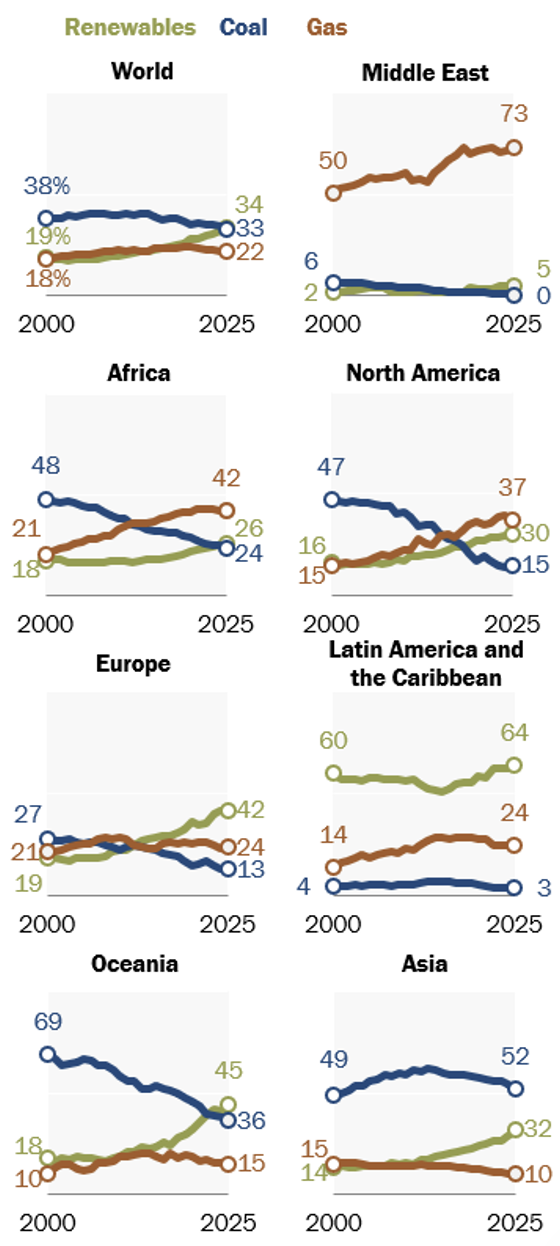
In 2025, a landmark milestone was reached: for the first time in history, the combined share of global electricity generated by renewable sources—including wind, solar, bioenergy, and hydropower—edged past coal (34% vs. 33%).
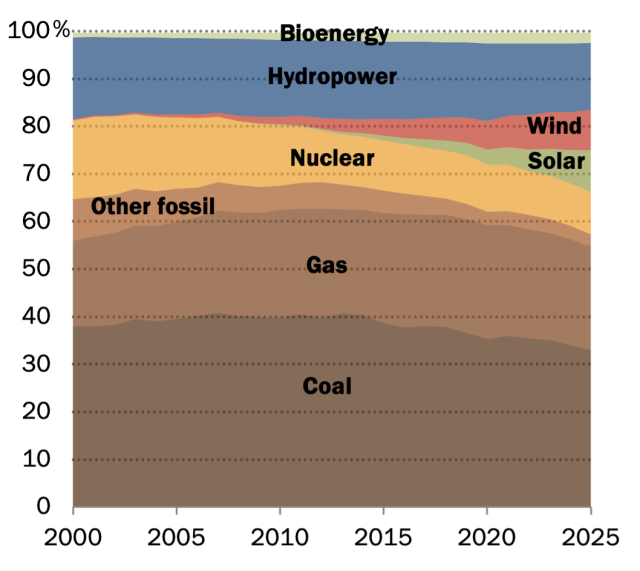
This shift is not occurring in a vacuum. It is happening alongside a sharp rise in total energy consumption. Because global electricity demand has surged, some energy sources have increased in absolute volume even as their percentage share of the total grid has declined. Hydropower, for instance, provides significantly more raw electricity today than it did in 2000, even though its overall share of the market has plateaued due to the rapid expansion of other energy forms.
The Solar Revolution: Costs and Capacity
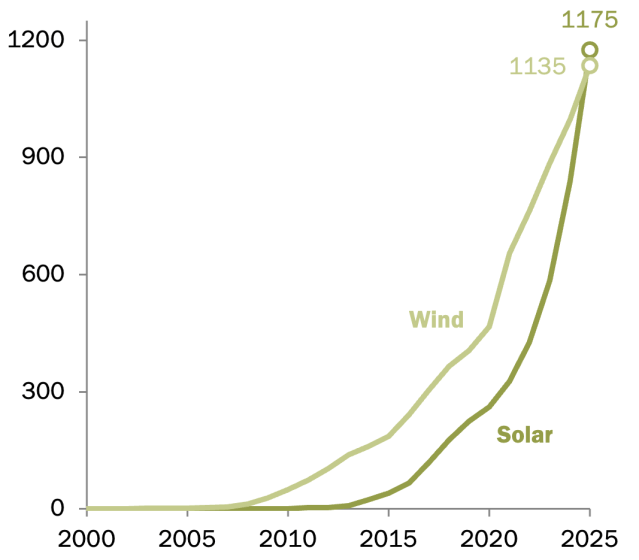
Perhaps the most striking story in the energy data is the meteoric rise of solar power. At the turn of the century, solar accounted for a negligible 0.01% of global electricity. By 2025, that figure had climbed to 9%.
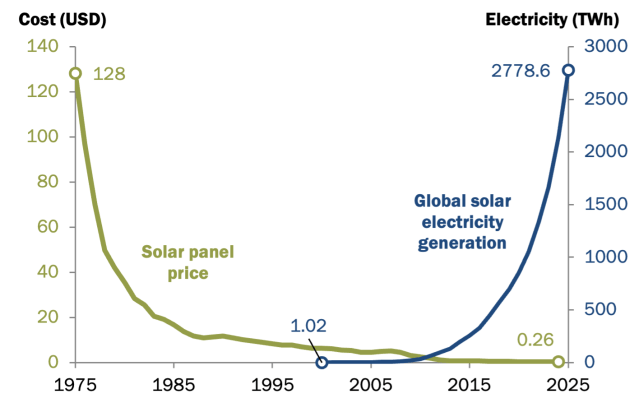
The primary catalyst for this explosion is the radical reduction in cost. In 1975, the average price of a solar panel was approximately $128 per watt. By 2024, that cost had plummeted to just $0.26—a decline of more than 99%. This economic transformation has turned solar from a niche laboratory technology into the most cost-effective method for adding new power capacity in many parts of the world.
Regional Snapshots: A Tale of Two Grids
The transition to renewables is not happening at the same pace everywhere. Regional data highlights a complex, fragmented map of progress:
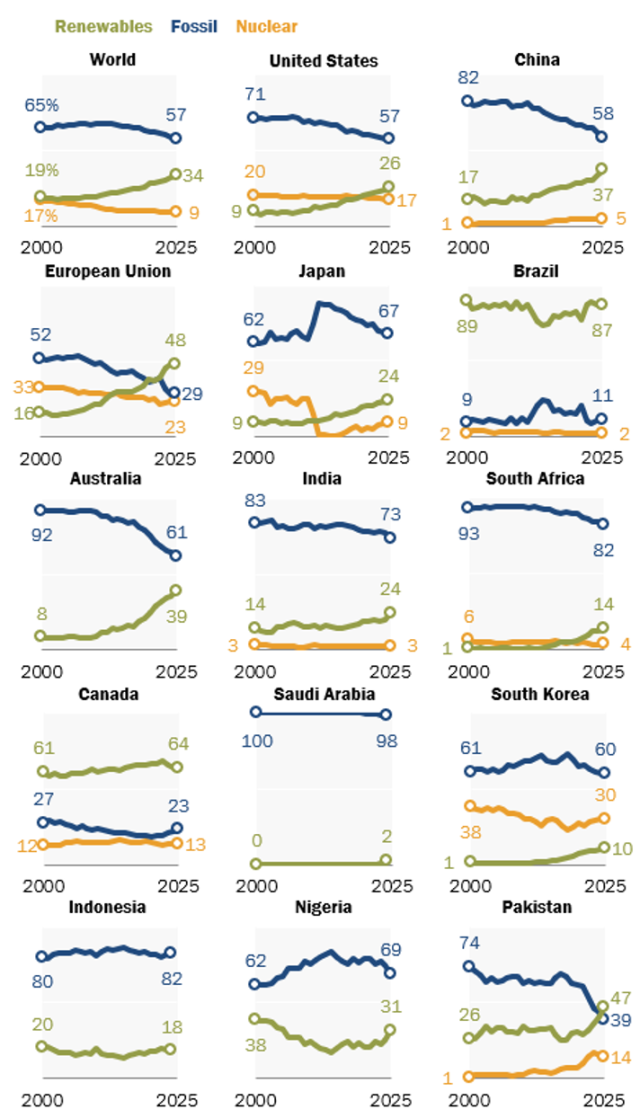
- The European Union: With nearly half of its electricity (48%) now sourced from renewables, the EU stands at the forefront of the global energy transition. Fossil fuels have been relegated to 29% of the generation mix, with nuclear power providing a stable 23% baseload.
- The Americas: In both North America and Africa, natural gas has effectively unseated coal as the primary fossil fuel. In North America, coal’s share of electricity production fell from 47% in 2000 to just 15% in 2025, while natural gas rose to 37%.
- The Asian Surge: Asia represents the most volatile and high-growth region. Electricity generation in Asia expanded by a staggering 298% between 2000 and 2025. China, in particular, has become the world’s primary engine of both demand and innovation, accounting for more than half of the total global growth in electricity demand over the last 25 years.
- The Exception of Japan: Japan’s energy journey has been shaped by the 2011 Fukushima disaster, which prompted a temporary but severe withdrawal from nuclear energy. In the years since, the country has navigated a complex path, slowly reintegrating nuclear power while simultaneously accelerating its investment in renewable capacity.
China: The Engine of the New Energy Economy
China’s role in the global energy shift is multifaceted. Not only is it the world’s largest producer of electricity, but it is also the undisputed leader in solar and wind deployment. In 2025, China generated more solar and wind power than the 38 nations of the OECD combined.
The pace of this growth is unprecedented. Since 2020, China has added over 100 terawatt-hours of wind energy capacity annually, and its solar sector has seen consistent year-on-year growth exceeding 25%. In 2025 alone, China’s increase in solar output was larger than the entire electricity production of the United Kingdom. This scale has allowed China to dominate the global supply chain for clean-energy technologies, from battery manufacturing to electric vehicle production, effectively setting the pace for the global energy transition.
The Persistence of Coal in Southeast Asia
Despite the global trend toward decarbonization, some regions are doubling down on coal. The Association of Southeast Asian Nations (ASEAN) provides a stark contrast to the global trend. Between 2000 and 2025, the ASEAN member states more than doubled their reliance on coal-fired electricity, moving from 20% to 45%. This highlights the tension between the global need for climate action and the immediate, urgent requirement for affordable, reliable baseload power in rapidly industrializing nations.
Implications for the Future
The implications of this 25-year shift are profound. The world is clearly moving toward a more electrified, decentralized, and renewable-heavy future. However, the data suggests that this is not a linear path.
- Grid Stability and Investment: As intermittent sources like wind and solar become the backbone of the grid, the challenge shifts from generating power to storing and distributing it. The rise of battery storage and smart-grid infrastructure will be the next major hurdle for global policy.
- The Nuclear Question: With nuclear energy falling from 17% of global generation in 2000 to 9% in 2025, the industry faces an identity crisis. As nations struggle to meet climate goals, there is renewed debate about whether nuclear power should be revitalized as a low-carbon baseload partner to renewables.
- Economic Disparity: The gap between regions that have successfully pivoted to renewables and those still tethered to coal infrastructure will define the geopolitical landscape of the coming decade. Technology transfers, climate financing, and international cooperation will be essential to ensure that the global energy transition does not leave developing economies behind.
Conclusion: A Turning Point
The data from the last quarter-century paints a picture of a world in transition. While fossil fuels still dominate the global power mix, their supremacy is eroding under the weight of falling costs for solar and wind technologies and an urgent, global demand for clean energy.
As we look toward the next 25 years, the focus will likely shift from simply increasing capacity to optimizing the efficiency and sustainability of the entire system. The progress made in the last two decades is impressive, but the scale of the challenge ahead—to decarbonize the world’s growing power needs—remains the defining test for the global community. The energy systems of 2050 will look nothing like those of 2000, and if the current trends are any indication, the shift toward a renewable-led global grid is not just likely; it is already well underway.
 Pevita Pearce
  Neng Nana