
 By Asep Darmawan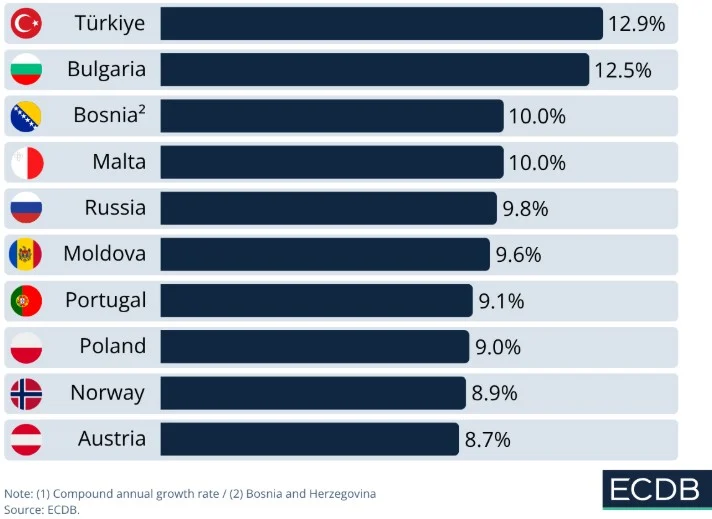
The landscape of European digital commerce is undergoing a profound tectonic shift. According to the latest comprehensive analysis by the Germany-based ecommerce intelligence firm ECDB, the traditional dominance of Western European powerhouses is being challenged by a dynamic surge in Eastern and Southeastern Europe. Between 2025 and 2029, the fastest-growing digital marketplaces on the continent will be concentrated in these emerging regions, signaling a structural transformation in how European consumers shop, pay, and interact with global brands.
Main Facts: The Rise of the Emerging Markets
The ECDB report, which utilizes predictive modeling to forecast average annual growth rates, places Turkey at the pinnacle of the European ecommerce expansion, with an anticipated growth rate of 12.9 percent through 2029. Bulgaria follows closely behind with 12.5 percent, while Bosnia and Herzegovina and Malta are tied for third place, both projected to see annual growth of 10.0 percent.
This data underscores a clear trend: the "growth race" is being won by nations where digital infrastructure is currently maturing rather than saturating. Unlike the mature, high-penetration markets of Western Europe—where ecommerce growth often mirrors GDP expansion—these Eastern and Southeastern economies are benefiting from "leapfrogging" technologies, increased internet penetration, and a burgeoning middle class eager to embrace digital convenience.
A Chronology of Digital Transformation
To understand the current forecast, one must look at the recent historical context of these markets.
2020–2023: The Catalyst Years
The pandemic acted as an accelerant for ecommerce globally, but in markets like Turkey and Bulgaria, it forced a fundamental change in retail habits. In Turkey, the government reported that online spending reached a staggering 86 billion euros last year, marking a 16 percent year-over-year increase. This period proved that even in inflationary environments, Turkish consumers were turning to digital platforms to secure goods at competitive prices.
2024: Infrastructure and Institutional Investment
Throughout 2024, significant capital flowed into the logistics and marketplace ecosystems of these regions. In Bulgaria, for instance, the anticipation of major players like Zalando entering the market signaled that international retailers were beginning to view these regions not as peripheral, but as essential growth drivers. The infrastructure developments during this year—ranging from better last-mile delivery networks to the adoption of sophisticated fintech payment gateways—have laid the groundwork for the 2025–2029 expansion.
2025–2029: The Forecasted Expansion
The coming five-year window is expected to be characterized by the consolidation of these gains. As the ECDB analysis suggests, the growth is not merely a statistical anomaly but a reflection of structural changes. By 2029, the cumulative effect of these investments is expected to fundamentally alter the retail landscape of the Balkan and Anatolian regions.
Supporting Data and Regional Analysis
The ECDB ranking provides a granular look at where the capital is moving. While Turkey leads, the presence of Russia in the fifth spot (9.8 percent growth) serves as a reminder of the massive scale of the Eastern European market. Russia, despite geopolitical complexities, remains home to industry giants like Ozon and Wildberries, which continue to dominate the regional ecommerce hierarchy.
The Top 10 Growth Drivers (2025–2029)
- Turkey (12.9%): Fueled by a massive population of 86 million and a highly resilient consumer base.
- Bulgaria (12.5%): Characterized by low initial adoption rates, providing significant room for "catch-up" growth.
- Bosnia and Herzegovina (10.0%): A beneficiary of regional integration and digital service expansion.
- Malta (10.0%): Driven by a high-tech, service-oriented economy.
- Russia (9.8%): Sustained by established domestic platforms and deep market penetration.
Poland, while not leading in percentage growth, represents a critical pillar of Central European stability. Its steady expansion serves as a benchmark for how these smaller, high-growth markets will likely evolve over the next decade.
Structural Drivers: Why Now?
The "why" behind this growth is perhaps more important than the "what." ECDB experts highlight that this development is "structural and by no means accidental."

1. The Adoption Gap
In many of these markets, ecommerce is still in its relative infancy compared to the UK, Germany, or France. This "adoption gap" is a double-edged sword: it implies that the logistical challenges are greater, but it also means that the "low-hanging fruit"—first-time online shoppers—are still abundant.
2. Marketplace Ecosystems
The rise of local marketplace ecosystems is providing a framework for SMEs (Small and Medium Enterprises) to sell online. When a local artisan or a small distributor in a remote part of Bulgaria can suddenly access a national, or even international, customer base via a centralized marketplace, the economic output of that sector expands exponentially.
3. Regulatory and Logistical Maturation
In many of these high-growth countries, governments are actively incentivizing digital payments and cross-border trade to reduce the reliance on cash-on-delivery, which has historically been a friction point. As trust in digital payment systems increases, the velocity of transactions naturally accelerates.
Official Perspectives and Industry Implications
The implications for global retail stakeholders are clear: the "European" market can no longer be treated as a monolith.
The Retailer’s Dilemma
International brands that have spent the last decade focusing exclusively on the DACH (Germany, Austria, Switzerland) region are now recalibrating their expansion strategies. The cost of acquiring a new customer in a saturated market like Germany is exponentially higher than in an emerging market like Turkey or Bulgaria. Consequently, we are seeing a shift in marketing budgets toward these high-growth regions.
The Infrastructure Opportunity
The ECDB findings also point to a significant opportunity for logistics providers. The growth in volume is currently outpacing the development of specialized delivery infrastructure in these regions. Companies that can solve the "last-mile" puzzle in rural Turkey or across the Balkan nations will likely become the backbone of the next generation of European retail.
Economic Resilience
For the governments in these top-10 nations, the growth of ecommerce represents a vital tool for economic diversification. By formalizing retail sectors, states can increase tax transparency and improve the efficiency of domestic trade. The digital transformation of the retail sector is being viewed by policymakers as a hedge against traditional economic downturns.
Conclusion: A Shift in the Continental Balance
The ECDB report serves as a wake-up call for stakeholders across the continent. While Western Europe remains a massive, stable market, the engine of future growth is undeniably shifting toward the East and Southeast.
As we move toward 2029, the combination of technological maturation, infrastructure investment, and a growing digital-native population will ensure that countries like Turkey and Bulgaria remain at the forefront of the global ecommerce conversation. For investors, retailers, and logistical firms, the message is unequivocal: the future of European commerce is being written in the markets that, until very recently, were considered the periphery of the continent. The era of the "Digital East" has officially arrived, and it is poised to redefine the standards of convenience and consumerism for years to come.
 Ali Ikhwan
  rifanmuazin
  Nana Muazin