
 By Nana Muazin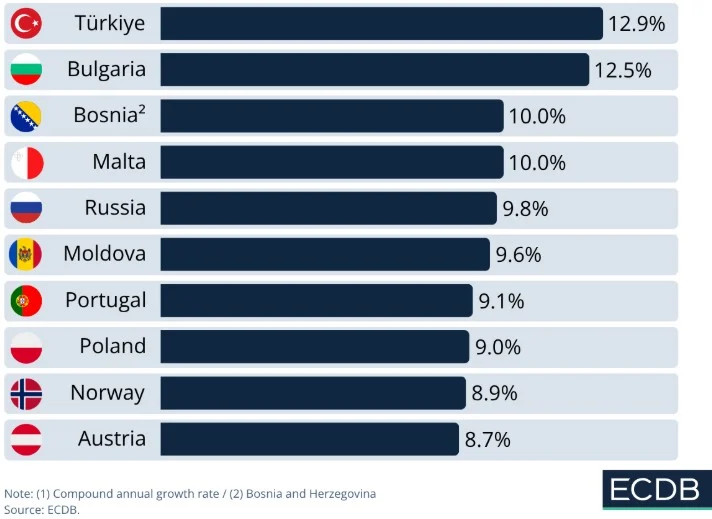
The landscape of European digital commerce is undergoing a profound tectonic shift. As mature markets in Western Europe reach saturation points, the engine of growth is moving rapidly toward the eastern and southern peripheries of the continent. According to a comprehensive new report released by the Germany-based ecommerce analytics firm ECDB, the next five years will see a dramatic surge in online spending across emerging economies, with Turkey and Bulgaria emerging as the undisputed frontrunners.
The ECDB study, which meticulously analyzed growth forecasts for European nations between 2025 and 2029, paints a clear picture: the future of European retail is being written in regions that were, until recently, considered secondary players in the digital economy.
The Main Facts: A Shift in the Digital Center of Gravity
The report, which calculates the Compound Annual Growth Rate (CAGR) for online retail, reveals that the highest growth trajectories are no longer found in the established hubs of London, Paris, or Berlin. Instead, the focus has pivoted to markets characterized by rapid digitalization, evolving consumer habits, and a vast, untapped potential for marketplace integration.
Turkey currently stands at the summit of this list, boasting an eye-watering projected average annual growth rate of 12.9 percent through 2029. Hot on its heels is Bulgaria, with a projected growth rate of 12.5 percent. This data underscores a broader trend identified by analysts: the "growth race" is being dominated by Southeastern European nations.
Rounding out the top tier, Bosnia and Herzegovina and the island nation of Malta share the third position, both anticipating a 10 percent annual increase in online transaction volumes. The data indicates that these figures are not mere statistical anomalies but reflections of fundamental structural shifts within these economies.
Chronology: The Evolution of a Digital Revolution
To understand why these nations are peaking now, one must look at the timeline of digital adoption in these regions.
Phase 1: The Foundation (2015–2020)
During the mid-2010s, ecommerce in Eastern Europe was largely fragmented. While internet penetration was rising, trust in digital payment gateways remained low, and logistics infrastructure—the backbone of ecommerce—was inconsistent. In countries like Turkey and Bulgaria, consumers were accustomed to brick-and-mortar shopping, and the transition to digital was inhibited by concerns over security and delivery reliability.
Phase 2: The Pandemic Catalyst (2020–2023)
The global health crisis acted as a forced accelerator. Across the globe, lockdowns pushed hesitant consumers toward online platforms. In Turkey, this was particularly pronounced; the country’s massive domestic market, coupled with a robust local logistics network, allowed online spending to soar. By 2023, Turkish online spending had hit a staggering 86 billion euros, a 16 percent increase from the previous year.
Phase 3: Structural Maturation (2024–2029)
We are currently in the midst of the third phase. As ECDB notes, the growth is no longer just a reaction to external shocks but a result of "structural and by no means accidental" improvements. This includes the entry of major international players—such as Zalando’s expansion into Bulgaria—and the modernization of local digital payment infrastructures.
Supporting Data: Regional Breakdown and Market Dynamics
The ECDB report provides a granular look at the drivers behind the numbers. A key takeaway is the sheer diversity of the markets involved.
The Turkish Behemoth
Turkey is an outlier in this ranking, not just in its growth rate but in its sheer scale. With a population of approximately 86 million, the Turkish market is significantly larger than any other country in the top ten. The 12.9 percent growth projection is particularly impressive given the base size. The government’s recent focus on digitalizing the retail sector has fostered a environment where local marketplaces can compete with global giants, keeping the capital within the ecosystem.

The Bulgarian "Early-Adoption" Curve
Bulgaria represents the opposite end of the spectrum. Ecommerce there is still in a relatively early stage of development, with total online spending reaching approximately 1.2 billion euros last year. However, this is precisely why its growth potential is so high. As infrastructure catches up to the rest of Europe, the percentage growth spikes, a phenomenon common in markets undergoing rapid modernization.
The Regional Cluster
The list also highlights the persistence of regional trends. Russia remains a significant force, occupying the fifth spot with a 9.8 percent growth projection. Despite geopolitical complexities, the strength of local e-retailers like Ozon and Wildberries continues to drive high transaction volumes. Meanwhile, Poland’s 8th-place ranking illustrates the "steady-state" expansion typical of Central European markets—less explosive than Bulgaria, but perhaps more resilient and consistent over the long term.
Official Responses and Expert Analysis
The consensus among market analysts at ECDB is that the "digital divide" within Europe is closing. Their report notes: "The reasons for their fast development are structural and by no means accidental. In many of these markets, ecommerce is still at a relatively early stage of adoption. In addition, infrastructure and marketplace ecosystems continue to offer substantial growth potential."
Industry experts point to three primary pillars driving this growth:
- Infrastructure Upgrades: Heavy investment in last-mile delivery and localized warehouse distribution centers is removing the friction that previously hindered online shopping in Southeastern Europe.
- Fintech Integration: The proliferation of digital wallets and "Buy Now, Pay Later" (BNPL) schemes has lowered the barrier to entry for consumers who were previously underbanked or wary of traditional credit cards.
- Consumer Demographics: These regions possess a younger, tech-savvy demographic that is more willing to bypass traditional retail models in favor of the convenience and price transparency offered by digital platforms.
Implications: What This Means for Global Business
The shift of the ecommerce center of gravity toward Eastern and Southern Europe has profound implications for global retailers, investors, and policymakers.
For Global Retailers: Expansion Strategy
The findings suggest that the "Western-first" strategy is outdated. Companies looking for the next phase of growth must prioritize markets where the "early adoption" phase is just beginning. The success of Zalando in Bulgaria serves as a blueprint: enter markets as the digital infrastructure is being laid, rather than after the market is saturated.
For Local Businesses: The Competitive Threat
While the growth is positive for the overall economy, local businesses in these regions face an existential challenge. As international giants enter these markets, local retailers must pivot to niche products, superior customer service, or hyper-localized experiences to survive. The ability to integrate with the sophisticated logistics networks being built by major players will be the deciding factor between survival and obsolescence.
For Policymakers: The Digital Economy
The rapid growth in these countries necessitates a new regulatory approach. Governments in the region are now under pressure to harmonize their digital trade laws with broader European standards, particularly concerning consumer protection, data privacy, and cross-border taxation. The "growth race" is not just about sales volume; it is about establishing a regulatory framework that can support a digital economy that is expected to double in size in many of these nations within the next decade.
Conclusion
The data provided by ECDB serves as a wake-up call for the European business community. The center of gravity for online retail is migrating. While the established economies of the West remain vital, the heartbeat of the next decade’s growth will be found in the bustling, transforming markets of Turkey, Bulgaria, and their neighbors.
As these nations continue to build the infrastructure, payment systems, and consumer trust necessary for a robust digital economy, they are not merely catching up to their Western peers—they are creating new models for retail expansion that emphasize rapid, tech-driven adoption. For businesses, investors, and observers alike, the path forward is clear: watch the East, and watch it closely. The next five years will not just be about growth; they will be about the total redefinition of what it means to shop in the European digital age.
 Pevita Pearce
  Ammar Sabilarrohman
  Iffa Jayyana