
 By Evan Lee Salim
In the rapidly evolving landscape of digital finance and speculative wagering, prediction markets have emerged as a significant, albeit controversial, force. Platforms like Polymarket and Kalshi have transformed from niche experimentation grounds into high-volume financial hubs, boasting a combined trading volume that reached nearly $24 billion by April 2026. As these platforms gain mainstream traction, questions regarding who is participating, how they interact with these markets, and what drives their speculative behavior have come to the forefront of financial discourse.
A recent, comprehensive analysis by the Pew Research Center provides the most detailed look yet into the mechanics of this ecosystem. By tracking nearly 12,000 active Polymarket accounts over a six-week period from May 7 to June 19, 2026, researchers have begun to pull back the curtain on the "typical" user, revealing a landscape defined by both modest hobbyists and hyper-active, high-frequency traders.
The Rise of the Prediction Economy: Main Facts
Prediction markets function on a simple yet profound premise: the "wisdom of the crowd." By allowing users to trade on the outcomes of real-world events—ranging from presidential elections to sports championships and crypto price fluctuations—these platforms create a decentralized mechanism for forecasting.
The scale of this activity is staggering. With billions of dollars in volume, these platforms are no longer just forums for political enthusiasts; they are serious financial instruments that integrate cryptocurrency, specifically USD Coin (USDC), as the primary medium of exchange. The Pew Research Center’s investigation confirms that the participation is widespread, though not evenly distributed. While some users approach these platforms with a casual, almost recreational intent, others are treating them as full-time professional trading venues.
Chronology of the Study: A Six-Week Snapshot
To capture a representative view of market behavior, the Pew Research Center conducted its longitudinal study during the spring and early summer of 2026. The methodology was precise, utilizing the Polymarket user activity API to sample wallets that had engaged in 10 high-volume events.

- Early May 2026: Researchers identified 10 diverse, high-volume trading events to serve as the baseline for the sample. A pool of 16,836 accounts was initially identified based on their participation in these specific events.
- May 7 – June 19, 2026: The research team conducted 15 distinct data collection intervals. By the end of the period, the study successfully tracked the activity of 11,989 active wallets, providing a granular view of how traders shifted their positions, entered new markets, and managed their capital over 42 days.
This timeline was critical, as it allowed for the observation of "bursts" in trading activity, particularly around news-heavy events, while also filtering out noise to identify persistent patterns in user behavior.
Supporting Data: The Anatomy of a Trade
The data reveals a stark divide between the casual participant and the "power user."
The Typical User
The median Polymarket trader is a moderate participant. Over the six-week study, the typical user executed 46 trades across 10 active days. Perhaps most surprising is the modest scale of the financial commitment: the average value of a single trade was just $6.50.
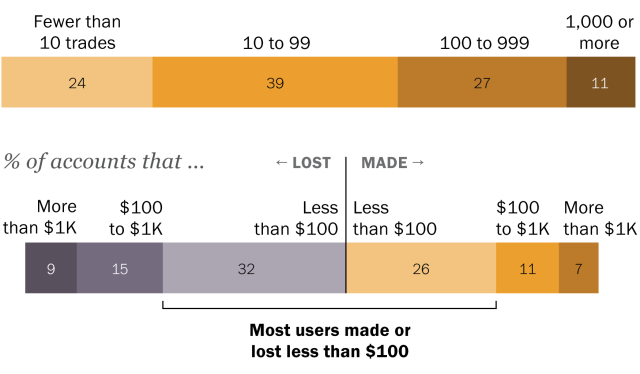
For the majority of participants, these markets are not vehicles for massive wealth creation or ruin. In fact, 58% of traders saw their net gains or losses stay within a $100 range. The "break-even" nature of the typical user suggests that for many, the primary utility of these platforms is entertainment or "skin in the game" rather than aggressive wealth management.
The Power Users
The data takes a sharp turn when looking at the top tier of users. While 24% of accounts placed fewer than 10 trades, a dedicated 11% of accounts were responsible for 1,000 trades or more within the same six-week window. These hyper-active users represent the "engine" of the platform’s liquidity. They are not merely placing bets; they are engaged in high-frequency trading, likely utilizing automated scripts or advanced monitoring tools to capitalize on minute fluctuations in event probabilities.
Topic-Based Segmentation
The study highlights that users are rarely generalists. Instead, they tend to specialize:
- Sports Traders: These are the most active cohort, with a median of 69 trades over the period. They tend to bet with higher individual stakes ($9 average).
- Crypto Traders: This group is highly active (59 trades) but focuses on smaller, more frequent bets, averaging less than $4 per trade.
- Politics Traders: This segment is significantly more reserved, with a median of just 13 trades over the six weeks. This may reflect the longer, more drawn-out nature of political cycles compared to the rapid-fire outcome of a basketball game or a sudden cryptocurrency price movement.
Official Perspectives and Regulatory Context
While the Pew Research Center has remained neutral, providing only the analytical data, the implications of their findings are being discussed in regulatory circles. The absence of data from other major players like Kalshi highlights a growing tension: the "prediction economy" is currently a "black box."
Industry advocates argue that these markets provide superior predictive accuracy compared to traditional polls. However, critics—and recent research on the morality of gambling—suggest that the gamification of serious events like elections or economic policy shifts could have unforeseen social consequences. The fact that the majority of users are placing small bets suggests that while the systemic risk might be contained for now, the cultural impact of "betting on reality" is expanding.
Implications: The Future of Prediction Markets
What does this mean for the future of information and finance?
1. The Professionalization of Forecasting: The emergence of a distinct group of high-volume traders suggests that these platforms are moving toward a professionalized model. As these traders refine their algorithms, the "crowd wisdom" found on Polymarket may become increasingly skewed by those with the most capital and the fastest technology, potentially undermining the democratic ideal of the "wisdom of the crowd."

2. The "Gamblification" of Information: The study indicates that users are deeply segmented by interest. When people only trade on what they know (or think they know), they may be creating echo chambers. A sports bettor rarely crosses over to political markets, and vice-versa. This specialization suggests that prediction markets are not necessarily creating a holistic view of the future, but rather aggregating siloed expertise.
3. Data Transparency as a Necessity: The methodology used by the Pew Research Center—relying on public API data—underscores a critical need for greater transparency. As these markets become more influential, the ability for researchers and the public to audit the health and fairness of these platforms will be paramount. Without better data sharing, regulators may feel compelled to impose stricter oversight, which could stifle the innovation currently driving this sector.
In conclusion, the typical Polymarket user is a far cry from the high-rolling gambler often depicted in media. They are, in large part, modest participants looking to validate their hunches on sports or crypto. However, beneath this surface lies a complex, highly active layer of professionalized traders whose behavior is rapidly evolving. As we look toward the remainder of 2026 and beyond, the influence of these markets on our perception of truth and event-probability is likely to grow, making the continued study of these digital arenas more essential than ever.
 Pevita Pearce
  Neng Nana