
 By Azzam Bilal Chamdy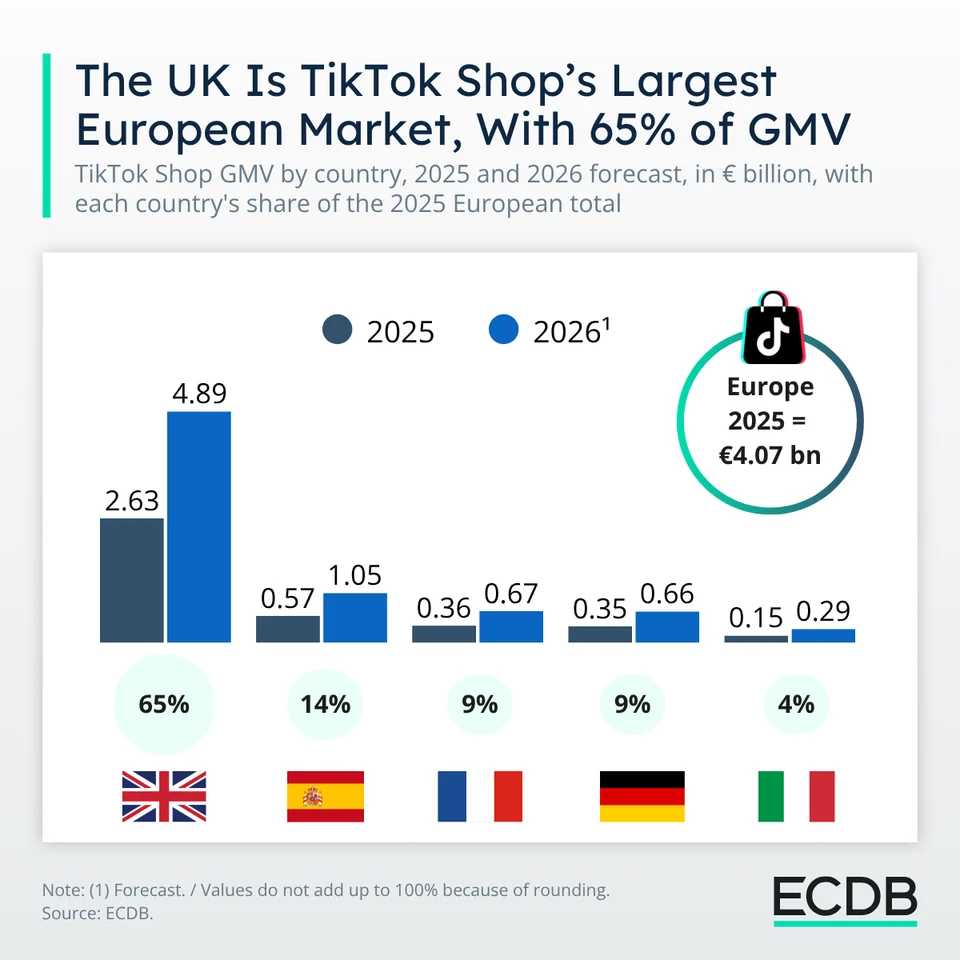
The boundaries between social media entertainment and retail commerce are dissolving at an unprecedented pace. TikTok Shop, the integrated e-commerce arm of the viral video platform, has firmly established itself as a formidable player in the European digital economy. New data provided by the German e-commerce intelligence firm ECDB reveals a landscape dominated by the United Kingdom, where the platform has transitioned from a niche marketing tool into a retail powerhouse. As the platform aggressively expands its footprint across the continent, it is not merely chasing market share—it is fundamentally altering the "social commerce" paradigm for millions of European consumers.
Main Facts: The UK’s Unrivaled Dominance
The figures for 2025 paint a clear picture of a market defined by early adoption and scale. According to ECDB, the United Kingdom remains the uncontested engine of TikTok Shop’s European operations. Having pioneered the market in 2021, the UK has reaped the rewards of being an early adopter, with gross merchandise value (GMV) expected to surge to nearly 5 billion euros this year.
This dominance is not accidental. The UK benefits from a robust digital infrastructure and a consumer base already highly accustomed to mobile-first e-commerce. Currently, more than 300,000 British small and medium-sized enterprises (SMEs) have integrated their storefronts into the TikTok ecosystem, leveraging the platform’s unique "shoppertainment" model—where live-streamed content and video feeds facilitate impulse purchases without the user ever leaving the app.
To put this in perspective, the UK accounted for a staggering 65 percent of all European spending on TikTok Shop last year, moving 2.63 billion euros in goods. While other markets are beginning to catch up, the sheer volume of British participation acts as a benchmark for the rest of Europe.
A Chronological Evolution of TikTok’s European Expansion
TikTok Shop’s journey in Europe has been marked by a strategic, phased rollout that prioritizes high-spending, high-engagement markets.
2021: The UK Beta Phase
The platform officially cut its teeth in the United Kingdom in 2021. By treating the UK as a sandbox, TikTok refined its algorithmic recommendation engine, payment gateways, and logistics partnerships. This period was critical in proving that social commerce could function effectively outside of its massive Asian markets.
2024: The Strategic Pivot
As the UK model stabilized, 2024 served as a year of significant geographic diversification. TikTok Shop launched in Spain toward the end of the year, quickly securing its position as the second-largest market on the continent with 570 million euros in GMV. Ireland also saw the arrival of the platform in late 2024, signaling TikTok’s intent to deepen its reach into Western Europe.
2025: Pan-European Scale
The year 2025 stands as the definitive year of expansion. In late March, TikTok Shop launched simultaneously in France, Germany, and Italy. While these markets are still in their infancy relative to the UK, their growth trajectory is steep. By June, the platform had expanded its operations further into the Netherlands, Belgium, Poland, and Austria.
This rapid expansion culminated in the introduction of "Sell Across Europe," a strategic initiative that transformed TikTok Shop from a collection of fragmented national markets into a cohesive, pan-European marketplace. This evolution allows merchants to reach consumers across twelve different countries, standardizing the cross-border selling experience.
Supporting Data: The Growth Trajectory
The data provided by ECDB highlights a fascinating trend: while the UK holds a massive lead in absolute numbers, the growth rate is becoming a continental phenomenon.

Market Share and GMV Breakdown (2024 Data)
- United Kingdom: 65% market share (€2.63 billion)
- Spain: 14% market share (€570 million)
- France: 9% market share (€360 million)
- Germany: 9% market share (€350 million)
- Italy: 4% market share (€150 million)
What makes these figures particularly noteworthy is the forecast for the remainder of 2025. Despite the disparity in how long the feature has been available in each country, ECDB predicts a uniform trend: a near-doubling of GMV across all these markets. This suggests that the platform’s "viral loop"—the speed at which a product can trend on a For You Page (FYP) and convert to a sale—is consistent regardless of the linguistic or regional differences of the European markets.
Official Responses and Strategic Shifts
While TikTok has historically remained tight-lipped regarding specific internal revenue goals, their actions speak to a clear long-term strategy. The launch of the "Sell Across Europe" program indicates a move toward full integration with European logistics providers, aiming to minimize friction in shipping and taxation.
Furthermore, the most significant strategic move of late 2025 is the facilitation of cross-border trade between the European Union and the United Kingdom. Recognizing that trade barriers post-Brexit have been a pain point for many small businesses, TikTok has positioned itself as a bridge. A pilot program for cross-border sales between the EU and the UK commenced on September 21, 2025. Following successful initial testing, a broader rollout was scheduled for October 19, 2025, essentially turning TikTok Shop into a bypass for traditional, clunky international e-commerce supply chains.
Implications for the Future of Retail
The implications of these developments for the European retail sector are profound and far-reaching.
1. The Disruption of Traditional Search-Based E-Commerce
Traditional e-commerce platforms like Amazon are built on intent; users search for what they need. TikTok Shop is built on discovery; the platform anticipates what the user wants based on consumption patterns. This "push" marketing model is significantly more effective at generating impulse demand. Traditional retailers must now grapple with the fact that their products may be losing visibility to products that are "better at being viral."
2. The Empowerment (and Pressure) of the SME
For the 300,000+ SMEs in the UK and the growing number of merchants in the EU, TikTok Shop provides a low-barrier entry to millions of eyeballs. However, this comes with a new kind of pressure: the requirement to be a content creator. Business owners are no longer just merchants; they are expected to produce high-quality, engaging, and authentic video content to remain relevant in the feed. The "creator economy" and the "retail economy" have officially merged.
3. Regulatory and Logistic Hurdles
As TikTok Shop grows, it inevitably draws the gaze of European regulators. The platform’s ability to move such high volumes of goods—often sourced from global suppliers—will likely face increased scrutiny regarding product safety, tax compliance (VAT), and data protection. Furthermore, the cross-border pilot between the UK and the EU is a logistical test of epic proportions. Navigating the complex customs and regulatory requirements of the post-Brexit landscape is no small feat, and if TikTok succeeds, it will set a new standard for how cross-border trade should look in the digital age.
4. The "Shoppertainment" Standard
The success of TikTok Shop suggests that European consumers are moving away from static, catalogue-style shopping. The success of the platform’s live-streaming features, where influencers demonstrate products in real-time and offer limited-time discounts, creates a sense of urgency that traditional web stores struggle to replicate. Retailers who fail to incorporate interactive, video-led shopping experiences risk becoming obsolete in the eyes of Gen Z and Millennial demographics.
Conclusion
TikTok Shop’s trajectory in Europe is not merely a story of a tech company expanding its services; it is a fundamental shift in how goods are discovered, marketed, and sold. With a near-doubling of GMV expected across the continent and a new, unified marketplace strategy, TikTok is forcing every major retailer in Europe to reconsider their digital strategy.
As the lines between the content we consume and the products we buy continue to blur, one thing is certain: the platform that successfully captured the world’s attention is now successfully capturing its wallet. Whether this growth can be sustained in the face of impending regulatory challenges and the intense pressure of logistical expansion remains the defining question for the next fiscal year. For now, the "TikTok Shop" icon on the bottom of a phone screen has become one of the most powerful retail real estate locations in the modern world.
 Laily UPN
  Asep Darmawan