
 By Evan Lee Salim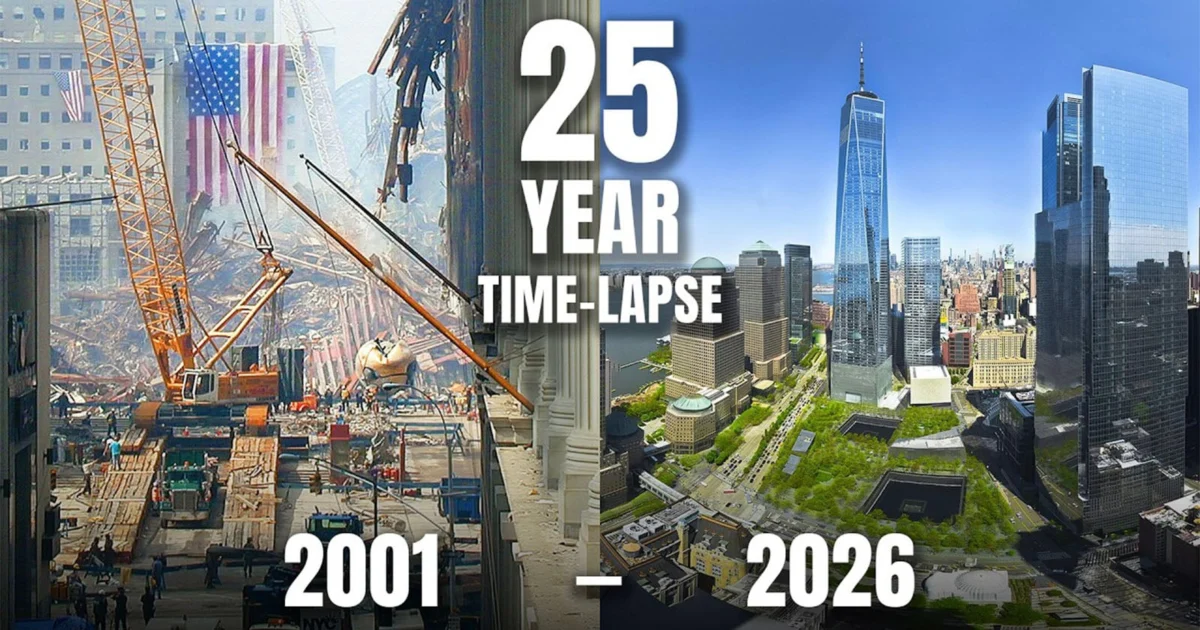
NEW YORK — In a profoundly moving visual testament to human endurance, global webcam pioneer EarthCam has released a sweeping, comprehensive 25-year timelapse video chronicling the destruction, recovery, and remarkable rebirth of the World Trade Center site in Lower Manhattan. Spanning a quarter of a century, the high-resolution compilation offers an unprecedented look at how Ground Zero transformed from a smoldering landscape of unimaginable tragedy into a bustling architectural marvel of modern urban renewal.
The release of the footage coincides with the somber 25th anniversary of the September 11 terrorist attacks—a watershed historical moment that permanently altered geopolitics, aviation security, and the collective consciousness of the global community. While the anniversary naturally prompts solemn reflection on the nearly 3,000 innocent lives lost on that tragic Tuesday, EarthCam’s newly published archive shifts the narrative toward the tireless spirit of recovery, engineering ingenuity, and unbroken resilience that defined the decades that followed.
Main Facts
The newly minted archival release captures the entire chronological evolution of the 16-acre World Trade Center site from a singular, multi-angle vantage point scaled across twenty-five years of digital advancement.
Initially deployed mere days after the September 11, 2001 attacks, EarthCam’s very first camera was installed not for commercial documentation, but as a critical tool to aid emergency services, rescue operations, and structural engineers navigating the unstable rubble of the fallen Twin Towers. What began as an emergency deployment evolved into a permanent historical duty. Over the next quarter-century, EarthCam maintained an uninterrupted vigil over Lower Manhattan, recording the monumental construction phases of landmark structures including:
- One World Trade Center (the Freedom Tower), the tallest building in the Western Hemisphere.
- The Oculus, Santiago Calatrava’s striking bird-like transportation hub.
- 3 World Trade Center and surrounding commercial towers.
- St. Nicholas Greek Orthodox Church and National Shrine, meticulously redesigned by architect Santiago Calatrava.
- The Perelman Performing Arts Center (PAC NYC), the site’s cultural cornerstone.
- Ongoing construction milestones at the yet-to-be-completed 2 World Trade Center.
According to EarthCam, the multi-decade timelapse stands as a dedicated memorial to the victims of 9/11 while explicitly honoring the first responders, heavy recovery crews, architects, ironworkers, and everyday citizens who orchestrated the monumental revitalization of the Manhattan skyline.
Chronology of a Quarter-Century Transformation
To fully understand the gravity of EarthCam’s 25-year visual archive, one must trace the chronological steps of how a gaping wound in the heart of New York City gradually healed through deliberate, generational effort.
Phase 1: The Dark Days of Rescue and Recovery (2001–2003)
In the immediate aftermath of the attacks, EarthCam’s early webcasting technology provided a vital, remote window into Ground Zero. The initial footage—captured during a period when image sensors operated at a fraction of a megapixel—depicts the frantic, agonizingly slow recovery operations. Heavy machinery picked through twisted steel and pulverized concrete, while search-and-rescue personnel combed the smoking debris for survivors and victims. This harrowing chapter transitioned into a massive site-clearing operation that took months of grueling, around-the-clock labor.
Phase 2: Master Planning and Deep Excavation (2004–2006)
As the recovery phase drew to a close, the focus shifted toward architectural vision and emotional healing. The timelapse captures the complex logistical challenge of clearing the subterranean "bathtub" structure that kept the Hudson River from flooding the foundations. Architects, city planners, and families of victims debated the future of the site, ultimately leading to the selection of Daniel Libeskind’s master plan and the construction of the National September 11 Memorial & Museum.
Phase 3: The Ascent of the Supertalls (2007–2014)
The middle years of the timeline demonstrate an explosion of structural engineering. Viewers watching the timelapse can observe the steady, floor-by-floor ascent of One World Trade Center, which eventually topped out at a symbolic 1,776 feet in May 2013. Simultaneously, foundational work for the surrounding towers and transit hubs began to reshape the Manhattan grid, turning the once-desolate construction zone into a hive of industrial productivity.
Phase 4: Cultural Integration and Modern Completion (2015–Present)
The final decade of the timelapse reveals the transition from raw construction to a functional, living urban neighborhood. The opening of The Oculus in 2016 brought millions of commuters back through a dazzling white transit hub. Soon after, the St. Nicholas Greek Orthodox Church—destroyed when the South Tower collapsed—rose anew as a glowing beacon of light. Most recently, the footage highlights the completion of the Perelman Performing Arts Center, injecting arts and culture directly into the footprint of the memorial site, while preparatory work for 2 World Trade Center continues to edge the project closer to its final master-planned vision.
Supporting Data and Technological Evolution
One of the most remarkable sub-narratives of EarthCam’s 25-year project is the parallel evolution of digital imaging technology. When the company first pointed its low-resolution camera toward Ground Zero in September 2001, the digital streaming landscape was in its absolute infancy.
In an interview with Spectrum News, EarthCam founder and CEO Brian Cury reflected on the staggering technological leap required to capture this quarter-century project:
"We started out with maybe a twelfth of a megapixel, and now we’re doing 80,000-megapixel imagery."
This exponential increase in resolution mirrors the broader technological revolution over the past 25 years. The early years of the Ground Zero archive feature grainy, low-frame-rate webcasts that reflect the dial-up era of the internet. By the 2010s and 2020s, the footage transforms into ultra-crisp, cinematic 4K and gigapixel panoramas capable of capturing the minute movements of individual construction workers hundreds of feet in the air.
Furthermore, the data underscores the immense economic and logistical scale of the rebuild. The World Trade Center rebuilding project is widely regarded as one of the most complex, expensive, and logistically challenging civil engineering endeavors in modern human history, involving coordinated efforts between the Port Authority of New York and New Jersey, private developers like Silverstein Properties, and thousands of skilled union laborers.
Official Responses and Perspectives
The release of the milestone timelapse has elicited profound emotional reactions from industry leaders, historians, and the public alike.
Brian Cury explained that EarthCam’s original mission was centered on community building through live camera technology. However, the unexpected horror of 9/11 fundamentally redirected the company’s historical purpose:
"EarthCam was started as a way to really bring people together using live camera technology," Cury told Spectrum News. "First, we were doing entertainment events. And when the terror attacks occurred on Sept. 11, we were compelled to use this technology that we had, this webcasting technology, to be able to share that witness to the world."
Cury emphasized that the evolution of the camera feeds mirrored the psychological journey of New York City itself:
"We first started documenting the rescue and recovery efforts, and that led to the construction and rebuilding efforts."
A Broader Reflection: Photographers Recall 9/11
The unveiling of EarthCam’s project coincided with extensive media retrospectives marking the 25th milestone. On Friday, industry publication PetaPixel published a poignant roundup of reflections from frontline photographers who documented the unfolding horrors of September 11, 2001—an event that claimed the lives of nearly 3,000 people and redefined global photojournalism.
Among the accounts highlighted was that of Associated Press photographer Richard Drew, who captured one of the most haunting and controversial images in modern history: The Falling Man, depicting an unidentified individual plunging from the upper floors of the World Trade Center.
Reflecting on the enduring legacy of the image, Drew noted:
"We’re seeing him in the last moments of his life."
The photograph, transmitted across news wires globally on the afternoon of September 11, immediately sparked a fierce ethical debate regarding the boundaries of documentary photography, grief, and public voyeurism—a debate that photojournalists and ethicists continue to grapple with a quarter-century later.
Implications of the 25-Year Archive
The publication of EarthCam’s 25-year timelapse carries deep implications for how society records, remembers, and processes collective trauma and urban renewal.
- Preservation of Historical Memory: As living memory of the events of September 11 inevitably transitions into historical textbook knowledge for younger generations, continuous visual archives ensure that the magnitude of both the tragedy and the subsequent recovery remains visceral and undeniable.
- The Intersection of Technology and Documentation: The project serves as a case study in the power of persistent, automated surveillance and documentation. By leaving cameras running for a quarter of a century, EarthCam accidentally created an irreplaceable anthropological record of urban adaptation.
- A Global Symbol of Resilience: While terrorist attacks are designed to break the spirit of a civilization, the multi-decade rebirth of Lower Manhattan stands as a permanent architectural rebuke to destruction. The timelapse proves that human communities possess an innate capacity to rebuild, innovate, and honor their past while stepping boldly into the future.
As work continues on the remaining parcels of the World Trade Center site, EarthCam’s digital vigil continues—capturing every sunrise over the Manhattan skyline, ensuring that the lessons, the memory, and the unbreakable progress of Ground Zero are never forgotten.
 Azzam Bilal Chamdy
  Basiran
  Pevita Pearce