
 By Azzam Bilal Chamdy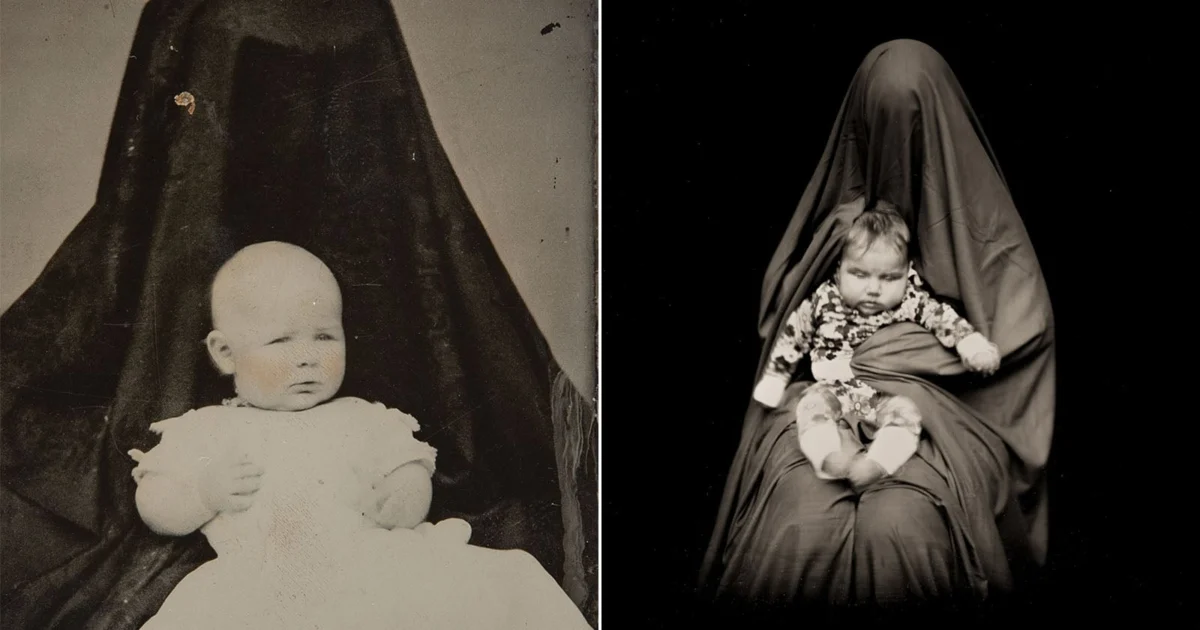
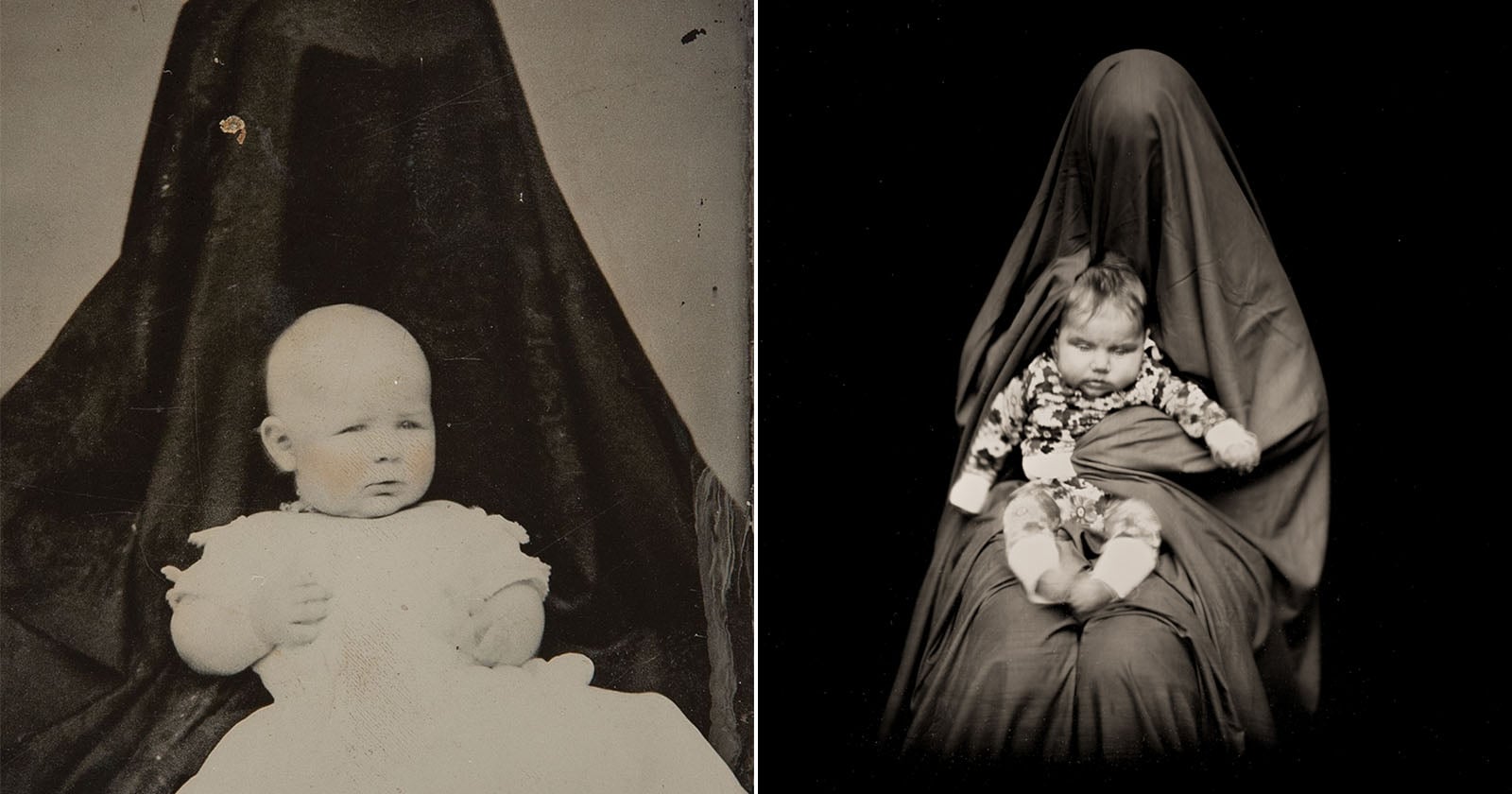
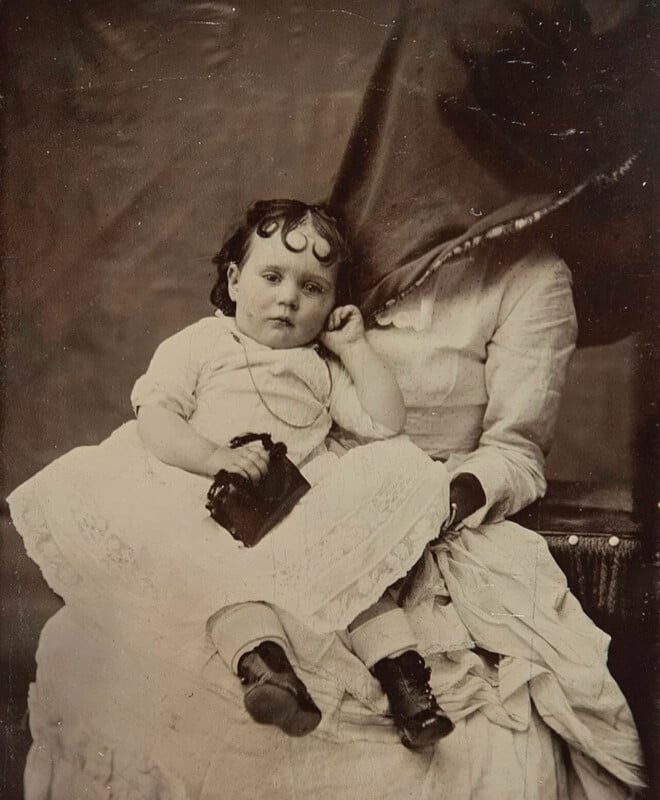
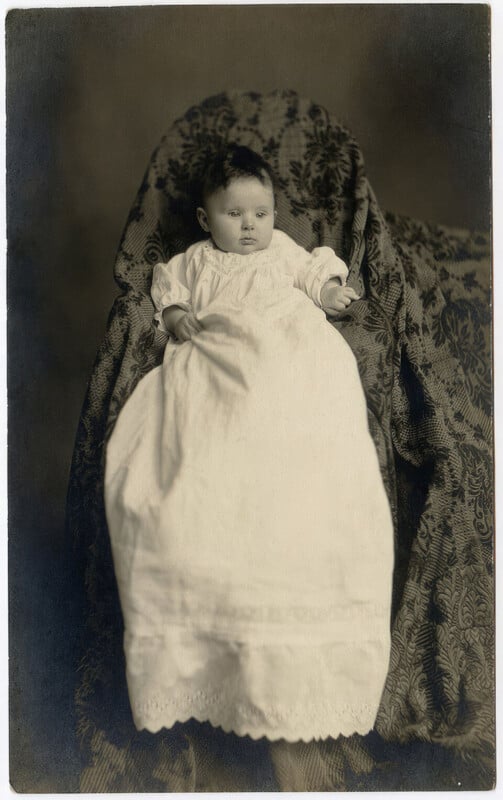
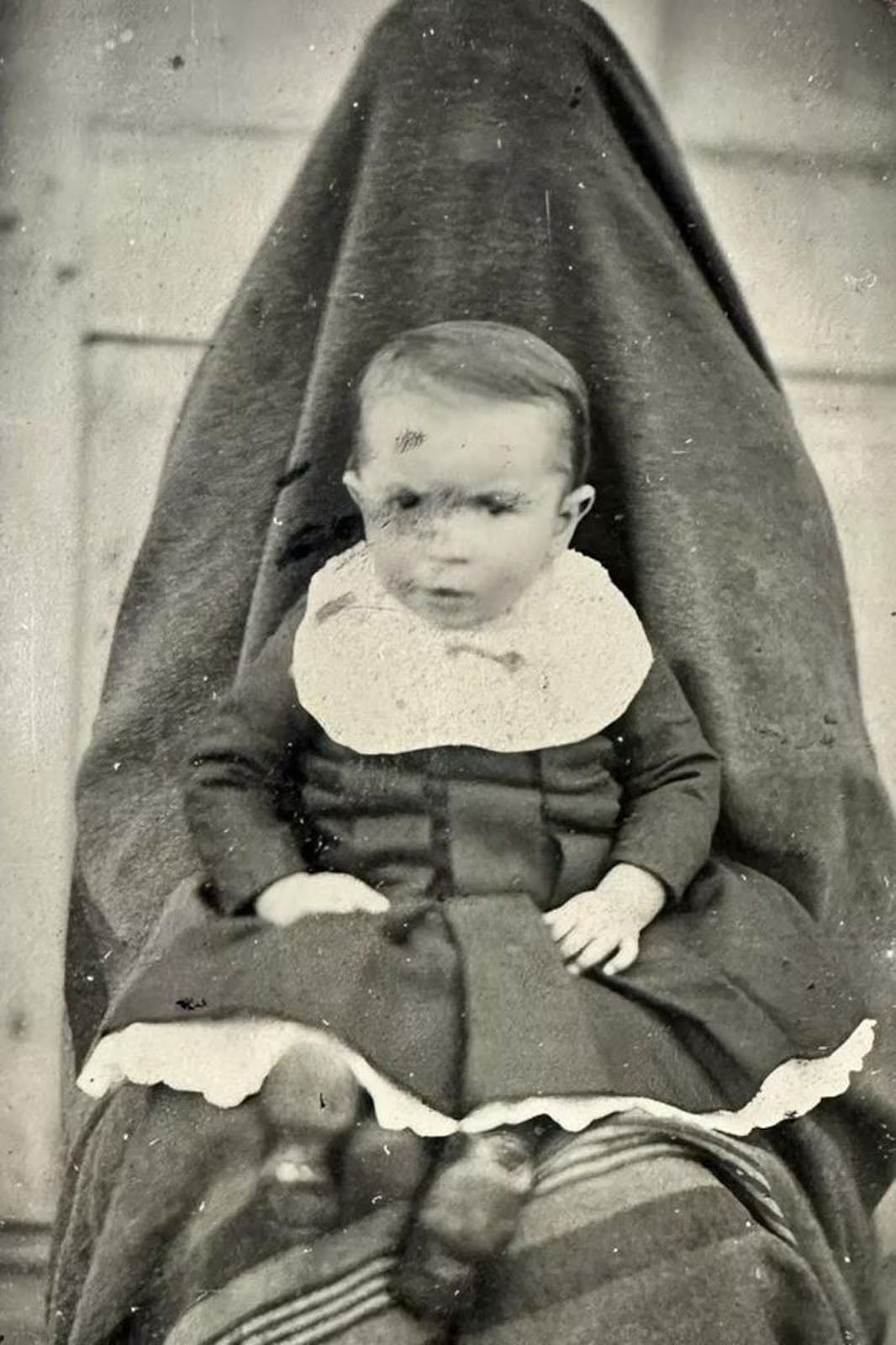
To modern eyes scrolling through digital archives or flea-market finds, 19th-century portraits of infants are often unsettling. Known broadly as the "Hidden Mother" genre, these historic photographs feature young babies or children seated upright, supported by adults completely shrouded in dark, heavy drapery, patterned blankets, or hidden behind cloaked chairs. To contemporary sensibilities shaped by horror cinema and ghost stories, these spectral figures look less like parents and more like phantoms lurking in the background.
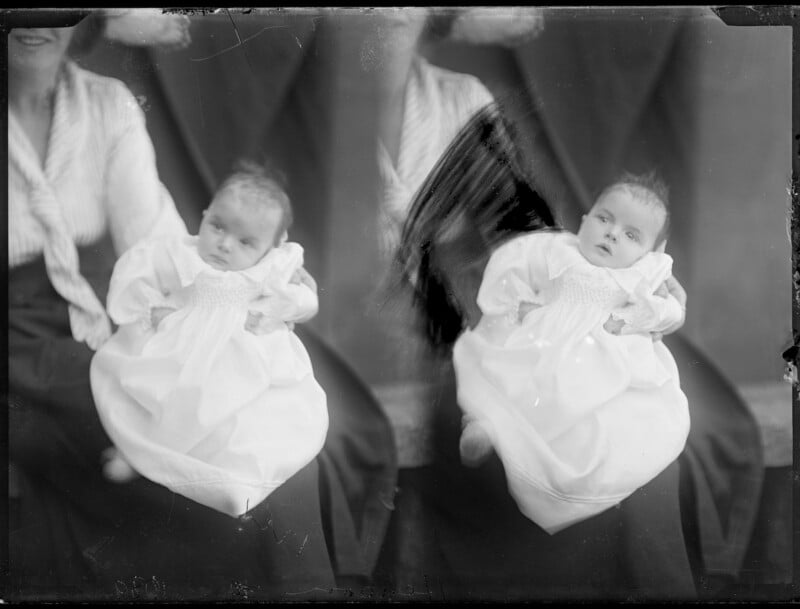
However, when the veil of mystery is pulled back, these haunting images reveal a fascinating intersection of primitive photographic technology, desperate parental devotion, and ingenious mechanical workarounds. As contemporary wet-plate collodion artist Shane Balkowitsch demonstrates through his modern recreations, these photographs are not records of the occult, but rather testaments to the lengths early families went to preserve the likeness of their children.
Main Facts: Decoding the Phenomenon
The "Hidden Mother" photography style dates back to the very infancy of the photographic medium, with early examples emerging alongside the invention of the daguerreotype in 1839. As the photographic industry evolved through the wet-plate collodion process introduced by Frederick Scott Archer in 1851, the practice persisted well into the 1920s.
The core mechanics of the trend were simple: early photographic emulsions required lengthy exposure times, forcing sitters to remain completely motionless. Because infants and toddlers naturally lack the impulse control or physical stamina to sit frozen for seconds or even minutes, parents stepped in—literally. By draping themselves in fabric matching the studio backdrop or hiding out of frame, mothers and fathers acted as human stabilizing structures.
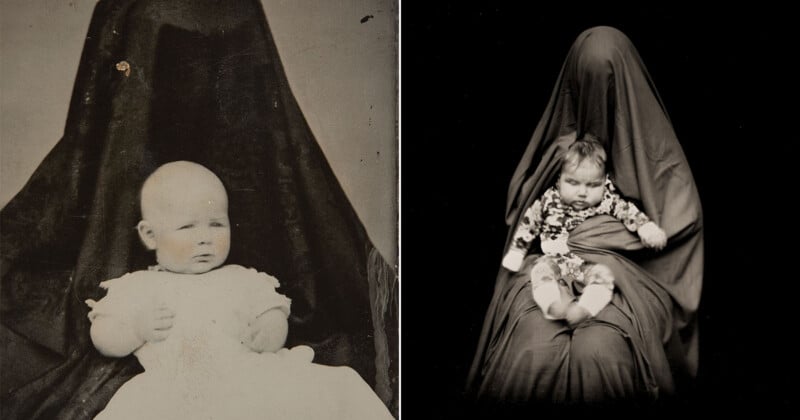
- The Exposure Challenge: Early photographic processes required lenses to remain open for durations ranging from a few seconds to several minutes, pushing human endurance to its absolute limits.
- The Solution: Parents functioned as living furniture, holding children steady, keeping them calm with familiar voices and touch, and preventing falls from studio chairs.
- The Cultural Legacy: Once fast lenses and rapid gelatin film rendered the technique obsolete, the obscured figures faded from public memory, only to be rediscovered in the 21st century as viral internet curiosities frequently mistaken for post-mortem or spirit photography.
Chronology: From Daguerreotypes to Digital Reconstructions
Understanding the "Hidden Mother" craze requires tracing the technological evolution of photography across two centuries.
- 1839: The public announcement of the daguerreotype process. Early portraiture is born, characterized by high sensitivity limitations and excruciatingly slow exposure times.
- 1851: Frederick Scott Archer introduces the wet-plate collodion process, which becomes the dominant photographic technique for the next three decades. It requires glass plates to be sensitized, exposed, and developed all while wet, demanding portable darkrooms and long exposure windows.
- Late 19th to Early 20th Century: The height of the "Hidden Mother" era. Studios utilize specialized posing stands, headbraces, and draped assistants to capture multi-generational family portraits including restless toddlers.
- 1920s: As camera technology advances—featuring faster lenses, sensitive film stocks, and shutter mechanisms capable of fractions of a second—the need for hidden physical supports evaporates.
- 2013: Italian-Swedish artist Linda Fregni Nagler publishes The Hidden Mother, a seminal archival book featuring over 1,000 such photographs, cementing the genre’s status in contemporary art circles. Today, original prints and rare artist monographs command steep prices among collectors.
- September 2026: Wet-plate collodion artist Shane Balkowitsch collaborates with friends Dana and Chris in his natural-light studio to recreate a historical "Hidden Mother" plate featuring their infant daughter, Mazie, using an 8×10 large format camera and a Carl Zeiss lens.
Supporting Data and Technical Realities
To truly appreciate why parents had to be hidden, one must examine the physical reality of historical photographic chemistry. In a modern natural-light wet-plate studio, exposure times typically hover between 6 to 12 seconds depending on seasonal sunlight availability. For a restless infant, this span feels like an eternity.
In Balkowitsch’s September 2026 recreation, titled "Mazie’s Hidden Mother" (Plate #5804), an exposure time of 8 seconds was utilized using an Alessandro Gibellini 8×10 large-format camera paired with a Carl Zeiss Tessar 250mm lens wide open at f/4.5. Even with the mother completely shrouded in a dark brown fabric drape to comfort the baby, an involuntary kick of the infant’s legs during the final two seconds resulted in a subtle motion blur on the final silver-on-glass ambrotype.
Beyond the shrouded parents, Victorian studios relied heavily on a device known as a headbrace or posing stand. These heavy iron stands featured adjustable metal rings designed to cradle the back of a sitter’s head, anchoring them in place. Contrary to modern internet myths that misinterpret these stands as evidence of "post-mortem" (death) photography, the mechanical physics of the era prove otherwise. As historical records confirm, a metal posing stand lacks the structural integrity to support dead weight ("dead weight" being a literal descriptor); it was strictly built to keep living, twitching adults and children from ruining multi-second exposures by blinking or swaying. Original Victorian headbraces are exceptionally rare today, commanding upwards of $10,000 at auction, though artisans and educators like Balkowitsch utilize modern foundry-cast replicas in their studios.
Official and Expert Perspectives
Experts in historical photography emphasize that the modern reading of these images as "spooky" or "macabre" speaks more about 21st-century shifting sensibilities than 19th-century intentions.
"When the veil, pardon the pun, is pulled back, there is a reasonable explanation for these ‘ghoulish’ historical records," notes Balkowitsch, a professor of photography at Bismarck State College whose archival wet-plate pieces reside in 117 museums globally, including the Smithsonian and the Library of Congress. "We need to put ourselves back in time when technology was simply different. Long exposures were commonplace, and a photographer and a mother would go to great lengths just to capture a photograph of a child."
Art historians point out that far from hiding children out of shame or fear, these portraits represent an immense financial and emotional investment. In the 1850s, photography was neither instant nor inexpensive; it required hours of careful chemical preparation, precise optical composition, and artistic deliberation before a single plate was exposed.
Implications: The Fragility of Visual History
The enduring fascination with the "Hidden Mother" genre sparks broader philosophical questions about the evolution of image-making and the preservation of human history.
Today, humanity captures trillions of digital photographs via smartphones, rendering images instant, disposable, and functionally free. However, experts warn that this ubiquity comes with a hidden cost: fragility. Digital files rely on software architectures, cloud storage systems, and proprietary hardware that inevitably face technological obsolescence. Estimates suggest that a minuscule fraction—far less than 1%—of modern digital photographs are ever physically printed and brought into the tangible world.
In contrast, a wet-plate collodion ambrotype—consisting of silver suspended on glass—is a fully archival artifact capable of surviving intact for a millennium. As society marches further into an era dominated by instantaneous digital capture and artificial intelligence generation, genres like the "Hidden Mother" serve as a humbling reminder of the deliberate, painstaking craft that once defined visual preservation. Whether our modern digital ephemera will survive centuries into the future remains an open question, leaving us to look back at the shadowy, shrouded mothers of the 19th century not with fear, but with profound respect for their enduring maternal dedication.
 Asro
Asro  Iffa Jayyana
  Basiran