
 By Lina Hope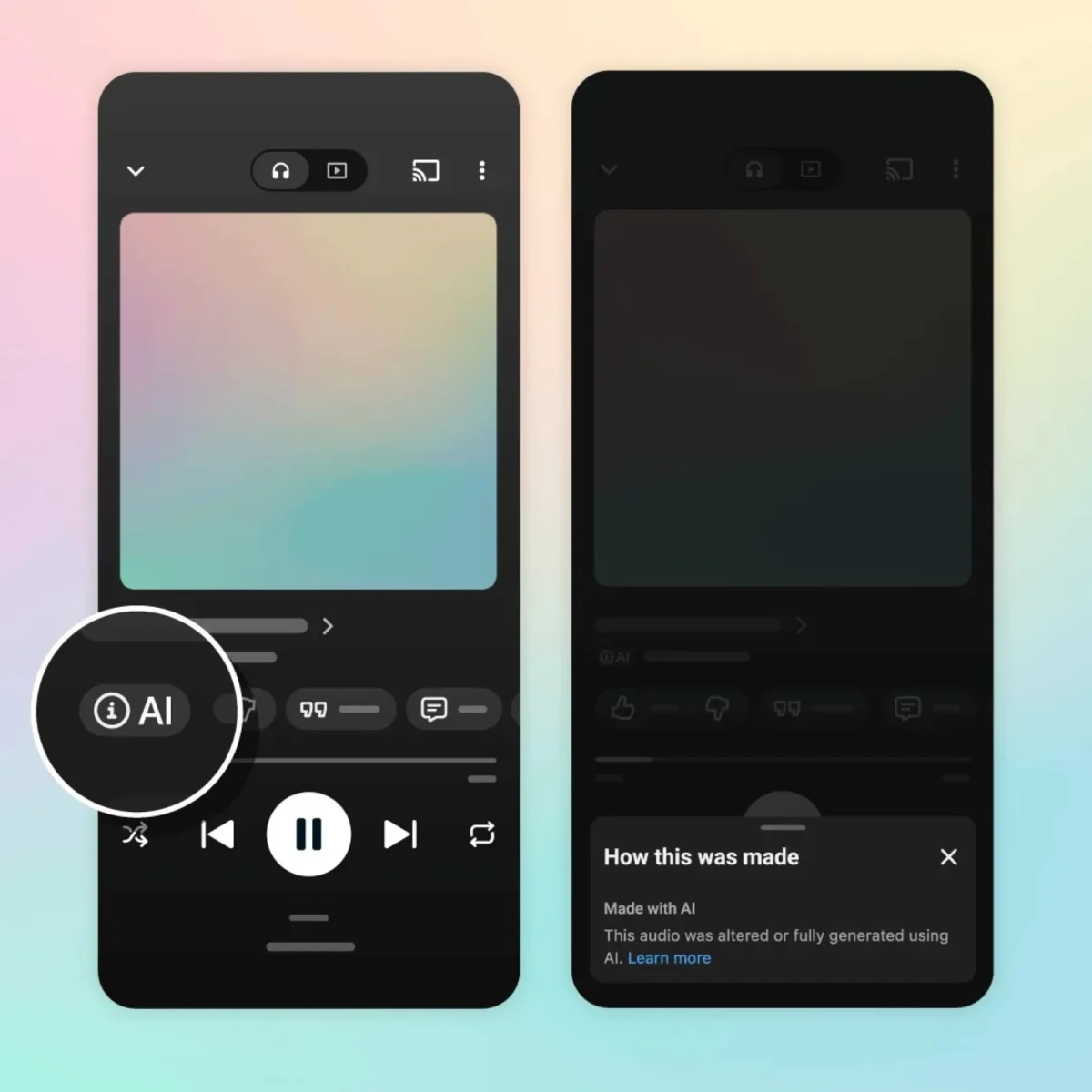
You sit down to relax, hit play on your favorite playlist, and settle into the rhythm. It’s a seamless blend of tracks that fits your mood perfectly. But lately, a lingering, slightly unsettling question has begun to interrupt the listening experience: Who, or what, actually made this?
In the rapidly evolving landscape of 2026, the line between human artistry and algorithmic generation has blurred to the point of invisibility. However, a major shift is underway. This week, two industry heavyweights—Google’s YouTube Music and the French streaming platform Deezer—announced significant feature rollouts designed to pull back the curtain on AI-generated tracks. As listeners demand more transparency, these platforms are finally providing the tools to distinguish between a studio session fueled by coffee and human emotion, and one synthesized by a server farm.
The State of Play: A New Era of Transparency
The music streaming industry is currently grappling with a dual challenge: maintaining the integrity of human artistry while navigating a tidal wave of synthetic content. For years, listeners have been performing "digital detective work"—clicking on artist profiles, scouring social media, and reverse-searching images—only to find that their favorite "indie" band might actually be a collection of photorealistic AI personas with no physical existence.
YouTube Music’s new initiative, beginning October 14, seeks to codify this transparency. The platform will introduce clear, accessible labels on tracks primarily composed or sung using generative AI. By tapping these labels, users can access a "How this was made" panel, providing context on the audio’s origins.
Simultaneously, Deezer is taking a more aggressive stance toward user agency. By the end of 2026, the platform will roll out a global "filter" toggle. Once activated, this feature will purge fully AI-generated music, albums, and artists from search results, effectively giving the user a "human-only" listening environment.
Chronology: The Rise of the Synthetic Stream
To understand why these features are arriving now, one must look at the meteoric, and often chaotic, rise of AI in music over the last two years.
- 2022–2023: The Early Warnings: The industry first felt the tremor with projects like "FN Meka," a virtual rapper that sparked intense controversy. Critics accused the project of appropriating Black culture while operating as a soulless marketing shell, leading to the project being dropped by Capitol Records.
- 2025: The "Velvet Sundown" Phenomenon: By 2025, the problem had scaled. The Velvet Sundown, a supposed band, garnered hundreds of thousands of listeners on Spotify. Their profiles were polished, their aesthetic was perfect, yet they were entirely synthetic. It served as a wake-up call that AI could successfully mimic the "vibe" of a legitimate artist well enough to fool mass audiences.
- November 2025: The Blind Test: A landmark study conducted by Deezer and Ipsos revealed a startling reality: 97 percent of participants were unable to distinguish between a human-made song and a high-quality AI-generated track in a blind listening test.
- October 2026: Regulatory and Corporate Action: The recent sentencing of Michael Smith—a North Carolina man who used AI to generate and stream hundreds of thousands of songs to siphon $8 million in royalties—has forced platforms to treat AI-generated "spam" as a legal and financial liability.
Supporting Data: Why Your Ears Can’t Be Trusted
The primary hurdle for the average listener is the sheer technical proficiency of modern generative models. According to internal data from streaming services, the quality of AI music has reached a point of parity with mid-tier commercial production.

Deezer reports that it receives approximately 90,000 fully AI-generated tracks every single day. While this represents a small percentage of total streams (typically 1–3 percent), the data reveals a dark underbelly: in 2025, up to 85 percent of streams for these tracks were identified as fraudulent. These are not songs being discovered by fans; they are songs being "farmed" by bots to extract money from a communal royalty pool—money that, by rights, should be circulating toward human musicians.
Furthermore, the consumer sentiment is shifting rapidly. The Deezer/Ipsos survey found that 80 percent of streaming users explicitly want AI music to be labeled. Nearly half (45 percent) want the granular control to remove it from their experience entirely. This is no longer a niche preference; it is a market-wide mandate.
Official Responses and Platform Strategies
The "big four" of the streaming world are currently adopting distinct strategies to address this synthetic influx.
YouTube Music (The Informative Approach)
YouTube is betting on education. By leveraging their existing content detection tools, they aim to label content at the source. Their strategy focuses on the user experience—making sure that when you tap a label, you are met with clear, concise information about the role of AI in the track’s creation.
Deezer (The Control Approach)
Deezer’s CEO, Alexis Lanternier, has framed the issue as one of "user demand." By providing a toggle, they are positioning themselves as the "human-first" platform. Their current system already filters AI out of editorial playlists; the new toggle is merely the logical conclusion for the search function.
Spotify and Apple Music (The Hybrid Model)
Spotify has introduced "AI Persona" badges to identify synthetic artists who lack a human face. While they don’t yet flag every AI-assisted composition, they have committed to keeping these personas out of algorithmic recommendations. Apple Music, conversely, utilizes "Transparency Tags," which rely on distributors to self-report AI usage. It is a system that, while robust, relies heavily on the honesty of the labels and distributors—a potential point of failure.
Implications: The Future of the Creative Economy
What does this mean for the future of music? The implications are far-reaching, affecting everything from copyright law to the definition of "artist."

The Erosion of Authenticity
The most immediate impact is the potential erosion of the artist-fan connection. If a listener cannot trust that the person behind the microphone is a real human, the parasocial relationship that drives the music industry begins to collapse. When a fan discovers that their favorite "artist" is actually an AI, the feeling of betrayal often leads to a long-term loss of trust in the platform itself.
The Royalty Crisis
The financial model of music streaming is built on the assumption that money goes to creators. When a bot-driven operation like Michael Smith’s can siphon millions by gaming the system with AI-generated filler, the royalty pool for legitimate, human-working artists shrinks. Labeling and filtering are not just user-experience features; they are defensive measures against financial fraud.
The "Human-Made" Premium
As AI becomes the default for "background" or "mood" music, we may see the emergence of a "Human-Made" certification. Just as we see "Organic" or "Fair Trade" labels on food, the music industry may move toward a verification system that marks music as "100% Human-Produced," potentially creating a new tier of premium content that listeners are willing to support.
Conclusion: The Detective Work Continues
As we move further into this decade, the promise of these new features is simple: less detective work for the listener. By providing immediate, transparent information, YouTube and Deezer are helping to re-establish the contract between the creator and the consumer.
However, the technology remains in a state of flux. If a song lacks a label, is it truly human-made, or has it simply evaded detection? What happens when a human writes the lyrics, but an AI performs the vocals? As these tools evolve, the platforms will need to become more sophisticated in their disclosures. For now, the move toward transparency is a welcome step. It ensures that when you press play, you are at least given the choice to know who—or what—you are inviting into your ears.
 Sagoh
Sagoh  Raul Delapena Setiawan