
 By Iffa Jayyana
The retail landscape in Austria has undergone a profound transformation, cementing the digital shift that began in the early 2020s. According to the latest comprehensive analysis by RegioData Research, 2025 marked a watershed year for the nation’s e-commerce sector. With online channels now accounting for more than 16 percent of total consumer retail spending—up from 14.9 percent in 2024—the sector has reached a robust market volume of approximately 12.4 billion euros. This transition reflects not merely a change in convenience, but a fundamental evolution in the shopping habits of the Austrian population, who are now spending an average of 1,400 euros per person annually in the digital marketplace.
Main Facts: The State of the Market
The data confirms that digital retail is no longer a peripheral activity for Austrian consumers but a core pillar of the national economy. The jump to 16 percent market share represents a significant acceleration in growth. This growth is driven by increased digital literacy, a sophisticated logistics infrastructure, and the growing influence of cross-border e-commerce giants.
While 12.4 billion euros in revenue is a milestone, the underlying narrative is one of diversification. Consumers are increasingly comfortable purchasing across a wide spectrum of categories, ranging from high-ticket electronics to daily essentials. However, this growth has not been uniform across all retail segments, revealing a nuanced picture of consumer trust and the tangible nature of certain products.
Chronology: The Road to 2025
The trajectory of Austrian e-commerce has been marked by distinct phases of adoption:
- 2020–2021 (The Catalyst): The global pandemic served as the ultimate accelerator. With physical storefronts shuttered or restricted, the Austrian populace turned to online shopping as a necessity rather than a preference, causing a surge in market share that exceeded previous five-year projections.
- 2022–2023 (The Stabilization): As the economy reopened, market watchers anticipated a "snap-back" effect where consumers would return to brick-and-mortar stores. While a minor correction occurred, the underlying digital habits remained entrenched, with hybrid shopping models gaining popularity.
- 2024 (The Rebound): After a period of inflation-driven caution, 2024 saw the online share climb to 14.9 percent. This year proved that digital retail was immune to the broader economic cooling that affected physical retail centers.
- 2025 (The Digital Milestone): Reaching the 16 percent threshold, the market entered a phase of maturity. Investment shifted from basic infrastructure to personalization, AI-driven customer service, and international logistics efficiency.
Sectoral Breakdown: Where Austrians Spend Online
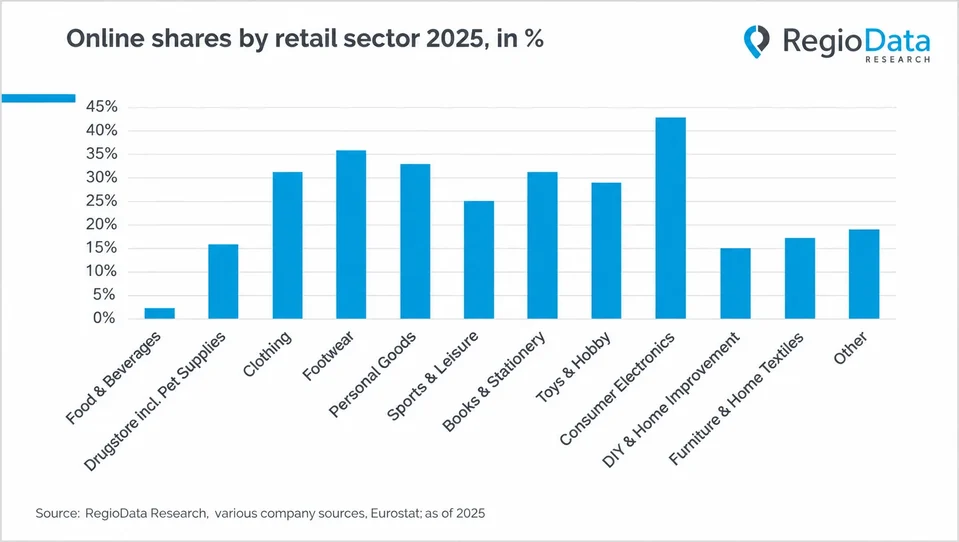
The RegioData analysis highlights a striking disparity between sectors, illustrating that some product categories are naturally more suited to the digital experience than others.
Electronics and Lifestyle Goods
Consumer electronics leads the pack, with a staggering 43 percent of all spending occurring online. This trend is driven by the ease of comparing technical specifications and pricing across multiple platforms. Close behind, footwear accounts for 36 percent of digital sales, indicating that size-inclusive return policies and digital sizing tools have effectively overcome the "fit" barrier that once plagued fashion e-commerce.
Personal goods (33 percent), clothing (31 percent), and books (31 percent) follow closely. These categories benefit from high-frequency repeat purchases and the ability to leverage consumer reviews to mitigate the lack of physical interaction with the product before purchase.

Comparative European Context
Austria’s position within the broader European market is that of a "moderate digital adopter." It occupies a middle ground that mirrors the stability of its central European neighbors.
- The UK Benchmark: The United Kingdom remains the clear leader in Europe, with an online penetration of 29.3 percent. The UK’s mature logistics network and early adoption of "click-and-collect" services continue to set the standard for the continent.
- The German Parallel: Austria mirrors Germany closely, with the latter reporting a 16.8 percent online share. The two countries share similar retail demographics and a high degree of integration in their supply chains.
- The Growth Frontier: In contrast, countries like Serbia, with an online share of just 6.7 percent, represent the next frontier for digital retail expansion in Europe. The discrepancy between these nations often comes down to banking infrastructure, digital payment adoption, and the density of delivery networks.
The Dominance of Cross-Border Platforms
A critical finding in the 2025 report is the reliance on international rather than local platforms. Only 40 percent of online spending in Austria stays within domestic digital storefronts. The remaining majority is captured by cross-border entities.
Amazon continues to hold an iron grip on the Austrian market, accounting for a massive 35.1 percent of all online retail spend. Its ability to offer unparalleled delivery speeds and a vast catalog of goods makes it the default starting point for many Austrian shoppers. Following Amazon, international giants like Temu (5.1 percent) and eBay (4.1 percent) have carved out significant niches.
The rise of Chinese e-commerce platforms—specifically Temu, Shein, and AliExpress—is particularly notable. Collectively, these players have captured 7.9 percent of the market. This surge has sparked intense debate among local retailers regarding the impact of ultra-low-cost, direct-to-consumer models on the pricing power of local SMEs.
Implications for the Future
The shift toward a 16 percent online share has profound implications for stakeholders across the Austrian economy:
1. The Challenge for Local Retailers
The reliance on cross-border platforms poses an existential challenge for local retailers. To compete, many Austrian businesses are being forced to adopt "omnichannel" strategies. This involves integrating their inventory management systems with online marketplaces or investing heavily in their own digital platforms. The "digital-only" or "physical-only" business model is increasingly becoming a relic of the past.
2. Regulatory and Environmental Concerns
With the influx of goods from international, non-EU marketplaces, the Austrian government is under pressure to harmonize tax and customs enforcement. Furthermore, the environmental impact of high-volume, cross-border shipping is becoming a topic of public discourse. Consumers are becoming more conscious of the carbon footprint associated with international delivery, which may eventually favor domestic retailers who can offer more sustainable, localized fulfillment.

3. The AI and Personalization Frontier
As the market reaches maturity, the next phase of growth will likely be defined by the quality of the user experience. Retailers that can successfully leverage AI to provide personalized recommendations and seamless, frictionless checkout experiences will be the ones to capture the next percentage points of market share.
4. Logistics as a Competitive Differentiator
The dominance of Amazon is built on its logistics network. For local retailers, the ability to offer same-day or next-day delivery—often by partnering with local courier services—will be the key to retaining customer loyalty. The "last mile" has become the primary battleground of the retail war.
Official Responses and Expert Outlook
While no single entity speaks for the entire retail sector, trade associations in Austria have expressed a mix of optimism and concern. Industry advocates emphasize the need for "level playing field" regulations, particularly regarding customs duties and VAT compliance for goods arriving from outside the European Economic Area.
RegioData researchers note that while the growth rate may stabilize as the market matures, the total volume is expected to continue its upward trajectory as consumer habits become even more ingrained in the younger generations, who consider online shopping their primary method of consumption.
Conclusion
The 2025 data serves as a clear signal that the digital transformation of Austrian retail is not a temporary trend but a permanent structural change. With 12.4 billion euros flowing through digital channels, the influence of online commerce on the national economy is undeniable. As international platforms continue to vie for dominance, the success of the Austrian retail sector will depend on its ability to marry local service values with the digital efficiency demanded by modern consumers. The coming years will be defined by how well domestic businesses navigate this cross-border reality and whether they can reclaim a larger share of the digital wallet.
 Ammar Sabilarrohman
 Siti Muinah
 Nana
