
 By Ammar Sabilarrohman
In an era defined by rapid geopolitical shifts and evolving social dynamics, the ability to accurately gauge public opinion is more critical than ever. As policy analysts, researchers, and global citizens seek to understand the complexities of modern life, the methodologies underpinning major surveys become the bedrock of public discourse. Pew Research Center, a nonpartisan "fact tank," remains at the forefront of this effort. This report provides an in-depth examination of the methodological framework utilized for the Spring 2026 Global Attitudes Survey and the American Trends Panel (ATP) Wave 190, offering a transparent window into how modern, high-stakes public opinion data is gathered, validated, and analyzed.
Main Facts: The Anatomy of Modern Survey Research
The integrity of public opinion research relies on rigorous sampling, objective questioning, and sophisticated statistical modeling. In 2026, the Pew Research Center undertook two massive, parallel data collection efforts: a far-reaching Global Attitudes Survey and a deep-dive domestic assessment via the American Trends Panel.
The Spring 2026 Global Attitudes Survey serves as a vital barometer for international sentiment. It employs a diverse, multi-modal interview strategy, incorporating telephone, face-to-face, and online interviews. The project was executed in collaboration with leading global research firms, including Gallup, Langer Research Associates, and the Social Research Centre. By utilizing national samples, the survey provides a representative snapshot of populations across varying socioeconomic landscapes, standardized by international benchmarks such as those provided by the United Nations and the World Bank.

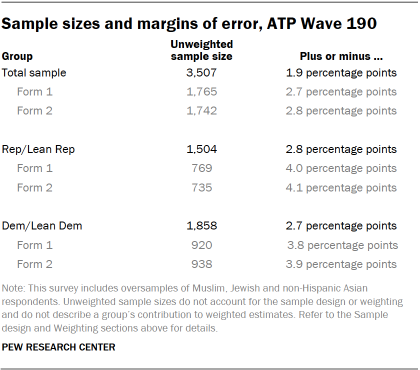
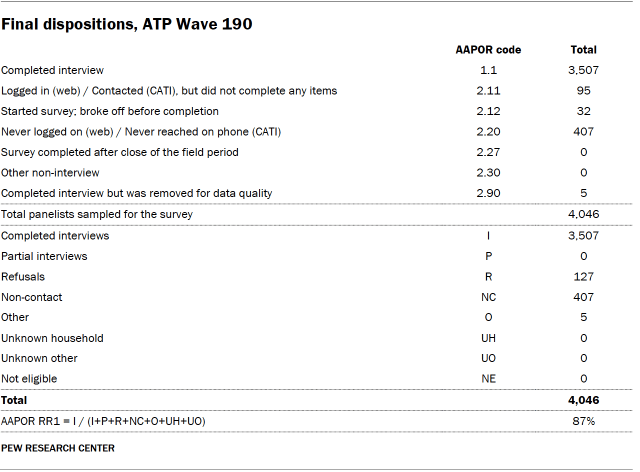
Simultaneously, Wave 190 of the American Trends Panel offers a high-resolution view of the U.S. populace. Conducted between March 23 and March 29, 2026, this wave successfully engaged 3,507 participants out of 4,046 sampled adults. With a survey-level response rate of 87% and a precise margin of error of ±1.9 percentage points, the ATP stands as one of the most reliable instruments for tracking American social and political shifts.
Chronology: The Lifecycle of a Survey Wave
The success of a large-scale poll is not determined by the day of the release, but by the weeks of meticulous preparation and the execution of the field period. The timeline for the ATP Wave 190 illustrates the complexity involved:
- March 20, 2026: Preparatory phase commences with the mailing of pre-notification postcards to phone-based participants to encourage engagement.
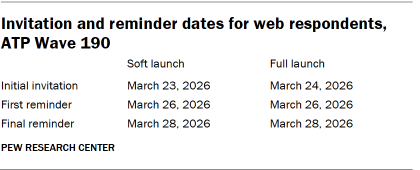
- March 23, 2026: The field period officially opens. For online respondents, a "soft launch" is executed, involving 60 panelists to ensure the digital infrastructure—tested rigorously on both PC and mobile devices—functions without error. Simultaneously, phone interviews begin for the selected subset of the panel.
- March 24, 2026: The full-scale launch is initiated. Invitations are dispatched to the remaining pool of English- and Spanish-speaking online panelists.
- March 23–29, 2026: Active data collection occurs. Throughout this window, researchers engage in constant monitoring, sending up to two email reminders to non-responders. Phone panelists are subject to as many as six follow-up calls to ensure maximum participation and minimize non-response bias.
- Post-March 29, 2026: Following the close of the field period, the data enters the cleaning phase, where quality checks are performed to remove "satisficers"—respondents who exhibit patterns like straight-lining (answering all questions the same way) or high rates of incomplete surveys.
Supporting Data: Ensuring Accuracy Through Rigor
The reliability of Pew’s findings is bolstered by three pillars: oversampling, standardized demographic categorization, and complex weighting.
The Role of Oversampling
To provide granular insights into often-underrepresented communities, Pew Research Center employs oversampling. In the 2026 cycle, the ATP specifically oversampled Muslim, Jewish, and non-Hispanic Asian adults. This deliberate strategy ensures that the resulting data provides precise estimates for these groups rather than washing them out in the national average. Once collected, these groups are weighted back to their accurate proportions within the U.S. population.
Standardized Demographics
Data is only useful if it can be compared across borders. Pew employs:
- Education: Standardized via the UNESCO International Standard Classification of Education (ISCED).
- Income: Classification of "high" or "middle" income based on World Bank per capita gross national income metrics.
- Ideology: A nuanced scale ranging from left to right, adjusted for regional political differences.
The Weighting Process
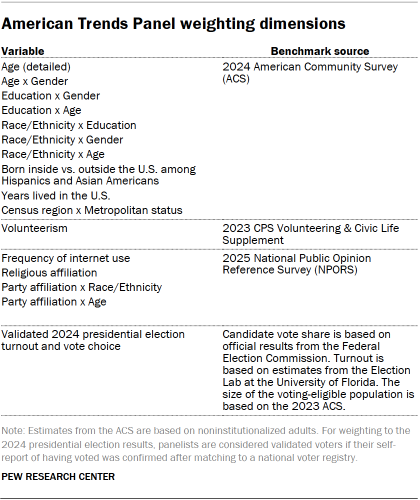
The raw data is merely a starting point. The "Weighting" process is a multi-stage, mathematical correction. Each panelist begins with a base weight reflecting their probability of selection. This is subsequently calibrated against population benchmarks (age, gender, education, race, and geographic region) to account for non-response and panel attrition. Finally, weights are trimmed at the 1st and 99th percentiles to ensure that extreme outliers do not disproportionately skew the results.
Official Responses and Methodology Protocols
The transparency of Pew’s process is a deliberate response to the challenges of modern polling, such as declining response rates and the digital divide. By utilizing address-based sampling (ABS) since 2018, the Center reaches 90% to 98% of the U.S. population through the Postal Service’s Delivery Sequence File.
Furthermore, the Center’s commitment to incentivization is a key protocol. Recognizing that some demographics are harder to reach, the Center offers post-paid incentives ranging from $5 to $20 in the form of gift codes or checks. This tiered incentive structure is not merely a "thank you," but a strategic tool designed to increase participation among groups with traditionally low survey propensities, thereby reducing the risk of selection bias.
The consultation process is equally rigorous. Before a single question is asked, the questionnaire is developed in partnership with SSRS, a leader in survey research. This collaboration ensures that questions are not only culturally sensitive but also cognitively tested to prevent misunderstandings, particularly when surveys are administered in both English and Spanish.
Implications: Why Methodology Matters
The implications of these rigorous methodological standards extend far beyond the pages of a report. In a landscape where public opinion is often manipulated or misunderstood, the Pew Research Center’s commitment to "fact tank" status provides a stabilizing force for democracy.
Strengthening Democracy
When policymakers, journalists, and the public have access to data that is transparent, weighted, and statistically sound, the quality of democratic debate improves. By tracking shifts in national identity, views on globalization, and satisfaction with democratic institutions, these surveys act as a pulse-check on the health of the body politic.
Identifying Blind Spots
The use of standardized international methodologies allows for cross-national comparisons that are essential in a globalized world. For instance, by using World Bank metrics to compare attitudes toward major global powers (like China) across different income brackets, researchers can identify whether geopolitical skepticism is a function of economic development or cultural divergence.
The Future of Research
As the methods of communication evolve, so too does the Center’s approach. The transition from random-digit-dialing to address-based sampling and the integration of SMS-based invitations reflect a commitment to staying current with how people live, work, and interact with technology. This adaptability is the hallmark of credible research.
Conclusion: Trusting the Process
The 2026 Global Attitudes Survey and the American Trends Panel Wave 190 are more than just numbers; they are the result of thousands of man-hours, sophisticated statistical engineering, and a deep, institutional commitment to objectivity. By acknowledging the limits of polling—such as the inherent challenges of human behavior and the potential for question-wording bias—Pew Research Center sets a gold standard for the industry. For anyone looking to understand the currents of the 21st century, these reports serve as an essential, transparent guide to the state of global and domestic opinion.
As we look toward the future, the lessons learned from the 2026 data collection cycle reinforce a fundamental truth: in an age of information overload, the most valuable commodity is not information itself, but the verified, methodologically sound understanding of that information. Through its continued adherence to these rigorous protocols, Pew Research Center ensures that its findings remain a cornerstone of informed, evidence-based decision-making for years to come.
 Pevita Pearce
  Neng Nana