
 By Neng Nana
A new comprehensive report from the Pew Research Center reveals a striking, systematic correlation between a nation’s economic status and its public perception of China. As the global geopolitical landscape becomes increasingly polarized, the 2026 study of 45,658 individuals across 37 countries suggests that where a person lives—and how affluent their country is—is a primary predictor of their stance on Beijing’s leadership, domestic policies, and international conduct.
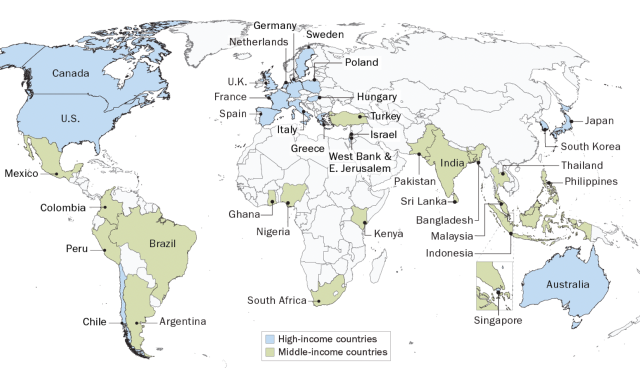
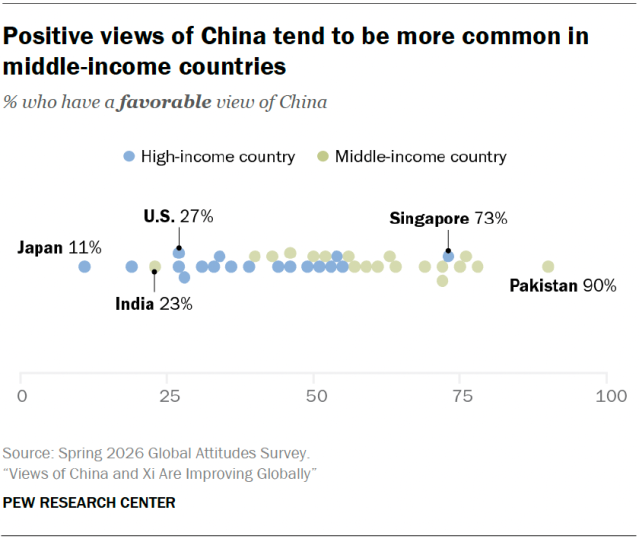
The data paints a world bifurcated: while citizens in high-income nations increasingly view China with skepticism and concern, populations in middle-income countries generally maintain a warmer, more favorable outlook.
The Core Findings: A Tale of Two Economies
The fundamental takeaway from the 2026 survey is that favorability toward China is not distributed randomly. Instead, it follows a predictable "wealth gradient." In the 18 high-income countries surveyed—ranging from the United States and Japan to Germany and Sweden—China’s image is predominantly negative. Conversely, in the 18 middle-income countries—including Nigeria, Pakistan, Kenya, and Indonesia—the narrative is markedly different, with substantial majorities expressing positive sentiments toward the East Asian power.
This divide extends beyond general favorability. When asked about Chinese President Xi Jinping, the respect for individual freedoms within China, and the nature of territorial disputes, the responses consistently mirror this economic divide.

Chronology: A Multi-Year Shift in Global Sentiment
To understand where we are, one must look at where we have been. The 2026 report is the latest in a multi-decade effort by the Pew Research Center to track China’s evolving image on the world stage.
- Pre-2022: For years, China was viewed primarily as an economic engine, with many developing nations welcoming investment. However, the early years of the decade began to see a hardening of public opinion in Western nations, fueled by trade tensions and growing concerns over human rights.
- The Xi Era (2022–2024): Previous research highlighted a significant shift during President Xi’s presidency. As China adopted a more assertive "wolf warrior" diplomacy and increased its military posturing, global favorability ratings in high-income nations began to crater, a trend that accelerated following the global pandemic.
- The 2026 Snapshot: The most recent survey, conducted between February 8 and May 13, 2026, confirms that this "image gap" has become a structural feature of modern international relations. By comparing these findings to data from 2023 and 2025, researchers have identified a hardening of existing positions: high-income nations have remained consistently critical, while middle-income nations have largely buffered China from the total loss of global soft power.
Supporting Data: By the Numbers
The breadth of the survey allows for a granular look at how these attitudes manifest across different regions and political contexts.
Favorability and Confidence in Leadership
The divergence in opinion is perhaps most visible when looking at confidence in President Xi Jinping. In Japan, for instance, a staggering 92% of the population lacks confidence in the Chinese leader. Similarly, majorities in Australia, France, Israel, and South Korea report a profound lack of faith in his leadership.
In sharp contrast, the narrative in the Global South is defined by support. In Pakistan and Kenya, approximately three-quarters of the population express confidence in President Xi. This reflects a broader trend where the "China Model" of development—often associated with infrastructure projects and non-conditional aid—remains an appealing alternative to Western-led governance frameworks for many in the developing world.
The Debate Over Personal Freedoms
The issue of human rights and personal freedoms serves as a flashpoint. In every high-income country surveyed, the consensus is that the Chinese government does not respect the personal freedoms of its citizens. In nations like Japan, Sweden, and Germany, this sentiment is held by nine-in-ten respondents.
However, in the middle-income cohort, the picture is more complex. While Latin American nations tend to be more critical, majorities in countries like Nigeria, Bangladesh, and Sri Lanka continue to suggest that the Chinese government does, in fact, respect its people’s freedoms. This disparity highlights a fundamental disagreement in what "freedom" entails, with some nations prioritizing economic stability and poverty reduction over the civil liberties emphasized by Western liberal democracies.
The Asia-Pacific Exception: A Geopolitical Crucible
The Asia-Pacific region provides a unique microcosm of these global tensions. Because of their geographic proximity to China, these nations are forced to navigate a precarious path between economic reliance and security anxieties.
The report identifies a clear divide within the region. High-income Asia-Pacific countries are increasingly likely to characterize China as a threat. However, the Philippines stands out as an outlier among middle-income nations. Despite its economic classification, 86% of Filipinos express concern over territorial disputes in the South China Sea, and they are more likely than any other public in the survey to explicitly label China as a security threat. This suggests that in the face of direct territorial friction, regional proximity can override economic ties, leading to a surge in negative sentiment even in middle-income markets.
Official Responses and Methodology
The Pew Research Center maintains that the rigor of this study is essential for policy-makers and global stakeholders. To ensure accuracy, the methodology was tailored to the economic realities of each region. In middle-income countries, where digital connectivity may vary, face-to-face interviews were prioritized to allow for deeper, more nuanced conversations. In high-income countries, phone and online surveys were used, which are standard for these populations.
The study serves as a critical baseline for understanding how China’s "Belt and Road" initiatives and diplomatic maneuvers are being received on the ground. By separating the data by income level, the research allows analysts to strip away the "global" average and see the distinct political realities of different economic tiers.
Implications for the Future
The implications of these findings are profound for the next decade of international diplomacy.
- The Persistence of the "Soft Power" Gap: China is effectively building a "parallel" sphere of influence. While it has lost the battle for public opinion in the West, it is successfully consolidating its image as a primary partner for the developing world. This could lead to a permanent fracturing of international norms, where the UN and other global bodies face increasing gridlock due to these divergent worldviews.
- Economic Dependency as a Buffer: The data suggests that for middle-income nations, the tangible benefits of trade and infrastructure investment may be providing a "cushion" for China’s international reputation. As long as China can provide capital where Western institutions are perceived to be absent or overly demanding, this positive sentiment is likely to persist.
- The Security Dilemma: For high-income nations, the combination of unfavorable views and concerns over territorial disputes suggests that the "de-risking" or "de-coupling" strategies currently in vogue are likely to remain popular with domestic voters. Public opinion in the West has become a significant constraint on policy-makers, making any rapprochement with Beijing politically toxic in the near term.
In conclusion, the 2026 Pew Research Center report does not merely track opinions; it documents a fundamental shift in the global order. The world is not just divided by geography or ideology, but by an economic chasm that dictates how different nations view their future alongside China. As these trends continue to solidify, the challenge for the international community will be to bridge this gap, or risk a future where the world remains permanently divided by its perception of one of its most powerful actors.
 Pevita Pearce