
 By Lina Hope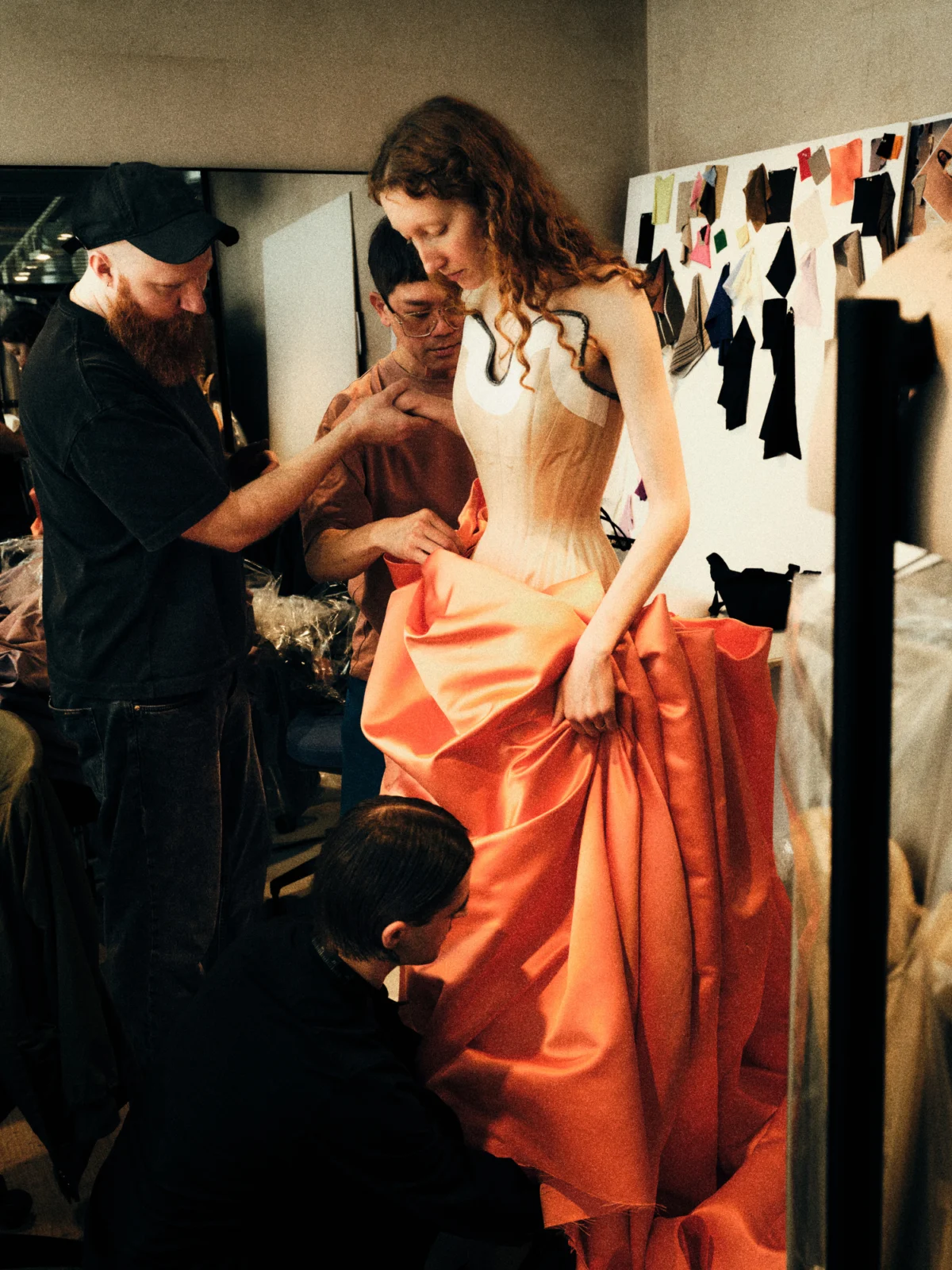
While the gargantuan machinery of legacy fashion houses like Balenciaga and Jean Paul Gaultier dominated the official calendars of Paris Couture Week this past July—each presenting high-stakes collections under the stewardship of new creative directors—the true gravitational pull of the week originated from a far more modest source. In the lead-up to the shows, as the industry’s elite gathered for private dinners and exclusive previews, the whispered consensus was unanimous: all eyes were on a small, London-based house that had, until now, operated almost entirely in the shadows.
Standing Ground, the brainchild of Irish designer Michael Stewart, arrived in Paris not with the roar of a conglomerate, but with the quiet, imposing authority of a monolith. Stewart, a Royal College of Art graduate whose work has been quietly garnering a cult following among the world’s most discerning tastemakers, made his Parisian debut this summer, effectively transforming a "David versus Goliath" narrative into a masterclass in independent design.
The Rise of an Outsider: From LVMH Prize to the Heart of Couture
Michael Stewart’s ascent has been anything but conventional. Operating on the fringes of the traditional fashion system, Stewart has eschewed the standard retail model, opting instead to build Standing Ground like a heritage couture house. Since its inception in 2022, the brand has functioned through bespoke, made-to-measure commissions for a private, highly affluent clientele, while simultaneously dressing cultural icons like Beyoncè Knowles-Carter, Tilda Swinton, and Florence Pugh.
The turning point for the brand came during the 2024 LVMH Prize for Young Designers. Stewart’s technical prowess and sculptural approach to draping caught the judges’ eyes, leading him to win the inaugural Savoir-Faire Prize. This accolade, which has previously served as a launchpad for talents like Simon Porte Jacquemus and Marine Serre, signaled to the industry that Stewart was no longer a well-kept secret.
Critics have long drawn parallels between Stewart’s work and the legendary Azzedine Alaïa—a comparison rooted in his shared obsession with technical mastery, body-conscious silhouettes, and a stubborn refusal to bow to the industry’s frenetic, seasonal show schedules. His arrival in Paris, the global epicenter of haute couture, was the inevitable next step for a designer who views his garments not as transient products, but as permanent sculptures.

Chronology of a Debut: Preparing for the World Stage
The days leading up to the Paris debut were a high-wire act of resource management and creative refinement. Speaking to WWD from the gilded, historic confines of the Irish Embassy, located mere steps from the Arc de Triomphe, Stewart was a portrait of focused intensity. Even as he put the final touches on his collection, he maintained a sense of humble gratitude.
"I genuinely feel very welcomed by Paris," Stewart noted, his demeanor shifting between the exhaustion of a craftsman and the excitement of a pioneer. "Having this audience and the stamp of haute couture, which I would never have dared say before now, is really special. It means a lot to me because it’s what I’ve been working toward. It was the goal from the beginning."
The logistics of the show were notoriously difficult. With a seating capacity limited to 150 guests, the selection process was brutal. The guest list was a curated mix of industry heavyweights—Anna Wintour among them—and private clients. Notably, Stewart opted to keep the front row celebrity-free. "I can’t accommodate everyone who’s wanted to come," he admitted, explaining that he would rather divert every available cent of his budget toward the clothes themselves rather than toward the high-cost fanfare of celebrity appearances.
Technical Mastery: The "Shoestring" Philosophy
For Stewart, the "shoestring" nature of his budget is a badge of honor, not a limitation. In an industry where branding and optics often take precedence over garment construction, Stewart’s philosophy is refreshingly austere: "Don’t spend it on everything else and show some shitty collection. Do a great collection, and then squeeze everything else."
This approach manifests in his deep respect for the process. Stewart is a designer who can "command a fitting." During his interview, he repeatedly excused himself to adjust the drape of a skirt or the tension of a hem, displaying a hands-on obsession that he finds lacking in many contemporary peers. "I’ve done consultancies where I’ve seen people inept," he remarked with a laugh. "They don’t know what to do with their hands. They don’t know what’s going on. I’m like, ‘You clearly don’t have a clue.’"

His collection showcased this technical rigor. New directions included the use of covered beading to outline tailored silhouettes—such as a solemn, pearl-gray capelet-back coat—and the daring use of exposed rock crystals and synthetic rubies on black velvet columns. Many of these pieces were anchored by aerodynamic, molded corsets developed in collaboration with the renowned Mr. Pearl, creating an aesthetic that felt simultaneously prehistoric and futuristic.
Supporting Data: The Craft of Ireland
Perhaps the most poignant element of the collection was the bridal gown modeled by Kristen McMenamy. The garment featured intricate Carrickmacross lace, a traditional Irish craft that took a team of women—ranging from 21 to 95 years old—nine months to complete. The motif, which incorporated blackberry thorns and dragonflies, was more than just a design choice; it was a socio-political statement.
"When I decided I was going to show couture, I wanted to choose something that represented the craft of Ireland, and essentially something that’s almost a dying craft," Stewart explained. "It deserves to be seen at haute couture, because it’s haute couture level."
This endeavor was supported by the Design & Crafts Council Ireland, The Heritage Council, and Tourism Ireland. These organizations have rallied around Stewart, recognizing that his platform offers a rare opportunity to highlight traditional needlecraft skills that are currently losing their place in the modern economy. As Stewart lamented, "Ireland does not have a craft culture that permeates life, like some areas in the world, so the value can be a little bit lost."
Official Responses and Industry Reception
The reaction to the collection was one of reverence. Industry icons like sound designer Michel Gaubert, who has defined the auditory experience of Chanel for three decades, volunteered to be part of the debut. Even competitors offered support; when Stewart found himself short on display materials, he emailed Rick Owens, who promptly provided mannequins for the showroom.

The LVMH mentorship, overseen by Delphine Arnault, also played a pivotal role. A 50,000-euro grant allowed Stewart to collaborate with the esteemed embroiderer Maison Vermont. The resulting "cosmic crocodile" corset—studded with black opal beads—became the show’s definitive image.
However, the professional relationship between Stewart and the industry is complex. He has become increasingly guarded about lending pieces to magazines or stylists, arguing that the expectation for independent designers to provide free red-carpet services is unsustainable. "Red carpet dressing is lovely for emerging brands, but the world is built on big brands that have the budget for that," Stewart said. "I’m expected to do what Dior does, essentially, and obviously that’s not possible."
Implications: The Future of the Independent Couturier
The inevitable question following such a critically acclaimed debut is whether Stewart will eventually take the helm at a legacy fashion house. While the designer remains open to the possibility, noting that his expertise in eveningwear would likely transition well into broader luxury categories, he remains grounded.
"Everything’s an audition, but I haven’t made it to be an audition," he stated firmly. "I’ve done it because it’s what I believe in. Even if nothing happened, I would still be doing this for my own enjoyment."
Yet, one cannot ignore the ambition simmering beneath his modest exterior. As he looked toward the future, the designer who spends his time obsessing over the physics of lace and the structural integrity of corsets allowed himself a moment of aspiration. "I mean, can you imagine what I could do if I had a budget? I could do anything," he said with a smile.

For now, Michael Stewart stands as a testament to the power of singular vision. In a world of fast-moving trends and corporate conglomerates, Standing Ground offers a reminder that true luxury is not found in the marketing budget or the celebrity guest list—it is found in the silence of the studio, the steady hand of the maker, and the refusal to compromise on the craft. As Paris Couture Week moves on to the next season, the echoes of Stewart’s "ancient and futuristic" aesthetic are likely to linger, leaving the fashion world to wonder exactly how far this Irish sculptor can reach when he finally gets the scale he deserves.
 Iffa Jayyana
  Suro Senen
  Nana Muazin