
 By Basiran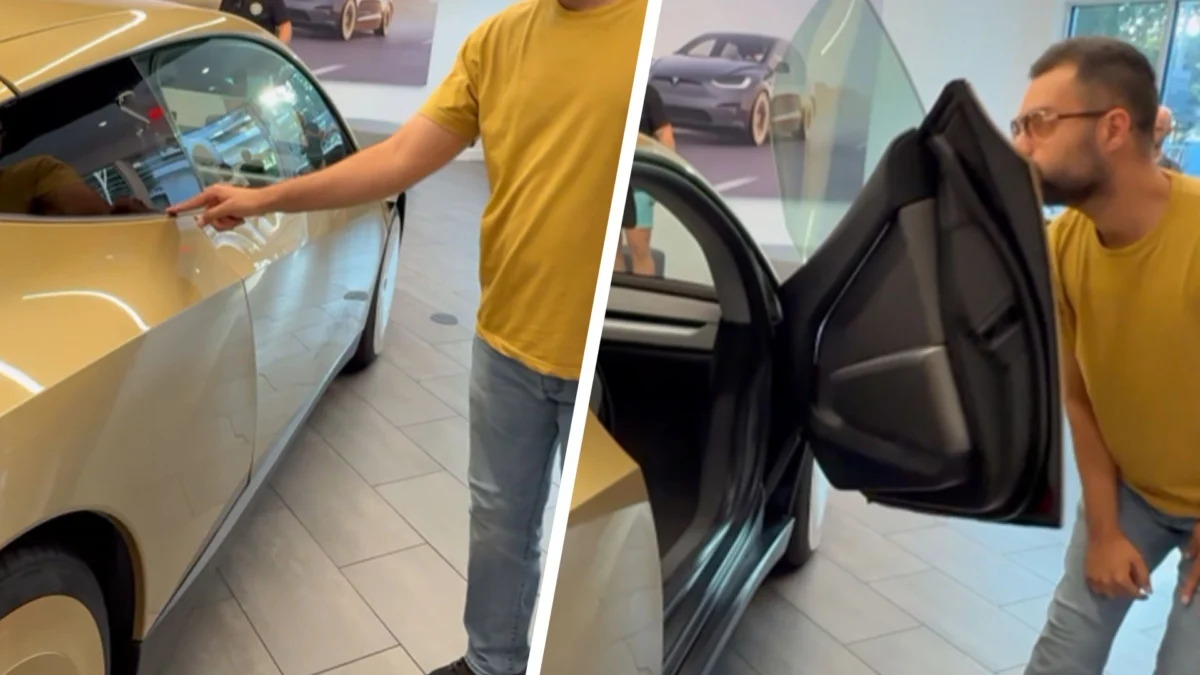
In the wake of the polarizing reception to the Tesla Cybertruck—a vehicle that has become a lightning rod for criticism regarding its utilitarian aesthetics and real-world durability—Elon Musk’s automotive empire is facing fresh scrutiny. This time, the focus has shifted to the "Cybercab," Tesla’s highly anticipated fully autonomous robotaxi. While the company markets the vehicle as the future of urban mobility, recent footage suggests that the Cybercab’s striking, futuristic design may prioritize visual impact over fundamental user safety.
The primary point of contention centers on the vehicle’s dramatic butterfly doors. Designed to evoke the flair of high-end concept supercars, these doors have been captured on video failing to detect and stop for pedestrians standing in their path, resulting in what some have colloquially termed "love taps." While the manufacturer insists these encounters are harmless, the incident has ignited a broader debate about whether Tesla’s design philosophy is drifting too far from the practical realities of everyday public transit.
The Chronology of the Controversy
The discourse surrounding the Cybercab’s door mechanism began in late 2026, when viral footage surfaced on social media platforms. The video captured the automatic doors swinging outward with significant force, making direct contact with a person standing in the vehicle’s "blind spot."
- September 20, 2026: Initial video evidence emerges on X (formerly Twitter), showing the Cybercab door failing to retract or pause when it encounters an obstacle. The user who posted the footage attempted to mitigate the backlash, describing the impact as a "love tap" and asserting that the technology is, in their estimation, safe.
- Late September 2026: Following the viral spread of the video, automotive design forums and tech commentary sites begin to analyze the mechanical failure. The consensus shifts from a minor quirk to a fundamental flaw in the vehicle’s sensor integration.
- October 2026: Public concern escalates as disability advocates and urban planning experts weigh in. The conversation evolves from "is this a bug?" to "is this a dangerous design choice?"
Supporting Data and Technical Realities
To understand why the Cybercab doors are causing such consternation, one must look at the intersection of aesthetic ambition and engineering reality. The butterfly door, while visually captivating, is inherently complex. In a traditional sedan, doors are designed to be manually controlled by the passenger, who inherently acts as the safety sensor. In the Cybercab, which is entirely devoid of manual controls, the burden of safety falls exclusively on the vehicle’s sensor suite and AI-driven logic.
Sensor Blind Spots
The primary engineering challenge lies in the vehicle’s object detection capabilities. If the cameras and ultrasonic sensors embedded in the vehicle’s frame have a blind spot—specifically in the low-profile area where the door arcs outward—the system effectively "sees" an empty sidewalk even when a passenger is present.
Data from similar autonomous test vehicles suggests that for a door to be truly "pedestrian-safe," it must incorporate pressure-sensitive edges or advanced LiDAR proximity detection that can override the motor command instantly upon contact. The current iteration of the Cybercab appears to lack this secondary fail-safe, opting for a pre-programmed movement arc that assumes a clear landing zone.
The Implications for User Safety and Accessibility
The "love tap" defense—the notion that the impact is too light to cause harm—has been met with significant pushback from experts in ergonomics and accessibility.
Vulnerable Populations
Critics argue that while a light tap might be a minor annoyance to an able-bodied adult, the safety implications for other groups are severe.
- The Elderly: Individuals with fragile health or reduced mobility could easily be knocked off balance by an unexpected mechanical strike, leading to falls and potential fractures.
- Children: The height of the door’s arc often aligns with a child’s head or upper body. An unexpected motion at that level is not just a nuisance; it is a potential injury hazard.
- Assistive Devices: For those using canes, walkers, or wheelchairs, the space surrounding the door is a critical "buffer zone." If the car dictates the movement of that space without regard for the user, it effectively renders the vehicle inaccessible to a significant portion of the population.
Beyond physical injury, there is the issue of property damage. As noted by concerned observers, the force of the door could easily knock a smartphone, tablet, or bag from a user’s hand, creating an immediate point of friction between the consumer and the automated service provider.
A Pattern of Design Failures
The Cybercab incident does not exist in a vacuum; it is the latest chapter in a series of design-related controversies for Tesla. The Cybertruck, in particular, has set a precedent for vehicles that prioritize a "Blade Runner" aesthetic over functional reliability.
The Cybertruck Legacy
Tesla’s electric pickup has been plagued by reports of poor performance in extreme weather, with owners documenting the vehicle’s struggle to navigate snow and ice—conditions for which a truck is traditionally purpose-built. Furthermore, there have been high-profile concerns regarding the vehicle’s structural integrity at high speeds and the debunking of CEO Elon Musk’s claim that the truck could function as a "boat" in deep water.
When viewed alongside these issues, the Cybercab’s door problem reinforces a growing narrative: that Tesla may be neglecting the "human-centered design" phase of production. In its rush to deliver disruptive technology, the company is increasingly ignoring the "boring" but vital safety features that have governed the automotive industry for decades.
Official Responses and Corporate Strategy
As of this writing, Tesla has remained largely silent on the specific mechanical updates intended to address the door-closing logic. Historically, the company has favored a "ship first, patch later" approach, using over-the-air (OTA) software updates to rectify issues that would traditionally require a physical recall.
However, the Cybercab presents a unique challenge. Unlike a software glitch that impacts a screen interface or a driving algorithm, the door mechanism is a physical actuator. If the issue lies in the physical sensor placement rather than the software, a simple firmware update may not be enough. If Tesla is forced to retrofit thousands of vehicles with improved sensors or modified hinges, the financial and logistical costs would be immense.
Conclusion: The Cost of Innovation
The controversy over the Cybercab’s doors serves as a litmus test for the future of autonomous transit. We are entering an era where vehicles are no longer passive machines, but active participants in our physical environment. When a car decides where its doors open and when it starts its journey, it assumes a level of responsibility for the safety of the people surrounding it.
If Tesla wishes to succeed in the robotaxi market, it must prove that it values the safety of the pedestrian as much as it values the sleekness of the silhouette. The "love tap" may be a small issue today, but it is symptomatic of a larger design philosophy that needs to be recalibrated. As the industry moves toward a future without human drivers, the margin for error must be zero. Designing for "cool" is easy; designing for the unpredictable, messy, and diverse reality of human movement is the real challenge—one that Tesla has yet to fully master.
 Asep Darmawan
  Neng Nana
  rifanmuazin