
 By Neng Nana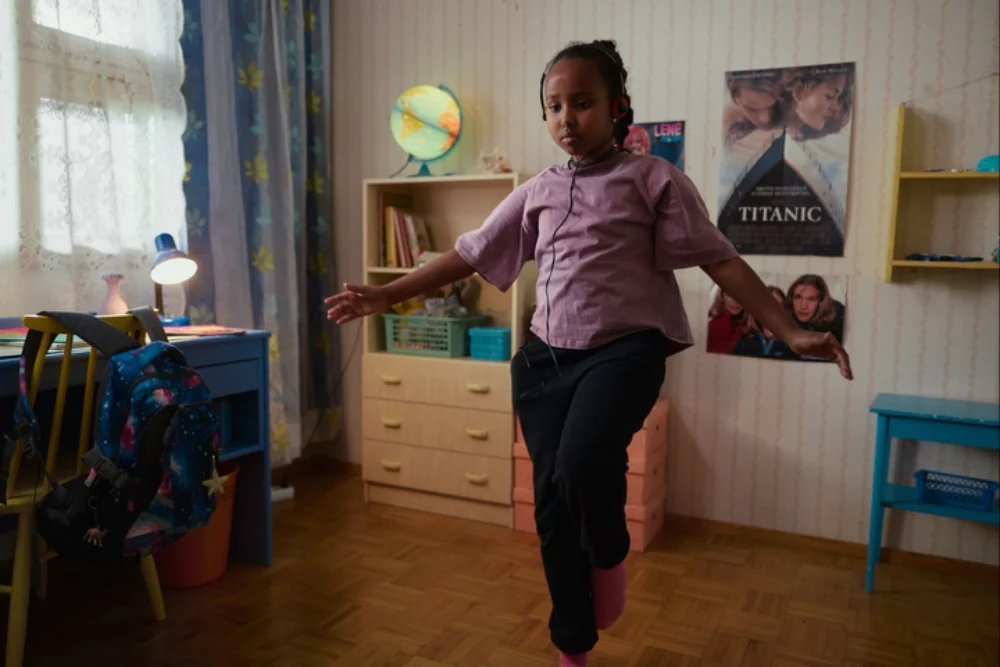
In the landscape of contemporary Finnish cinema, a seismic shift is underway. With the debut feature Halima, director Naima Mohamud has not only captured the attention of critics and festival programmers but has officially secured a milestone in national film history: she is the first Black woman to direct a feature-length fiction film in Finland.
The project recently took home the Best Fiction Project award at the prestigious Finnish Film Affair, an accolade that underscores both the technical prowess of the production and the cultural necessity of the story it tells. Currently in post-production, Halima is poised to bridge a long-standing gap in the Finnish cultural narrative, offering an intimate, vibrant, and deeply human look at the Somali-Finnish experience.
The Core Narrative: A 1998 Odyssey
Set against the backdrop of 1998 Finland, Halima is a coming-of-age story that eschews the typical tropes of trauma-based migrant cinema. The titular character, a 10-year-old girl with an irrepressible imagination, is a devotee of Leonardo DiCaprio and the Eurodance group Aqua. Her singular ambition is to become a pop star, a dream that stands in stark contrast to her reality.
Her family is constantly in flux, moving from one location to another, preventing the formation of stable friendships. Furthermore, the domestic sphere is marked by a pervasive silence; her mother is reticent regarding the absence of her father, and the cultural disconnect between the household and the outside world is a constant, quiet tension.
"To be honest, I really think that a film like Halima was a long time coming," Mohamud told Variety. "We Somalis have been living in Finland for over 35 years, yet most Finns still don’t know anything about us, our culture, or how we interact at home. None of those things. This film might help someone with a Somali neighbor finally get a glimpse. I hope that’s what this film does: opens up Finns to understanding Somalis."
Chronology and Production Context
The journey to this point has been one of persistence and vision. Produced by a consortium of It’s Alive Films, No-Office Films, and Vico Films, the project has navigated the complexities of the Finnish film funding landscape while maintaining its unique identity. While Halima has already generated significant international buzz—most notably recognized during the festival circuit in Haugesund—its win at the Finnish Film Affair marks a transition from a promising concept to a highly anticipated release.
The film’s development began with a desire to capture the specific energy of the late 90s, a decade defined by the rapid expansion of global pop culture and the burgeoning integration of immigrant communities in Northern Europe. By focusing on the perspective of a 10-year-old, Mohamud taps into a universal sense of wonder and confusion, bypassing the didactic nature of social-issue dramas to deliver something far more relatable.

Supporting Data: The Power of Representation
The significance of Naima Mohamud’s debut cannot be overstated in a country where the film industry has been historically homogenous. For decades, the Finnish screen has largely reflected the experiences of the white majority. The entry of Halima signals a diversification of the "Finnish" identity.
Industry analysts point out that film festivals are increasingly prioritizing stories that challenge established national mythologies. The success of Halima at the Finnish Film Affair is not merely a testament to the script’s quality but a reflection of a changing industry that recognizes the commercial and cultural value of underrepresented voices. By producing a film that is fundamentally "joyful," Mohamud is disrupting the expectation that films about immigrant life must center on tragedy, suffering, or victimhood.
The Director’s Perspective: A Child’s-Eye View
Directing a film about a child requires a specific kind of intuition, one that Mohamud claims is still very much a part of her internal landscape. "I’m still a kid!" she laughs, noting that her connection to the protagonist is immediate and visceral.
"I’ve always understood kids, so I had a great time working with them," she explains. "I really enjoy this innocence of childhood. The older you get, the more you overthink. You start doubting yourself too much. Kids don’t have that. Halima thinks she can dance, and in her mind, she’s brilliant. When I decided to become a filmmaker at 14, I also didn’t think it was impossible—or that it would take so many years."
This "childish" outlook—the refusal to accept boundaries—is the engine of the film. Mohamud recalls her own childhood, defined by curiosity and a desire to experiment with the mundane. "I’d wonder: ‘Would my backpack fit in the school mailbox? What would it feel like to jump out of the window in the middle of class and roll around in the snow? Let’s find out!’"
This sense of mischievous, uninhibited wonder is what she aims to translate to the screen. She notes that even in the face of bullying—such as when Halima attempts to emulate her idol, Lene from Aqua, by cutting her own hair—the character’s spirit remains resilient.
The Philosophy of Joyful Cinema
A defining characteristic of Mohamud’s directorial philosophy is her commitment to "joyful films." While she holds a deep appreciation for the somber, poetic, and high-minded dramas that often dominate the European arthouse circuit, she is clear about where her own talents and interests lie.

She cites the example of a short film she wrote titled Camphor, which centers on a reclusive Muslim scholar performing the ritual washing of a stranger’s body. While she recognized the artistic merit and emotional depth of the story, she realized it wasn’t a film she could direct. "That film needed a poetic soul, and that’s not me—at least not as a director," she admits. "I’d probably make the characters tell a few jokes and it would be so inappropriate."
This self-awareness is rare and refreshing. While her classmates at film school were heavily influenced by the French New Wave, Mohamud found herself drawn to the grand, populist, and emotionally resonant style of filmmakers like James Cameron. She isn’t interested in being an auteur of misery; she wants to be an architect of optimism.
"I make films that I hope make you feel good when you leave the cinema," she says. "A tear here or there is great, but at the end, I want people to say: ‘You know what? Life is amazing.’"
Implications: A New Chapter for Finnish Film
The arrival of Halima serves as a catalyst for broader discussions regarding diversity and inclusion in Nordic cinema. It poses a fundamental question: Who has the right to tell stories about "Finnish" life?
By rooting the film in the 1998 experience, Mohamud is effectively rewriting the history of that era to include the Somali diaspora. It invites the audience to see the 90s not just through the lens of the Finnish majority, but through the eyes of a young girl navigating a new country, struggling with identity, and finding solace in the universal language of pop music.
The implications for future filmmakers are significant. Mohamud’s success acts as a beacon for other minority filmmakers in Finland, proving that it is possible to secure funding, win critical acclaim, and tell personal stories without compromising one’s voice or vision. As the film moves toward its eventual release, the industry will be watching closely. If Halima succeeds in the way its early reception suggests it might, it will likely pave the way for a more inclusive, vibrant, and multifaceted era of Finnish storytelling.
For now, Naima Mohamud remains focused on the post-production process, ensuring that the triumph of her protagonist—a triumph she describes as "mischievous"—is captured with the same vibrancy that she brings to her own creative life. She has set a new bar, not just for what a "Finnish film" can look like, but for the kind of emotional impact a filmmaker can aspire to have on their audience. In a world that often demands darkness, Halima is a bold, confident, and necessary step into the light.
 Laily UPN
  Layla Zulfa
  Ali Ikhwan